
Starting writing at what is, quite literally, the crack of dawn this morning, it is apparent that all the forecasts about the local elections in England were broadly accurate.
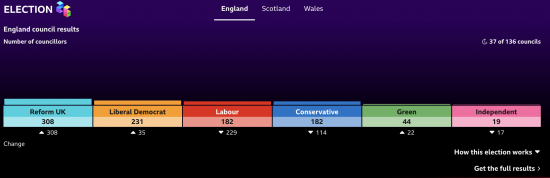
Whichever version of the charts being produced on gains and losses you look at, and there are variations between them depending upon which baseline they use for comparison, Reform is doing very well in the election, both Labour and the Conservatives are doing very badly, the Liberal Democrats are doing better than they might have dared hope, and so far, the Greens are probably underperforming against expectation.
A chart from the BBC puts the gains and losses like this:
The Guardian presents it slightly differently:
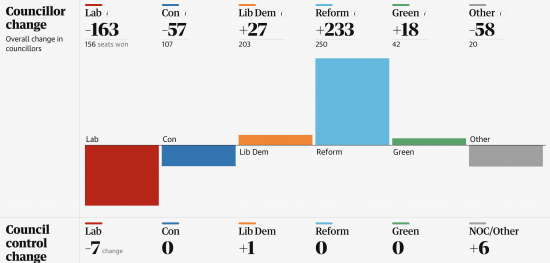
The results will never be the same. The BBC is comparing declared results to the last time seats were contested, whereas The Guardian is comparing to who held seats prior to this election, meaning that by-elections and defections since the last time seats were generally contested are taken into account in their reporting. There will also be timing differences.
This being said, there are obvious trends that are unavoidable.
In northern seats, Reform is doing very well indeed.
In Hartlepool, Reform won 11 seats, with the losses being split between Labour, independents and the Conservatives, with Labour being the biggest loser.
The same trend was seen in Hull, although there the Liberal Democrats also lost to Reform and lost overall control of the council.
This pattern was repeated in North East Lincolnshire, where Reform won 13 seats, but on this occasion the Conservatives were the biggest losers by far.
This was an exception because, generally, the swing was from Labour to Reform, as was also seen in Plymouth and Redditch, although in both cases losses to Reform were right across the board by party. In Plymouth, the Greens also succeeded in taking a seat.
Similar patterns were found in Essex, where Rochford Council saw Reform take all the available seats, with losses being spread amongst all other parties standing, although Labour had nothing to lose there and did not do so as a result. Notably, though, half the gains came from independents and the local residents' association.
In nearby Southend-on-Sea, Reform were once again the winners, with losses being shared amongst Labour, Conservatives, independents and the Lib Dems, but the Greens won two seats.
Moving away from coastal areas, Salford in Manchester saw a massive swing, with Labour losing 13 seats and Reform winning the same number, but the Greens also had gains. They took three seats, with the Conservatives, Liberal Democrats and Your Party losing one apiece.
In contrast, in nearby Stockport, the Liberal Democrats took seats to gain overall control of the council, doing so at the expense of Labour and independents, whilst Reform won just two seats and the Greens one.
One of the biggest swings of the night, however, was seen in the north-west, where in Wigan Labour lost 20 seats, with Reform winning 23; the other losers were independents and Conservatives. This was a pattern also seen in Tameside in Manchester, where Reform made heavy gains at Labour's expense.
As yet, results from London are limited, but notably, in Richmond upon Thames, the quite extraordinary result was that all 54 seats on the council were won by the Liberal Democrats, with the Greens losing the five seats that they had previously held.
This was not the only exceptional result for the Liberal Democrats on the night. In Sutton, in South London, they took 23 seats, with the Conservatives losing 20, independents losing four and Labour losing one, with Reform taking two. They now hold all but four seats on the council.
The Liberal Democrats also gained in Portsmouth, where they now control the council, mainly at Labour's expense. Reform also made small gains there.
Looking at more inland, and maybe larger, locations, the trends are slightly different. Oxford, with half the seats up for election, saw no Reform gains, but the Greens won four seats at the cost of Labour and independents, whilst in Lincoln, which I had expected to be a Reform stronghold, they won just four seats, with the losses being suffered by Labour and the Conservatives, with the Liberal Democrats and the Greens also winning a seat apiece.
The same broad situation was found in Peterborough, where, again, I would have expected wins for Reform, and although they did win four seats, mainly at the cost of independents, the other odd pattern on display there was a swing from Labour to the Conservatives, with Labour losing three seats and the Conservatives gaining the same number.
This pattern of Conservatives gaining at Labour's expense was also seen in Harlow, Essex, where Conservatives won all their gains from Labour.
Reading provided an odd exception for the night. Labour lost three seats, the same number that the Greens gained, whilst the Conservatives won two seats and Reform and independents lost one apiece, the Reform representation on the council being eliminated as a result.
And, as I move towards concluding this early morning review, a flurry of results have come in, mainly from London. These deliver a totally different perspective on the night. The trend is for Reform to take no seats at all. This is, for example, the case in Ealing, Merton, Wadsworth and Hammersmith and Fulham. Across all these bars, the trend is for small patterns to have changed to emerge, with liberal Democrats consolidating where they are already strong, the Greens making small gains, and, in Wandsworth, the Conservatives making a small revival at Labour's expense. The Reform influence is, however, completely absent, suggesting that in the parts of the country where immigration has had its greatest impact, Reform has nothing to say to populations who reject its message of hate. Overall, Labour will take some comfort from these results.
So, what is the trend being seen so far, with a note of caution being added that many results across England have still to be counted, including most of those in London?
The trend is obvious. As expected, Reform has won heavily overall, and most especially in seats in the north, north west and on the coast. In many of these councils, they came from a standing start, as they previously held no seats. Despite this, Reform has not won control of any councils as a consequence, and so far it looks unlikely that they will.
Labour has done little better than disastrously, most especially outside London, having lost many more seats than they won, meaning that they have also lost control of councils as a consequence, although of the 17 council results available at the time of writing, they retain control of eight because not all seats on all councils were up for election.
The night was a little better for the Conservatives, and their rate of loss was not as bad as that suffered by Labour. However, they started from a weaker position. So far, they have kept every council they were defending.
The Liberal Democrats have net overall gains of seats. They have also translated these into real gains, having won two councils, but having lost one. What they have, however, clearly displayed is a resilience in the face of the Reform onslaught which stands them far apart from Labour and the Conservatives. Whilst those two parties look down and out, the Liberal Democrats do not.
For the Greens, so far, the night has been disappointing. They have won seats, but there is no sign of a major breakthrough here, including in the few London areas announced so far, and at this moment, there is no hint of them taking control of a council.
The same is also true for Reform. They might have won heavily, but so far this has not delivered them major influence. That they might have been the beneficiaries of a major protest vote is, then, an unavoidable conclusion at this moment. That their gains are limited also means that they will avoid accountability. That, in a sense, is unfortunate. There is a need for a Reform track record in council office to prove just how bad they are.
But there is one overwhelming conclusion to reach so far on the night. That is, the overall winner here is first-past-the-post, at cost to all of us and the whole idea of democracy. Reform is not nearly as popular as these election results would make them appear, and there are supporters of other political parties in places like Richmond upon Thames and Sutton in South London. The use of an electoral system that produces outcomes unrepresentative of the people's opinions, deliberately chosen by politicians in power, is not an exercise in democracy, and unsurprisingly, turnout reflects this. As is usual in council elections, turnout was generally low, though the trend seems to be a little up from the last time these seats were contested. No one should be surprised at that when the councils being elected cannot, and do not, truly represent local opinion.
The loser last night was, then, democracy, and I expect to see that trend continue in today's English council election results.
As a result, I am looking forward to outcomes in Wales and Scotland, where proportional representation might yield more representative results. If that is possible in both those countries, why it is not in England is something that must now be open to challenge. Amongst the many things in need of urgent reform in England, in particular, is our electoral system. It is well past its use-by date.
Thanks for reading this post.
You can share this post on social media of your choice by clicking these icons:
There are links to this blog's glossary in the above post that explain technical terms used in it. Follow them for more explanations.
You can subscribe to this blog's daily email here.
And if you would like to support this blog you can, here:

 Buy me a coffee!

Yes, Reform, the “I’m not a racist, but…” Party are, as expected, doing well. Unbelievable really, given their total failure and chaos when in power in local government.
Teflon Farage, Mini-Me Trump, with a rap sheet as long as his arm, a step closer to being Prime Minister. Britain closer to midnight than ever before on destroying itself by becoming a nation led by billionaires, MAGA America, grifters, fraudsters, charlatans, chancers, criminals, racists, and climate deniers.
My mother used to say, “you’ve made your bed, now lie in it.” Britain has made its bed, and now has to lie in it and live with the consequences.
In the next three years, Labour have one shot to do the right thing. After that, it’s game over for them.
I don’t agree that Labour have “one shot”. They are shot. I see no point even in them replacing Starmer, who (with the unlamented Macavity) has destroyed the great work of his early- and mid-20th-century forebears.
Just like ukip voters elected Farage to sit in Brussels to destroy the EU, Reform elect Reform to destroy Britain. They believe nothing is worth preserving or conserving. Our politicians are useless at communication. There can be no UK communion or political unity without this changing.
Britain has made its bed, and now has to lie in it and live with the consequences.
Although, given the population numbers, most ‘UK’ votes result in decisions made by voters in England being carried. So it’s really more a case of England making Britain’s bed and everybody being expected to lie in it and live with the consequences!
Plaid Cymru and SNP are now the largest parties in The Senedd and Holyrood (and with Scottish Greens, pro-independence parties form a majority). Also, I believe polling in Ireland shows support on both sides of the border for re-unification. So it doesn’t look as if the other 3 parts of the UK are happy to ‘take it lying down’ (as it were).
Interesting times…
Indeed
It’s like watching a bad dream unfold to be honest. It’s a mixture of real desperation and stupidity all in one, plus a large dose of frankly venal opportunism. People are simply running into the arms of an idea that is unproven and beyond the rhetoric of hate, offers much less.
Sad………………….
Agreed
@Pilgrim Slight Return,
The USA has already been through this two years ago. People who depend on a paycheck, no matter how small or large that paycheck is, are desperate for change as they see their standard of living sliding down the economic latter.
Reform will not be able to deliver what the people want and this mess will start up again in two rears in the next election cycle.
Getting “rid” of immigrants and practicing the politics of hate will not fix the NHS, bring down the cost of energy, add more school places, repair potholes, revitalize High Street (Main Street in the USA) or decrease violent crime. Most importantly, getting “rid” of immigrants and practicing the politics of hate, will not fix BREXIT!
Reforms core base is “Hard Core Haters (hard core MAGAts in the USA) the “swing” voters are just hoping for immediate and substantial change and are at a loss what to do except vote Reform. This is EXACTLY what happened in the USA with swing voters who really are responsible for the 2024 election of Trump. The swing voters found out very early on that Trump only cared about the oligarchs and his family reaping all the financial benefits possible and would do nothing for them as in continuing the Biden era healthcare insurance subsidies and homeowners clean energy subsidies.
Keir Starmer could have made a difference but does not seem to be interested in real change so you are left with a political and governing situation that in two years time will be EXACTLY where the USA is now for the average citizen.
Agreed
Nothing to disagree with Tampa, nothing at all………………………..
With five parties all with support in the 15-30% range the FPTP system makes it a complete lottery. Whether the next government elected is reactionary or progressive will depend on tactical voting. Personally I think Starmer needs to go and be replaced by Burnham with a few big ideas like PR, beefing up IHT to support social care and renationalising the utilities.
Exactly. FPTP works best (for some value of “works” and “best”) if only two parties are real contenders, and most third parties get squeezed out. In that sort of system, you need a party coalition to build around positions that can command a majority (or at least, more votes than anyone else in enough places to form a sizeable block in parliament).
The UK electorate are currently so fragmented that it becomes a lottery. Why vote Conservative (Reform-lite) when you can have real (nationalist, fascist, racist) Reform. Why vote Labour when in many ways it is just another neo-liberal party, a friendly face of centrist One Nation Conservatives painted red, and they are outflanked on many issued by the Greens. The Lib Dems and SNP and Plaid and the Northern Irish parties will do what they do but never form a majority
I’ve long supported electoral reform, but at best there is only three years for the current government to swing behind it and bring it in before the next election. The Lords could delay it, and in reality, it would probably need a general election mandate to force through. Absent that, can the electorate coalesce around one or two leftish or rightish positions? Can Reform get a Commons majority on 25% or 305% support because the rest is split?
One potential outcome is that Conservative support collapses further and they mostly roll over into Reform, just as Labour largely replaced the Liberals a hundred years ago after Asquith and Lloyd-George. If the (increasingly far) right unites, and the left remains divided, Nigel can win big.
“With five parties all with support in the 15-30% range the FPTP system makes it a complete lottery”
This is EXACTLY the same problem as exist with the electoral Primary System in the US in most states (definitely Florida).
30% of the voters are electing the representatives in the Senate and House of Representatives in the USA via the Primary System.
Agreed
Interesting comment from Twitter
https://x.com/JournalistJill/status/2052450164757958840
Saying to husband on way to polling station that I used to LOVE voting. I loved putting my X next to a name, feeling like my voice counted. That I was making some difference. Now I just want to write: ‘You’re all wankers’ over my ballot paper. I didn’t. But I thought about it.
Get rid of FPTP voting and go to Proportional Representation or Rank Choice voting and most of these electoral problems will disappear almost immediately.
[…] being said, and having already noted the trends developing as the English council election results are announced, let me try to stand […]
“Have not wok any councils as a consequence”.
I think actually a big reason they haven’t won control of councils is not because Reform came from a standing start, but because only a proportion of the seats were being contested.
In Halton for example, Reform won’t almost all the seats they contested in historically very strong Labour areas, but Labour still have overall control because not all seats were being contested.
Which is a long term benefit to labour as when reform “F*#ks-up” voters will be saying “Thank Joseph, Mary & Oprah” that we still have Labour in control”.
This has and is happening in the USA and the Federal, State and Local levels of governance with respect to Democrats.
Thank you for a very useful summary of the situation so far. I imagine the Greens will do better in national elections – curiously, they’ve never had much of a presence here in North Norfolk – and I’ll be happy if Zack Polanski continues to set his more forceful and thoughtful trend. Reform clearly benefits from the “anything but the current lot” attitude, but you’d have thought by now voters would have noticed their utter lack of capable and trustworthy politicians, even more so than recent Labour and Conservative parties.
I’m going to avoid the news and the media for a while. I can’t stand the thought of seeing Farage’s smug face talking about how the people have spoken, or some other suitably insane and meaningless platitudes. All that has been delivered today is more chaos and uncertainty. I wonder though, does this really reflect what will happen in 2023, with such a low turnout and very few younger people voting in local elections? Plus we have a few more years of the Orange One showing the world what could happen if you vote for Reform.
If only you had a preferential voting system. Alas, from across the pond (Australia).
Agreed
I am sorry to say that I no longer believe in democracy as it too often becomes a system where people are counted rather than weighed. In my view, this is what led to the Brexit disaster and now to the growing support for the very man and party that helped create it. Unfortunately, many Reform supporters do not understand the games and manipulations of politics, but instead follow politics with a cult-like mentality, and that is one of the greatest dangers facing our country.
If you do not believe in democracy why are you here?
I was expecting you to ask, “Why do I not believe in democracy?” rather than, “Why am I on your blog?” These are simply my views, because I increasingly see democracy as an imperfect, man-made ideology that is failing us, just as Marxism and other ideologies ultimately failed.
Let’s put it this way: should we blame democracy itself, or misinformed electorates when they become the majority? Did Trump not come to power through democracy? And what have been the consequences of that democratic choice? In my view, an utter disaster. Farage could also come to power through democracy, and we all know what the consequences might be and how much we could suffer from them.
These are simply my opinions, and I could, of course, be wrong.
You are
Try respect
It’s its absence that feeds Reform
That there is a crisis in democracy is a point worth noting – whether due to money from America or electoral system we have.
A study by Cambridge University’s Centre for the Future of Democracy published in 2020 found that some 58 per cent of people were unhappy with democracy
https://www.bbc.co.uk/news/education-51281722
I’m still a believer, but democracy needs to be argued for.
I do that
I know, of course!. Thank you!
this may be of interest on autocracy –
https://99-percent.org/defending-uk-democracy/
Thank you
@Derek, perhaps it’s not democracy that is making you despondent, but the fact that we don’t have enough democracy?
I don’t think the loser is democracy in this instance. It did demonstrate how First Past The Post delivers results that may silence non-trivial vote shares. However, it’s also a huge kick to Labour to consider ending First Past The Post, because it demonstrates the risk they have of gifting Reform the majority in the next General Election, and not only that, but that Labour may have less seats than its remaining vote share would suggest.
Like it or not, it was always likely the current government in charge would need that kind of evidence to seriously consider ending FPTP, so we can at least hope this is the kick needed to get that change on the agenda before the next General Election. If so, then democracy would be the winner rather than the loser.
I’m afraid that Labour in its current form has shown no signs of respecting democracy or indicating it would act to protect us from Reform and its brand of “I can’t believe its not fascism.” Suppression of protests due to outside influence, cosying up to the increasingly problematic American tech industry, neoliberal doctrine in the face of overwhelming resistance from the people, they do not work for us. If FPTP gives them a slim chance of remaining in power and keeping the donations coming in, they will keep it. Expect them to continue to fight amongst themselves, double down on attacking the Greens, and try not to be outflanked on the Right, all the way to their inevitable defeat at the next general election. That is politics now. That we know better than them is why we aren’t in politics. We wouldn’t be allowed.
I lived in Reading for many years and was active in Green politics and have friends who were re elected as councillors. I don’t believe Reading is an anomaly. Although there is poverty and deprivation in Reading it is generally a good place to live with good employment opportunities with a large university and young graduate population. It is a very well educated and relatively young town so not fertile ground for the lies of Reform. The long term Labour council is toxic and has lost touch with the local issues, but many remain loyal with genuine Conservative and LD voters in the more affluent fringes. The cost of living is an issue with regard to housing, but less so than London.
I poll clerked in Exeter yesterday and the Greens did well, and Labour lost overall control, but I was heartened to see Reform not gain as many seats as they had last year, so they won’t have much influence. We will have to see the London results to get a clearer picture of how the Greens do in urban areas. The awful treatment of Zack in the last 2 weeks may have affected the vote, we shall see.
Voters need to look at US and then draw parallels to what could happen here. Are so many unaware of what is happening elsewhere in the world?
So, for me, these results are depressing.
One spot of good news: out of the seats declared so far (as of 1pm Friday), Reform have only won about a third. This is down from the 41% won in the 2025 local elections. Further evidence that Reform’s support has slipped.
So far I have not been able to find the raw total of votes cast for each party. Just the number of seats won. I imagine it will show Greens have done better than the number of seats won.
I also wonder what will stop Reform. Could it be their identification with the MAGA movement across the Atlantic? If that fails spectacularly, could it knock Reform off their perch?
Ian,
Maybe a few more Reform councils will show the voters what they are really like, and be their downfall at the 2029 GE.
Inept grifters, in general.
We can hope so
It is likely , Darren
Hope you are right
As Churchill famously said “Democracy is the worst possible form of government. Except for all the others”. As I have un-famously said “Democracy is the process of voting for the least-worst candidate on the ballot paper.” This is especially true of the First Past The Post system.
Some sort of proportional representation is likely better than FPTP which could easily elect a broadly unpopular, minority fascist government in a country where the moderate and socialist side of politics is divided and dysfunctional.
Here in Tasmania we have the Hare-Clark electoral system which involves listing your 7 preferred candidates in order and then goes through a convoluted process of sharing votes out to make sure the least popular candidates are not elected. Does it give us a perfect government? No, of course not, but it may do a better job of reflecting the non-extremist desires of the silent majority.
https://www.tec.tas.gov.au/info/Publications/HareClark.html
Thanks