
The Guardian posted this comment yesterday:
Wealthy UK nationals fleeing war in the Gulf are seeking sanctuary in countries such as Ireland and France to avoid hefty tax bills back home.
In the face of possible demands from HM Revenue and Customs, high-net-worth individuals who had been living in the United Arab Emirates and neighbouring countries are hoping to wait out the missile and drone attacks elsewhere rather than return to the UK.
It appears that the conflict in the Middle East has created a new form of refugee: those who are fleeing a tax liability.
Neoliberal depravity is something with which I have become familiar over too many years. Despite that, it can still plumb new depths, and this is one of them.
This comment provided illumination on the conundrum in which these "poor" people find themselves:
With only about three weeks remaining in the current financial year, many overseas residents have already “spent” their allocation of days in Britain without incurring tax liabilities. Some are seeking guidance from HMRC on whether they would be granted 60 extra days under an “exceptional circumstances” provision.
Nimesh Shah, the chief executive of advisory firm Blick Rothenberg, said: “I've had a disproportionate number of calls from people wanting to leave the UAE in recent weeks.
“I've told them not to rely on any exceptional circumstances provisions from HMRC. I can't imagine HMRC are very sympathetic here.”
"Oh, dear", I thought when reading that, followed by "What a shame" and "My heart goes out to them."
Why do I have no sympathy? That's because in 2005 I co-authored, along with John Christensen, what became the foundational text of the tax justice movement, which set the direction of travel for International tax reform for the last 20 years:
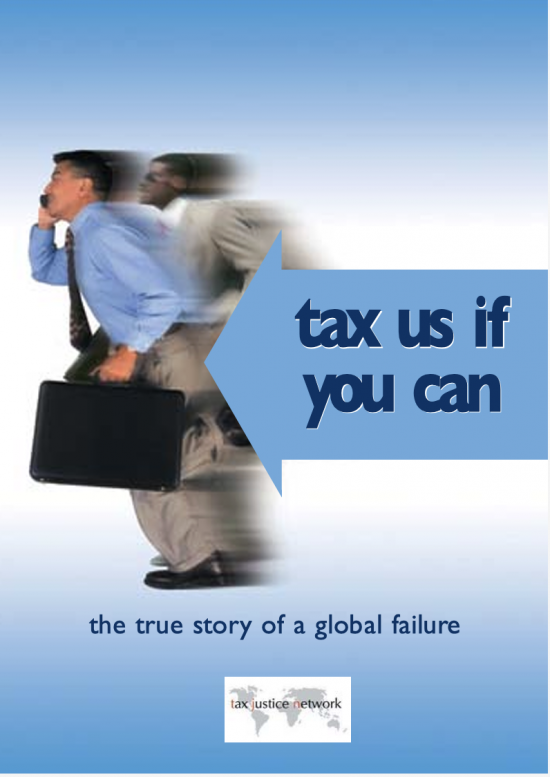
In that publication, we made this proposal:
Citizenship and personal taxation
High earners who travel frequently with their jobs can easily avoid paying tax. This is often possible because, in most countries, someone who is neither a citizen nor a long-term resident is typically only charged tax on that part of their income which is earned there, which means that income received elsewhere in the world will not be taxed unless it is sent to that country.
Any move towards a global framework for tax cooperation should involve the extension of the principle of automatic information exchange to corporate bodies and trusts as well as to individuals, since a lot of tax planning involves trusts and corporations. This opens up the opportunity for such people to divert large parts of their income to tax havens where it is held untaxed.
There are several problems with this:
- It means that the world's wealthiest people, including rock stars, set a poor example by appearing to spend much of their time endorsing the process of tax avoidance.
- It means that the people most able to pay tax in the world often pay little or no tax.
- It establishes a wholly parasitical industry of lawyers, accountants and bankers who service the desires of these people, who act as economic free-riders.
- It undermines the ability of any country to charge progressive rates of income tax because the wealthy threaten to leave.
This situation, which was unacceptable `in the days when travel was difficult and the number of truly mobile people in the world amounted to a few thousand, has deteriorated to the point of being a global crisis. Travel has become easier. Capital movements are virtually unrestricted. Access to offshore financial services has been extended to a far wider range of wealthy individuals.The sums of money lost to governments, particularly those of developing countries, are too large to be ignored.
There is an answer, and it is provided by the US. This is that every country should require its citizens to pay taxes on their world-wide incomes whether they are resident in the country of which they are a citizen, or not.
I admit that I would not write the proposal in quite this way now because so much has changed in the meantime, and we do now have automatic information exchange from tax havens, in no small part due to the campaigns that John and I pioneered. I would, however, stand by that last highlighted section. My point is that:
- If you want the protection of the UK state by holding its passport, you must have an absolute legal obligation to pay the taxes it requests.
- This charge should not create a duplicate payment: credit should always be given for taxes already paid in another country.
- For purely administrative reasons, I would not seek to impose this arrangement on anyone earning less than £100,000 a year.
- For those earning above that, the requirement that they declare their taxes in the UK, even if they claim to have never stepped in this country during a year, should be a necessary legal obligation. It is the price of citizenship. Much of the appeal of tax havens would disappear if we had such an arrangement in place. Indeed, many of those so-called professional people working in these places would find themselves paying tax in the UK as a result.
Those now fleeing to Ireland and France would have done so in vain if this proposal had been adopted by a wise government, but we have not had one of those during the intervening 20 years.
I have a simple name for this idea. It is a passport tax. It is time we had one.
Thanks for reading this post.
You can share this post on social media of your choice by clicking these icons:
There are links to this blog's glossary in the above post that explain technical terms used in it. Follow them for more explanations.
You can subscribe to this blog's daily email here.
And if you would like to support this blog you can, here:

 Buy me a coffee!

Excellent Idea
May I add another
Going back to the 60’s and 70’s when tax rates were much higher ‘regulated’ professionals such as accountants, lawyers and banks didnt as far as I am aware peddle tax avoidance schemes and it was left to outsiders to do so.
Surely it cannot be beyond the wit of a Government that claims to govern to make a heavy hint to The Law Society, Bar Council, ACAA, banks etc that either their members stop getting involved in tax avoidance OR they will be stopped whether they like it or not and that might mean taking powers away from the professional bodies and restrictions on banks which might not be pretty
It makes perfect sense to me.
If you want order and control that brings a safe haven – well, that’s not bad deal is it?
Agreed.
Oddly, my offspring and I were having this discussion recently. Our thinking aligned with this post to a very great degree.
My daughter is harder of heart than I and went further. She suggested that if they wanted to be removed from any of these countries using their UK Passports they should have to pay for the extraction. They may be UK citizens, but they’re not UK taxpayers, so shouldn’t be moved “at the taxpayers expense”. Since they’re earning enough to avoid paying tax, they should be able to afford it.
British citizens living overseas can vote in UK parliamentary elections so on the basis of “no taxation without representation” shouldn’t we also have “no representation without taxation”?
From an MMT perspective, though, is there any purpose in taxing people living overseas? There is equity – why shouldn’t they pay tax? But won’t any inflationary aspect of their spending be in their country of residence not the UK?
From an MMT perspective the key purpose of tax is to manage demand within the domestic economy and help shape the distribution of income. In that sense you are right: someone living permanently overseas and spending their income abroad is not adding to inflationary pressure in the UK economy.
However, tax systems also reflect legal residence, citizenship and equity considerations, not just macroeconomic management. Many countries tax citizens abroad partly to maintain fairness between residents and non-residents, and partly because those citizens may still benefit from UK institutions, infrastructure, or protections.
The UK has generally chosen to tax primarily on residence rather than citizenship, which is why most British citizens living overseas are not liable for UK income tax unless they have UK-sourced income.
So the main issue here is fairness and legal structure rather than macroeconomic necessity.
From Holyrood magazine a little while ago.
“Scotland’s second biggest land owner, a Danish man called Anders Holch Povlsen, pays no tax on his estate to the UK Exchequer. Given that there is no land tax in Britain, unlike most of Europe, this is not at all unusual.
The strange part is that Danish local authorities do have the power to tax land owned by Danish citizens – and not just in Denmark, but anywhere. This means that Povlsen, along with a few other Danes with land in Scotland, doesn’t pay the UK Government, Scottish Government or local authorities a penny on his land – while making a fairly substantial contribution to Danish public finances.”
It can happen…
Thank you for pointing that out. Scots are angry about this foreigner Polveson and others of his ilk. Our Andy Wightman is our land warrior ..he goes after the foreigners and hidden organisations who use Scotland’s land as an investment portfolio with no care for the land or its people. He has a blog worth reading and up till now has used his own money to access info on these groups…who they are and what they own. They do everything to make it difficult and expensive for Andy. He now is supported by donations. A bonny fechter. Read his blog if you care about Scotland’s land.
I agree “the price of citizenship” is an excellent description. I am sure that HMRC will not be sympathic to the plight of these people, and nor am I. Most probably they received an education in this country, medical care and much more, and probably for any children too – I am unsympathic. Equally I am unsympathic to the tax avoiders who seem to believe that is is the duty of the UK government, in times of difficulty, to get them out of the country in which they decided to live in order to avoid tax – although some have rented private jets, others have complained about lack of assistance. These people, holding a UK passport, appear to include not just those with high wealth, or those with high income, but also a number of ‘influencers’, mainly young people using social media platforms to promote products or lifestyle – would they be unable to report resulting income, or are they unwilling to do so?
Much to agree with
I understand where you are coming from in terms of the £100,000 limit. However, I would suggest that it would need to be any earnings as many would avoid it by having their housing allowance, local allowance, etc., made high and declare a salary less than £100,000.
Fundamentally, I agree with the principle, irrespective of whether they are in a tax-free or taxed regime and irrespective of the number of days they are, or are not, in the UK, they should be taxed based on having a UK passport. Whether this is aligned to the UK tax bands or local tax plus UK tax to take them to the same level of UK tax or, as per the US system, a base rate of tax irrespective of where they are, how much local tax they pay, how many days they are out of the country, etc. I believe it was 15% for all US citizens irrespective of where they were based overseas…this may have changed since I was last involved in this.
Uk tax rules would apply on benefits in kind. They would be taxable.
The bull would be uk tax less tax already paid, keep it simpler.
If taxation is used to control inflation and the money paid to the state as direct taxation, simply disappears, why does it matter where people pay their tax? I would have thought the important issue is that they do pay tax, not where they pay it.
I guess the real problem is that some administrations take less in tax and so contribute less to the control of inflation or to any redistribution to reduce inequality.
But maybe I should read a good book on taxation.