
The World Inequality Report 2026 opens with a sentence that should trouble anyone who cares about democracy or economic justice:
Inequality is a political choice. It is the result of our policies, institutions, and governance structures.
That is not an ideological claim. It is the conclusion of more than 200 researchers working with “the largest database on the historical evolution of global inequality”. And it demands that we ask a straightforward question: if inequality is a political choice, why does the UK keep making that choice?
Now I am recovering from my cold or 'flu, let me unpack what the report says, and then consider what it means.
Inequality is extreme
First, inequality is now extreme by any measure. The report says this plainly, with the following being representative of the data included within it:
-
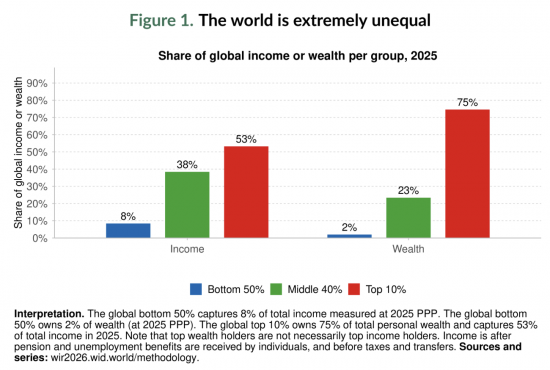
“The top 10% of the global population's income-earners earn more than the remaining 90%.”
-
“The wealthiest 0.001%… control today three times more wealth than half of humanity combined.”
-
Wealth concentration is so great that the bottom half of the world “holds only 2% of global wealth”.
Those numbers are not abstract. They describe a world in which economic power is held by a group so small that they could fit into a football stadium, while billions share what amounts to nothing.
The UK is not exempt. In fact, it has always been one of the global pioneers of the policy framework that has produced this outcome.
Inequality is not an accident
Second, inequality is systemic and not accidental. The authors are clear about this: they say that these outcomes “are not inevitable. They are the outcome of political and institutional choices”.
That matters, because for forty years successive UK governments have pretended otherwise. We have been told that globalisation, technology, the markets or “natural incentives” explain inequality. But the evidence says something very different.
It was choices that created this:
-
Choices to privatise public assets, shrinking public wealth.
-
Choices to deregulate finance, empowering financial extraction.
-
Choices to design tax systems that favour income from wealth over income from work.
-
Choices to suppress wages while treating rent-seeking as productivity.
The inequality we live with is, quite literally, the political economy our politicians chose to build.
Inequality undermines everything
Third, inequality now undermines everything else, including climate action. One line in the summary is especially significant in this regard:
The top 10% account for 77% of emissions associated with private capital ownership.
Add this:
The wealthiest 1% alone account for 41%.
And then note this:
The poorest half of the global population accounts for only 3%.
If you want a single illustration of why our climate policy fails, here it is. We load costs onto households with no power to change structural emissions, while refusing to confront those who generate most of the carbon and own most of the capital.
This is not a climate problem. It is a power problem. And refusing to face that guarantees policy failure.
The same is true of gender equality issues, where the report notes:
Gender inequality also looks starkly different if we take into account invisible, unpaid labor, which is disproportionately undertaken by women.
When unpaid domestic and care labor is included, the gap widens sharply. On average, women earn only 32% of what men earn per working hour, accounting for both paid and unpaid activities; compared to 61% when not accounting for unpaid domestic labor.
These findings reveal not only persistent discrimination but also deep inefficiencies in how societies value and allocate labor.
The conclusion that inequality is structural and deliberate is unavoidable, most especially as the report notes:
Wealthy economies continue to benefit from an “exorbitant privilege”: each year, around 1% of global GDP (approximately three times as much as development aid) flows from poorer to richer nations through net foreign income transfers associated with persistent excess yields and lower interest payments on rich-country liabilities. Reversing this dynamic is central to any credible strategy for global equity.
That could be done, but it is not happening.
One chart summarises the consequences of all these impacts:
The threat to democracy
Fourth, inequality is now dismantling democracy. The Executive Summary warns that inequality “reshapes democracies, fragmenting coalitions and eroding political consensus”.
This is very obvious in the UK:
-
Inequality is dividing the country geographically.
-
Educational divides too often determine voting patterns.
-
Wealth determines political access.
-
Austerity is fracturing societal solidarity.
-
Mistrust is corroding institutions.
When wealth is this concentrated, political capture is not an accident. It is a foregone conclusion.
Other options are available
Perhaps the most critical point within the report is that none of this is necessary. As the report notes:
Progressive taxation and redistributive transfers have significantly reduced inequality in every region, particularly when systems are well designed and consistently applied.
In other words, the tools exist, although the report's reliance on a wealth tax and the idea that tax funds public spending is predictable, but also disappointing. That said, the economics is not the problem. The political will is.
What should the UK conclude?
Three things seem obvious.
Firstly, inequality is the result of deliberate choices and can be undone by deliberate decisions. If inequality is a political construction, reversing it requires political reconstruction. That means:
-
A tax system that treats wealth as taxable.
-
A state that invests, not a state that apologises.
-
Fiscal rules that build public wealth instead of enforcing manufactured scarcity.
Secondly, climate policy must confront inequality or fail. You cannot decarbonise an economy in which those who emit the most also hold the most political influence, financial leverage, and legal protections.
A climate transition that protects wealth will never be a just transition.
Thirdly, democracy cannot survive if economic power remains this concentrated. A society in which fewer than 60,000 people own more than half of humanity can only be governed in one of two ways:
- by deep democracy, which redistributes power, or
- by hardening authoritarianism, which protects it.
The UK appears dangerously close to choosing the second path, dressed up as fiscal discipline.
More broadly
The report's final message is blunt:
The costs of escalating inequality are clear… But the possibilities of reform are equally clear.
The question is therefore not technical. It is political. We can:
-
Tax wealth, and the income and gains derived from it, both progressively and seriously.
-
Restore public ownership where markets have failed.
-
Rebuild public capital so society has a foundation on which private prosperity can actually stand.
-
Demand transparency from corporations, financial institutions and asset owners.
-
Fund public services at the level required to sustain a functioning society.
-
And treat inequality itself as the macroeconomic constraint that it plainly is.
But we will do none of these things until we abandon the comforting myth that inequality is an act of nature. It is not. It is the result of choices. If we want a fairer, greener and more democratic country, then we must choose differently. And that, above all, is what the World Inequality Report 2026 demands that we recognise.
Comments
When commenting, please take note of this blog's comment policy, which is available here. Contravening this policy will result in comments being deleted before or after initial publication at the editor's sole discretion and without explanation being required or offered.
Thanks for reading this post.
You can share this post on social media of your choice by clicking these icons:
There are links to this blog's glossary in the above post that explain technical terms used in it. Follow them for more explanations.
You can subscribe to this blog's daily email here.
And if you would like to support this blog you can, here:

 Buy me a coffee!

Having read this, I thought to myself ‘I wonder if this is mentioned on the BBC website’. So, I had a look and on the front page it says ‘UK economy unexpectedly shrunk’. The amount it shrunk? Sod all Says it all really.
No mention of this report on the front page of the news section either.
Craig
Feeling better by any chance?
Great post and all too true – and turbo charged by social media.
Wealth is a false god. We have been really led astray.
Better, yes.
Over it? Not yet.
What is the response of the political establishment to these irrefutable facts?
It’s fairly easy to convince people on the omnibus about this, although they don’t feel there is much THEY can do about it. Up to now, voting hasn’t made any difference. (STP!)
So, back to the political establishment…
Do THEY see it as a problem?
Do they claim to be unable to fix it?
Do they deny the facts?
Do they claim to be doing anything about?
Or do they hope to remain on the gravy train in their first class seats?
That’s what interests me.
Noted
It was just February last year that we saw Rishi Sunak’s tax return showing he paid just 22.8% tax on £2.2million of income. Unearned income is so very clearly widely undertaxed compared to hard work!
(https://taxjustice.uk/blog/rishi-sunak-pays-22-8-tax-on-2-2-million-in-earnings/)
A similar amount this tax year as PAYE would be at 47%.
I take issue with the Report’s use of the word ‘earn’, in “The top 10% of the global population’s income-earners earn more than the remaining 90%.” It’s not earned. It might be fairer to say it’s stolen. “The top 10% of the global population’s income-thieves steal more than the remaining 90% earn.”
That figure 1 is disappointingly misleading. I pondered what a better representation would be. Make the x axis ‘% of population’, so the blue box covers the first half, etc. Make the y axis ‘average earnings’. On any sensible scale, the blue box would be a thin horizontal line, and the red box would tower over the green. That’s the reality! Add a gold box for the top 1% and the inequality would be even more stark.
As some of you may have noticed I have a bit of an interest in ships, in particular their engines
What gets me is looking at the details of the superyachts
Now if I look at Wikipedia most are in the 8000hp and upwards range to move at best half a dozen or so people
I was allowed a go on the controls of the 1955 Manxman, it had the largest passenger certificate ever issued for a UK flag ship something like 2500 people and was powered by 2×4250 hp steam turbines
Its bizarre
The Dockers yacht (Sir Bernard and Lady not Liverpool) – who were not short of a bob or two, built in 1938 was only 210 feet long
https://en.wikipedia.org/wiki/MY_Shemara
Yet now they are 400 feet and upwards
I despair!
And rightly so
The key is communicating this to the wider population, over the heads of our ‘democratically elected’ representatives who are not addressing the issue of inequality. I recall that London only got a sewage system after the stink of the Thames, acting as a vast open sewer, reached Parliament and was so bad, MP’s couldn’t sit in the House of Commons. Only then did MP’s act. There’s a moral to that tale methinks.