
I have, during the life of this blog, used a program called StatCounter to monitor the number of people reading posts and to provide analytical data on where they come from, how long they stay here, how many posts they read, and so on.
This data is collected via a cookie, covered by our cookie policy, to which you will have been asked to consent on the first occasion you come here and occasionally thereafter.
StatCounter has recently changed how it provides information and has begun splitting data between visitors identified as human and those that might be bots.
I always presumed that we had some bot traffic. It would have been unrealistic to think otherwise, but it now appears that around 2 million of our views each year are, in fact, not human-generated.
What, however, surprised me most about this discovery is the source of this bot traffic. The top five geographic locations from which bot traffic on this blog emanates in the last month were:
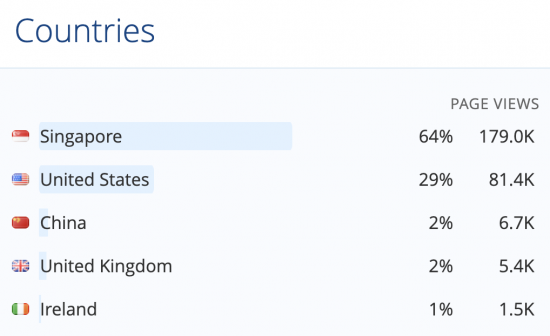
This I find weird. Why is Singapore sending so much bot traffic? And why, come to that, the USA? Is this just where the servers are located, or is there something more sinister behind this data? Suggestions are welcome.
Thanks for reading this post.
You can share this post on social media of your choice by clicking these icons:
There are links to this blog's glossary in the above post that explain technical terms used in it. Follow them for more explanations.
You can subscribe to this blog's daily email here.
And if you would like to support this blog you can, here:

 Buy me a coffee!

Maybe it is VPN (for AI?)
I honestly think part of your bot visitors are actually AI searches when someone talks about MMT and prompt a search for more info.
Ofc maybe I am wrong.
Interesting idea
Singapore is a major global VPN exit hub and a lot of bots emanate from Asia. It is plausible the bots are all over Asia and routing through Singapore (which has better internet than most of its neighbours).
Google has massive data centres in Singapore, so most likely any search for MMT or related matters made from anywhere in South East Asia (or maybe even wider) will be routed through this server.
I also moved from Singapore to Scotland last year, but I don’t think I’ve had that much effect 🙂
I don’t know why this is but I find that information about location is, more often than not, wildly inaccurate. I am often placed hundreds of miles from where I actually am. So I would take the information from StatCounter with a pinch of salt until I could verify its accuracy.
If true, the error would not concentrate the source in a single very small state, but it does.
I often feel like that. Must be an age thing.
I would say VPN use. How does it track reads from a feed aggregator? I use Feedly and rarely visit the site.
Just a few thoughts:
1 Do those using bots use some form of VPN for any reason?
2 Are there countries which “take a dim view” of bots? Could this be a surrogate for China?
3 I asked ChatGPT (too long to copy all of it); so the end conclusion
Singapore shows up in bot traffic reports mainly because it is:
A major global hosting hub
A regional internet gateway
A high-quality, low-friction environment for automation
AI search response to ‘bot traffic from Singapore’…
A widespread surge in bot traffic, particularly from Singapore and China, has impacted many websites since late 2025, often inflating metrics by 30-60%. Identified as likely AI scraping or “ghost spam,” this traffic frequently bypassed standard filters, appearing as high direct traffic with near-zero engagement. Solutions include enhancing Cloudflare rules, filtering GA4 by geography, and excluding compromised IPs.
Key Characteristics of Singapore Bot Traffic:
Timing: Started in mid-September 2025 and ongoing.
Metrics: Near 100% bounce rate, session duration near zero, and high traffic volume.
Behavior: Often “ghost traffic” (hits GA4 ID directly) rather than visiting the actual website.
Origin: Often routed through major data center hubs like Singapore.
How to Identify and Address:
Check Logs: Compare Google Analytics 4 against Cloudflare or hosting server logs to distinguish real hits from “ghost” traffic.
Filter Analytics: In GA4, create filters to exclude traffic originating from suspect city/country combinations.
Use Cloudflare: Block or challenge IP ranges identified in server logs using Cloudflare’s WAF.
Bot Management: Activate advanced bot management to identify and block automated crawlers.
Aah Singapore! Happy memories.
This is definitely irrelevant, but the founder and CEO of Phorm Inc https://en.wikipedia.org/wiki/Phorm (UK arm renamed PhluidMedia Inc) namely one Kent Ertugrul https://en.wikipedia.org/wiki/Kent_Ertugrul lived in Singapore for a time about a decade ago before Phorm went down the toilet with $284m of investor money and sev million in loans. A former non exec director was Norman Lamont (a man with interesting Iranian connections btw) https://www.ispreview.co.uk/news/EkklEukklAQnqAnjDw.html
Somewhere I have a Str**tv**w picture of Ertugrul’s front gate.
It was from a Singapore IP address that our small team of campaigners were all sent several personally crafted and targeted phishing emails containing keylogging spyware, disguised as MSWord documents, some purportedly about Phorm. (we weren’t fooled -I kept mine as souvenirs, the police weren’t interested).
This “entrepreneur” was still in the “startup” business when I last checked up on him, the last two schemes I followed were personally crafted fragrances, and fine dining in the sky (suspended from a crane).
I personally wouldn’t buy anything with that man’s name anywhere near it.
Even the most tightly governed countries can hide some very interesting and “creative” people doing some very antisocial strange things.
Very slightly off topic, Richard, but Cory Doctorow writes well Pluralistic: No one wants to read your AI slop (02 Mar 2026) – Pluralistic: Daily links from Cory Doctorow
Correct
All you may have done is offer real leadership to address our problems and real leadership does often cause trouble I’m afraid because it threatens those who are used to having their own way.
BTW – leadership in the form of new ideas, challenging that which has plainly not worked and providing a new, alternative vision(s). The sort of stuff good MBAs talk about.
From what I’ve seen, you’ve never been a ‘I want to be prime minister’ type. But I would still call what you do a form of leadership.
Thanks
PM? No thank you…