
New opinion poll data published by The Independent newspaper late last week is interesting:
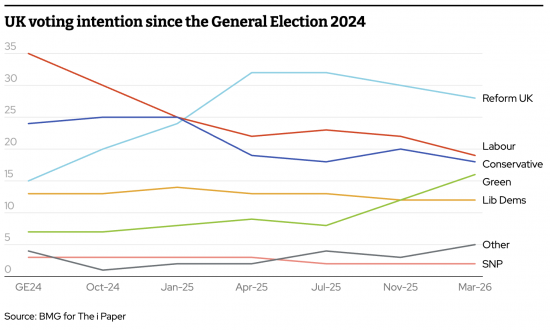
However, it is looked at, there is only good news in this poll for one party.
The Greens can be delighted with their performance over the last year.
Labour and the Conservatives are in terminal decline. This was the lowest poll rating for Labour that this survey has ever found in its history.
The LibDems are no longer picking up the protest vote.
Reform is, very obviously, past its peak, although it still enjoys worryingly large support.
The poll did not pick up the nuance of what is happening in Scotland and Wales, where pro-independence parties are comfortably in the lead.
I spend a lot of time worrying about the rise of the far right, but this poll shows three things.
Firstly, the far right might have a core level of support in the UK, but it can be contained.
Secondly, the belief that I have had for some time that the single transferable party system of power in the UK is broken is justified. Neoliberal parties now have no answers to the problems that the UK faces, and the people of the country have realised that.
Thirdly, with opinion in this widely dispersed, arguments against proportional representation now make no sense at all and are antidemocratic.
Thanks for reading this post.
You can share this post on social media of your choice by clicking these icons:
There are links to this blog's glossary in the above post that explain technical terms used in it. Follow them for more explanations.
You can subscribe to this blog's daily email here.
And if you would like to support this blog you can, here:

 Buy me a coffee!

It would be nice if the penny was beginning to drop for sure.
It may be just that they dont get reported but the Lib Dems seem to have taken a vow of silence
I was reminded the other day just how shallow the Lib Dems actually are when one of their councillors where I work insisted that future social housing development in the city had to sell some units on new schemes to the private market in order to part fund future development. There was no concept of that we are not set up sell, that we do not have the skills nor the staff. And that trying to sell private houses in affordable schemes has all sorts of problems (we tend to build in low value areas but the cost to build is the same as in high value areas; the government believes in mixed tenure – I can tell you now that ‘the market’ that values the homes does not. We would have to sell at a loss I think).
The Lib-Dems………..once Neo-liberals, always Neo-liberal. I mean – how an earth can one take them seriously? I wish one day someone will just pull the plug? Please.
Winning over the voters is going well for the Greens. Well done Zack. Roll on May local elections.
Changing the party and the policies to “get ready for government” is a huge challenge – and the recent conference didn’t encourage me (as an outsider), particularly on energy and public ownership.
I agree: the Greens have a loin way to go on policy issues
Key issues revealed in polls are where the lines cross over. This is evident in this plot. The Greens have overtaken the Lib Dems.
Previously the Lib Dems have been the third party. They inherited that mantle from Liberals and then the SDP. They have been capitalising on it for the past 40 years or more. They have promised different, conflicting, policies to different people, they have endorsed deeply unpopular policies, such as student loans, and have shown a monumental lack of economic understanding by repeated promising “a penny on income tax” to pay for various policies. They are basically a confused neoliberal party with no strategy. But, the Libdems have had the virtue of not being Labour or Conservative, hence their relatively good showing in the last election.
Now Libdems are consistently polling less than the Greens. In a first past the post system that makes the Greens the logical choice for anyone who doesn’t want Labour, Conservative (or Reform). So perhaps we have reached a tipping point where the Greens, the only non neoliberal party, may finally get a more reasonable representation in parliament at the next election. Time will tell.
It does seem as though the two main parties are facing a long-term decline, with more voters drifting away from traditional loyalties. Ideally, that creates space for new political movements that are genuinely representative rather than simply repackaging the same ideas or being populist opportunists.
That said, it’s worth being cautious about reading too much into mid-term polling. Opinion polls between elections often capture a degree of protest sentiment that doesn’t always carry through to a general election. If one were called tomorrow, the outcome might look quite different.
The results of the May local elections will be particularly telling. There are signs that some voters are starting to question how things are working, but it’s less clear how widespread that understanding really is. Continued support for Reform suggests it’s still relatively easy to mobilise a sizeable minority of voters, even where the policies may not necessarily align with their longer-term interests. It was said in a recent Private Eye Podcast that Reform appears to have a “high floor but low ceiling” — a solid base of support, but limited broader appeal. That may well prove accurate over time.
Ultimately, though, any meaningful shift in political support is likely to depend on a wider public understanding of how the systems shaping people’s lives actually function. While there’s clearly valuable work being done by yourself and others to raise awareness, there’s still a significant gap to close.
Yes it is time for PR but Labour/conservatives will not support it. What we will get at the next election is ‘Labour is the party for progressive voters, all progressive voters should vote for it, or else’! Which is basically what Emily Thornberry said the other week. There are two problems with that – Labour is not progressive and ‘winning’ on a third of the vote means you have no mandate!
The questions to be answered ref: LINO-Tory is a)their reaction to the May elections, b)events June 2026 through to 2028 (= inflation, & gov action/in-action etc). Deform will continue to be a policy free space/money-making vehicle for fart-rage. The expulsion from LINO of those with ideas (that don’t fit with what is left of Starmers coterie) suggests that if the Greens can get their act together (big IF in my view) they will continue to do well. The big problems that get UK citizens excited (inflation, cost of energy., water, NHS, transport, bloody potholes) are not difficult to resolve. Some need more money, others need policies that are formed without input from the usual suspects. It is all doable, provided there are enough people of good will and that egos & ideology don’t get in the way of the formation of good policies that have a timely impact. I mention this because I have been listening to some high profile people (hello Grace) who recently joined the Greens. I have a sense of ideology (& the perfect/utopia) getting in the way of the good-enough. This does not bode well for a green future.
The only thing I fear, is that with the STP in decline, the far right will be able to take charge while the opposition [SNP, Plaid, Greens etc], are still growing. Hopefully that will not happen. The recent bi-election shows us a hopeful future.
I’m pleased that the Greens are being appreciated, but I wonder whether some commenters support our policies in general but have not joined the Party – and could. Their wisdom could contribute to effect improvements in policy as well as representation.
I’ve been a member in Dorset for ten years. More thoughtful people are needed. Richard’s blog is brilliant and it would be unwise for him to take on anything else but I do hope that more people like this blog’s commenters will join us and/or help with finance.
The Greens for me = No MMT = No vote from me. xsojn
It does seem as though one of the two main parties is facing a long-term decline, with more voters drifting away from traditional loyalties. Ideally, that creates space for new political movements that are genuinely representative rather than simply repackaging the same ideas or being populist opportunists.That said, it’s worth being cautious about reading too much into mid-term polling. Opinion polls between elections often capture a degree of protest sentiment that doesn’t always carry through to a general election. If one were called tomorrow, the outcome might look quite different.The results of the May local elections will be particularly telling. There are signs that some voters are starting to question how things are working, but it’s less clear how widespread that understanding really is. Continued support for Reform/Conservative suggests it’s still relatively easy to mobilise a sizeable minority of voters, if you call 45% a minority, even where the policies may not necessarily align with their longer-term interests. It was said in a recent Private Eye Podcast that Reform appears to have a “high floor but low ceiling” — a solid base of support, but limited broader appeal. That may well prove accurate over time and lead to cooperation with Conservatives which history shows has happened before.Ultimately, though, any meaningful shift in political support is likely to depend on a wider public understanding of how the systems shaping people’s lives actually function. While there’s clearly valuable work being done by yourself and others to raise awareness, there’s still a significant gap to close.
Looking across Europe polling indicates that those inclined to vote far right is around a third of the population. However, their actual power is being kept in check by PR (Clearly not so in Hungary where the voting system is part majoritarian).
I think the following can reasonably be inferred
It’s structural, not temporary
→ shows up across countries and over time
It’s broad, not fringe
→ includes millions of ordinary voters, not just extremes
It’s multi-cause
→ not just immigration, not just economics, but a mix
It’s politically decisive
→ big enough to:
win elections (Italy)
dominate (Hungary)
or block governments (France)
Fidesz — ~30–45%
National Rally — ~30–35%
Brothers of Italy — ~28–30%
Freedom Party of Austria — ~25–30%
Reform UK — ~25–30%+
Vlaams Belang — ~25–30% (Flanders)
Party for Freedom — ~20–25%
Alternative für Deutschland — ~22–26%
Sweden Democrats — ~18–22%
Vox — ~12–18%
20 October 2022 was when Labour won the 2024 General Election. The execrable Liz Truss resigns after 7 weeks of self inflicted disaster.
I can’t for the life of me understand why that glorious opportunity prompted the miserably defensive, inspiration-free general election campaign of 2024. Nor can I see how 170 seat majority got interpreted as ‘we must chase reform voters’. It’s a massive disaster for our future democracy, our freedoms, rights and wellbeing.
There needs to be an awfully huge effort across the mainstream to keep the far right out of government in 2029 (and this includes what remains of the Tory Party) following such a squandering of a mandate, and I am concerned the maths don’t really work. Particularly if Starmer is at the helm of Labour and repelling tactical voters.
With the Greens doing so well, expect a Corbyn style take down very soon by the Right wing press and Zionist groups.
https://youtu.be/cBXHKG4zL-E?si=xWrUHUNQ1CPXZDGn