
As the Guardian reported yesterday:
Political donations from British citizens living abroad are to be capped at £100,000 a year from Wednesday, in a move that is likely to limit further funding from Reform UK's Thailand-based mega-donor, Christopher Harborne.
In a hugely significant move, the government said it would introduce the strict cap, as well as a temporary ban on donations in cryptocurrency, in its new representation of the people bill.
I do, of course, welcome this, but as I tweeted yesterday:
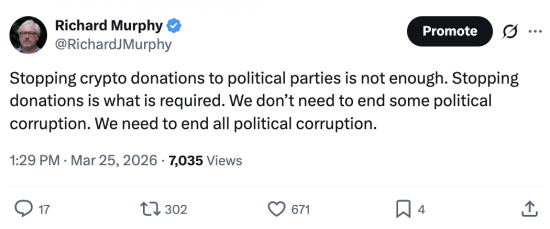
The move is, in other words, good, but a long way from sufficient. Until all bit small, personal donations to UK political parties are banned, the risk of corruption is not eliminated. We desperately need state-funded political parties in the UK, and we are nowhere near having them due to the Labour Party's obstinacy, which runs alongside its refusal to consider proportional representation.
Thanks for reading this post.
You can share this post on social media of your choice by clicking these icons:
There are links to this blog's glossary in the above post that explain technical terms used in it. Follow them for more explanations.
You can subscribe to this blog's daily email here.
And if you would like to support this blog you can, here:

 Buy me a coffee!

To an extent, UK political parties (at least, those with Parliamentary representation) already get state funding, in the form of Short money and Cranbourne money. Around £10m per year.
https://commonslibrary.parliament.uk/research-briefings/sn01663/
But the total amount of donations are significantly more than that. Over £65m in 2025.
https://www.electoralcommission.org.uk/media-centre/political-parties-accept-almost-ps65m-donations-2025
Capping non-UK donations at £100,000 does not go far enough. I don’t see why any one person should be allowed to donate a relatively modest amount each year – say, more than £10,000 per year. Or more then £1000 per member of an organisation. I could be persuaded that these caps should be lower.
– Should any “foreign” donations be allowed, at all? What benefit do these donors seek?
– all donations (above small amount, say 500gbp) must be made public. The ownership of any company giving donations must be known.
– donations from companies must be “small” and less than the profit declared in the UK in the last financial year. (Some donate, based on foreign loans to “companies” … Companies that don’t pay tax because they aren’t really active in the UK).
We could do well to look at Germany. And we need to look at the influence of non-uk media (press and on-line).
But we need to start!!
Why should any companies be allowed to donate to a political party ? companies dont get to vote, dont use the NHS, dont use the schools, dont drive on the roads, dont use leisure facilities, dont use social security etc, so why should a company give a political donation that could influence all of the services that voters use ?
Only people that are on the electoral role should be able to donate.
I said this in the House of Lords about political donations, which are effectively bribes. I was opposed by all parties.
https://www.youtube.com/watch?v=WMnYkYb2-ts
Thanks, Prem.
I suppose one could class the parties as turkeys & thus hardly likely to vote for Christmas. Pretty shameful list of donations.
A worthy attempt & at least you did not end up like the Gracchi in Rome when they proposed land reform.
I am not sure if the £65 million is the grand total of just the total of donations above a certain figure.
But if the state were to replace that funding it would cost a little under £2 per income tax payer. Less than a coffee. It would be worth it.
Agreed
I think it is the reported donations, so currently anything over about £11,000 a year. Anything under £500 does not even need to be recorded as a donation, under the Political Parties, Elections and Referendums Act 2000. Does anyone publish details of them if they are not reported?
OK, so the Labour Party accounts for 2024 show donations of £39.4m in the year to 31 December 2024, and £16.5m in 2023. It is quite hard to marry that up with the data published by the Electoral Commission for 2024 or 2023. In 2023, the central party (ignoring donations to constituencies) seems to have reported donations of £28m to the Electoral Commission. I can’t explain the difference, but there are large contributions from the House of Commons (presumably Short money), several unions, Ecotricity, Lord Sainsbury, Gary Lubner, Francesca Perrin, and others.
Thanks
Lets be honest about it they are bribes.
I don’t see the new rules interfering with the donations that, through the work of Labour Together, propelled Starmer and a significant cohort of Labour MPs into office, and represent the interference in democracy of both corporate wealth and a foreign power – (whom we now support in an appalling unlawful war).
Some of those donations broke Electoral Comission or Parliamentary rules about declaration, but without serious penalties or consequences.
Putting it bluntly, I don’t see why Mr Trevor Chinn’s wealth should give him more influence than me, in controlling who becomes Prime Minister.
But these new rules dont change that. They look more like a very panicky political swipe at Reform UK Ltd. and the optics are awful. Fa***e will make hay with that.
As Richard explains, we need much more radical change, but will turkeys ever vote for Christmas?
Robert J is right – turkeys won’t vote for Christmas. I am thinking about a recent exchange between PSR and Mr Osborne, about the health and strength of Civic society; we need an end to big political donations and we need proportional representation, but how do we achieve these? After Brexit, many are averse to referenda, and anyone with a job or dependent children has to think twice before joining a demonstration. This might be one for the bulletin board, please ditch it if inappropriate.
Party finance? Flat-rate membership fees only. No donations, no gifts, nothing else.
Rycroft points to many of the problems, but doesn’t really frame it in the stark terms the present corruption regime deserves.
As some doctor said on twitter – he is not even allowed to accept the gift of a pen from a pharmaceutical company in case it might influence his prescribing. So why on earth are those who control us, who legislate on our behalf allowed to swim in private vested interest money, ( notably the Health Secretary ‘donations’ from private healthcare interests), dubious 2nd jobs , and lucrative future employment by those they presume to regulate.<p>
Rycoft blithely states ‘there is little appetite for public funding of political parties’ – but that is never really examined in detail. There is already public money going to politics – so there could be ways of increasing that in a rules-based way , and drastically limiting private money flooding our politics.
Rycroft has a long list of references – so is thorough in some directions – but superficial in others (‘we have a vibrant free press’) . He even recognises there may be bad actors among our foreign friends like the US, and the network of lobbying organisations and think tanks . But as expected Israel gets no mention despite Labour Friends and Conservative Friend being in pain sight.
He did not mention Israel
Keeping rich people from having undue influence in politics is needed, the same for companies and the like. My question would be how do you detirmine whether new parties get funding? If the standard budget was small then parties would be unable to spread their message effectively. Too large and you need to ration the amount of parties you can have at one time.
If 200 people decided to launch new political parties working outwhich ones deserve funding would be tricky.
There could be a match funding arrangement that could be worked out, I suggest, subject to limits on individual donations.
No corporate donations, individual donations from registered voters limited to £500. All registered voters to be given a voucher for £20 for them to donate to constituency party organisation (or throw in the bin). Each party to decide the extent to which it calls in the donations centrally.