
Politicians and economic commentators are obsessing about the view that the cost of UK government borrowing is increasing as a consequence of the war in Iran. This is the relevant chart, reproduced from the Financial Times at around 10 am this morning, and it shows that the current borrowing cost on 10-year gilts is, supposedly, 4.99%.
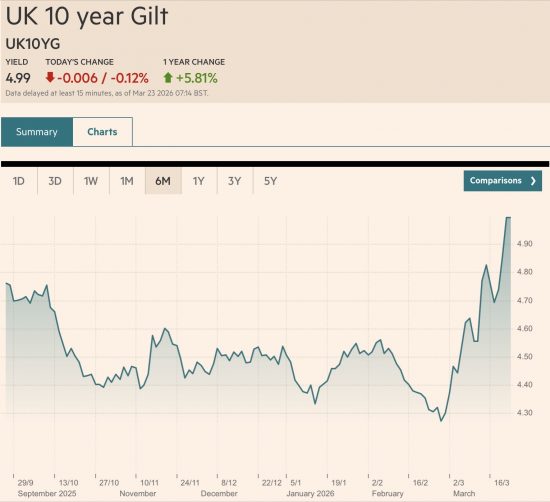
Let us be clear about this: there is no reason at all for this borrowing cost to be that high.
As a matter of fact, the UK government cannot default on its debts, so why the supposed risk of depositing funds with the UK government, which is all that we are talking about here, should vary significantly as a consequence of the war in Iran is almost impossible to work out, when this will always ultimately be the safest place to deposit sterling.
There is, however, one obvious response to this situation which the UK government should be taking, but which it clearly is not. When the world wishes to sell UK government bonds, at what must be an undervalue, because that is why the interest rate appears to be so high, the job of the UK government is to buy them in whatever quantity is required until the point is reached where the UK government has achieved the interest rate that it desires, which will be one way lower than 4.99%.
And let us not pretend that the UK government has not got the capacity to do this. When the UK government chooses to buy government bonds, all it does is an asset swap. It replaces bonds in the market, on which it pays an interest rate of 4.99%, with cash in the central bank reserve accounts, on which at present it is paying 3.75%. It is grossly irresponsible for it not to take this action at present, because it is imposing a cost upon us all which is utterly unnecessary.
Thanks for reading this post.
You can share this post on social media of your choice by clicking these icons:
There are links to this blog's glossary in the above post that explain technical terms used in it. Follow them for more explanations.
You can subscribe to this blog's daily email here.
And if you would like to support this blog you can, here:

 Buy me a coffee!

Sadly I don’t imagine this will be an option this morning’s COBRA meeting will be discussing with the governor of the BofE this morning – expect more warning of interest rates having to go up!
Hi Richard,
An alternative to 10y gilt asset purchases would be for the DMO to just not issue new gilts with the longer maturities and instead supply at the short end where there’s clearly more demand (likely due to increased uncertainty).
But yes, far better to at the very least eeadopt a tap system for debt management where the yield curve is fixed with quantity of gilts floating for each duration, leaving any shortfall as sterling reserves earning, preferably, 0%.
Wrong. There is an absolute gain to be had by buying 10 year bond. This is interest rate arbitrage and the government could do it.
Yes, I agree, but only assuming that the extant 10y gilt has a coupon yield greater than the current bank rate which is not the case for most of them given the 2022 Base rate hike.
If a 10 y gilt was issued in 2020 with a coupon of ~0.1% on face value, the state continues to pay that tiny interest flow on it. Buying that and replacing it with a floating 3.75% reserve balance would obviously *increase* overall interest expenditure.
In that case, better to keep that existing interest promise and just swap all higher-than-current-bank-rate outstanding fixed rate sterling liabilities back for sterling reserves earning 3.75% (could be cut to zero ofc).
You are ignoring the discount involved. Why?
“This is interest rate arbitrage and the government could do it.”
It is absolutely not arbitrage as there are different duration and there for different risk. Arbitrage is risk free profit and this simply isn’t . Clive Parry will endorse this 100%.
You are wrong, because you are assuming that the guilt acquired cannot be sold again. Elementary mistake.
Thanks for posting this. It needs to be said, and often. I entirely agree.
I find it is helpful to look in a little more depth, perhaps others do too.
The consequence of buying back bonds is that the government’s overdraft with the Bank of England increases by the amount spent buying the bonds. For some politicians this seems “bad” because the government then has a large “overdraft”. Actually it is neither good nor bad. The size of the overdraft has no substantive effect. That’s because the government “owes” the money to itself because it owns the bank. Any interest paid to the Bank is simply returned back to its owner the government. Any government debt (to the Bank) can be written of, at any time, with no substantive effect. The debt is merely the difference between what the government has spent, in this case buying back bonds, and what it has received in tax and through previous bond sales. Although it’s largely meaningless it makes some (most) politicians anxious because they don’t understand. 🙂 That’s why I think that government debt is misnamed and, as a consequence, leads to poor policy decisions.
What happens to the bonds when the government has bought them? Previously, QE, (the Bank) has held on to them, which make no rational sense. What is the point in the government owning (through the Bank) it’s own debt? The problem is that confused soles at the Bank then think they have to, later, sell those bonds back to the market, which sucks money out of the economy and depressed it. Bonds bought by the Bank, or the government directly, should, logically, be cancelled.
Another aspect is that the money paid to bond holders has to go somewhere and, as you say, it ends up in central government reserves where the government pays 3.75% . The money has to end up there since there is nowhere else for it to go. It is regressive that the government pays so much interest to the banks and their shareholders for those reserves. They did nothing to create them. So, to me, this highlights the need to tax the wealthy to reduce the level of reserves.
Just to check my understanding, the UK government isn’t actually paying an interest rate of 4.99% on existing bonds – that’s just the internal rate of return to solve price now vs coupons plus redemption? But new bonds might need to be issued a rate comparable with the prevailing yields?
Correct, broadly speaking
The markets are extremely volatile at the minute, changing with every media post from the maniacal Trump. I leave the interpretations of these gyrations to those who play the markets ( gambling in my book). Serious investors will just be watching.
Movements in interest rates, we hope, chart a much longer course than this, but there is no doubt they are too high whatever the markets are doing. As you say, our gov can, with sound economic reasons, decide what interest it is prepared to pay and ignore the wild gyrations of a casino stockmarket.
I was listening to the BBC this morning and hearing that the government’s cost of borrowing had risen. This is totally wrong. The rate is set when the bond is issued and the price when it matured is also fixed. What is happening is that the market price is lower than the issue price so the rate against this price is higher. You are correct that this is the time for the government to buy and cancel the bonds. If I can work this out why can the BBC not.
Thanks