
I recorded the video that we published this morning on the war in Iran a couple of days ago. Even then, I felt the outlook was pretty grim, and that even if the conflict could be contained at this moment, the consequences would be dire.
Then, overnight, Donald Trump published this:
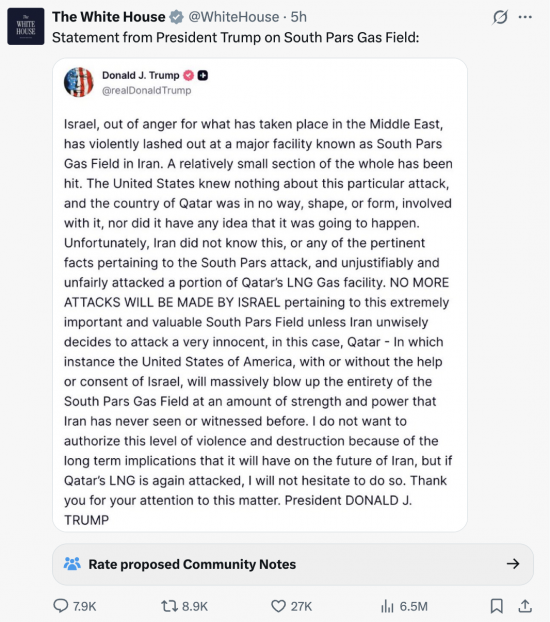
Several thoughts follow.
Firstly, Israel is out of control, and Trump is acknowledging the fact. By doing so, he is also admitting that he is not in charge of this war.
Secondly, he reveals that he was unaware of the regional nature of the conflict that he was bound to create by attacking around in the way that the USA and Israel did. Not recognising the entanglement of states in this region was a serious error of judgement on both their parts, with Qatar now being caught in the crossfire as a consequence.
Thirdly, Trump reveals, as ever, his confused logic. He says there will be no more attacks on Qatar's liquid natural gas (LNG) facilities, but then straightforwardly contradicts himself by saying that he reserves the right to destroy them. The South Pars gas field is jointly owned by Qatar and Iran.
Fourthly, the consequence of such destruction would be catastrophic. In the first instance, that impact would be on Iran, which is heavily dependent on this gas field domestically. However, the impact of the disruption to international gas supplies would be so great that some people say it would take 10 years to return to normal, during which the world would face enormous costs from higher gas prices. We would not then be talking about a recession arising from this war. We would, most definitely, be talking about a depression.
There would, of course, be other ramifications as I discuss in this morning's video. The most likely would be famine, as a result of disruptions to fertiliser production. But, because of problems with aluminium and other raw material supplies, many other industries are going to be disrupted as well, and since oil and gas are the drivers of the worldwide economy, if they become more heavily priced, there will be crises around debt, international insolvency for countries that are forced to borrow in the dollar, and more besides.
The price we are going to pay for this war is considerable, and its impact will last for a very long time.
That said, we do now have to plan for an upside. This is the moment to talk about renewable energy, reducing consumption, a changed understanding of economic processes, the reconsideration of how international money flows are managed, and the reconsideration of strategic alliances. Calm leadership is now required. What also worries me is that this is, perhaps, the thing in shortest supply of all.
Thanks for reading this post.
You can share this post on social media of your choice by clicking these icons:
There are links to this blog's glossary in the above post that explain technical terms used in it. Follow them for more explanations.
You can subscribe to this blog's daily email here.
And if you would like to support this blog you can, here:

 Buy me a coffee!

Transcript error:
feminine – should read famine?
If this awful war at last makes it possible to criticise Israel without being screamed at, then that is a long overdue correction.
Add that to the other pluses – Europe & Uk decoupling from USA, and an increased focus on energy security and renewables, and a growing openness to alternative economic ideas, and this could be the beginning of change.
But at a terrible and unnecessary cost in human life and destruction, for which there must, (and will) be a reckoning.
I must have read that three times and did not see it. Thanks
Spot on Richard. But just taking the UK government’s usual short termism, Rachel is looking to slash budgets to pay for increased defence spending. There does not appear to be anyone in “power” doing a “Beveridge” on the obvious points you raise.
All we are being told is we most spend more on defence, build more nuclear power stations etc.
‘Israel is out of control’.
Correct, absolutely correct – I’m glad to see that fact in print because speaking of the bleedin’ obvious!! But the nature of this ‘being out of control’ seems to me to be deeply racist as well as acquisitive, once more conflating religious sentiment and real estate. A most toxic mix.
Israel has had an effective veto on US foreign policy in the Middle East since Reagan, if not before.
It shows the danger of a domestic lobby getting control of foreign policy.
Robertsj says we can now criticise Israel- does that include the Israeli lobby in this country, I wonder? It seems to among the public but much less so in the media and political establishment.
We should be criticising the Israel lobby in this country. It has done massive harm, from Peter Mandelson onwards.
Of course we should criticise and expose ANY foreign state interfering in our domestic politics, constraining our freedoms, perverting our justice system and corrupting our politicians.
UK Lawyers for Israel (UKLFI) ate currently attempting to browbeat the Green Party and exert control over whether they can debate Zionism at their national conference.
https://www.uklfi.com/green-party-warned-that-motion-declaring-zionism-is-racism-is-legally-flawed-and-risks-discrimination-against-jewish-members
https://www.thecanary.co/uk/news/2025/08/14/uk-lawyers-for-israel/
UKLFI are NOT an SRA-regulated law firm, although they often give the appearance of being one and their letters and warnings can be very intimidating.
Robust and public rebuttal (after getting good legal advice) seems to be an effective tactic.
The current UKLFI “memorandum” in my personal opinion could itself be considered antisemitic as it seems to collate criticism of Israel and Zionism with hatred of Jews for being Jews. There are many diaspora Jews and British citizens who would be horrified at this attempt to once more conflate the Jewish religion and/or ethnic or cultural identity with support for the unlawful aggressive violence of the government of the rogue state of Israel. I thought that our civil courts had already established that “anti-Zionism” was a protected political belief?
https://www.jpost.com/diaspora/antisemitism/article-785403
and
https://www.middleeastmonitor.com/20241015-anti-zionism-ruled-a-protected-belief-in-landmark-uk-tribunal-decision/
Am I being alarmist in thinking that there is now an extremely large Zionist worldwide movement working for the Israeli state?
No.
And, of course, “all of a sudden” millions of less well-off citizens will see huge volatility in the value of their DC pensions, stock & shares ISAs, etc., likely trending downwards for a protracted period. In my experience, this can disrupt people’s thinking in that if they see the value of their “investments” fall they “tighten their belts” by significantly reducing discretionary spending with all of the obvious “knock-on” outcomes thus tipping an economy into recession.
Much to agree with
You really couldn’t make it up could you? It is clear, as Rubio let slip – Israel did drag Trump into this ‘war’. It is a catastrophe now – even Trump’s mad Christian fanatics are resigning , Vance is apparently against the whole adventure – but Trump now cant get out of it like he could last week by declaring ‘victory’.<p>
Europe, UK China, have to try talking to Iran and Arab countries , and the US – to try to get a ceasefire and to see if the Oman draft agreement can be salvaged – what a mess.<p>
Trump almost makes Hitler look canny.
In the words of Ted Hastings ‘Jesus, Mary, Joseph and the wee donkey!’ and Arnold J Rimmer ‘We all have something to bring to this conversation. What you should bring is silence!!’
How thoroughly depressing. Can somebody just put the Tangerine Toddler in a circular room and tell him to sit in the corner?
Craig
The Northern Ireland experience carries a disturbing lesson for democratic politics today because, ironically, it was the peace process itself that weakened, and ultimately destroyed, the moderate political centre.
The ceasefires declared by republican and loyalist paramilitaries in 1994 opened the way for talks that culminated in the Good Friday Agreement. However, the logic of the negotiations favoured the factions most closely associated with the paramilitaries.
Parties linked to armed organisations possessed leverage that moderates lacked. They could imply – sometimes openly, sometimes obliquely – that failure to reach agreement might bring a return to violence. During negotiations this latent threat gave them influence far beyond their electoral strength. As the terms of the settlement were debated, figures connected to the paramilitaries increasingly came to be treated as indispensable participants in the process.
The moderate centre were wholly neoliberals
People realised they offered them nothing.
Donald Trump’s governance is looking increasingly like my son’s WhatsApp message group, only with far less dignity. He is both pleading with Iran to de-escalate, showing that all that matters to him is money, and threatening like a child if he doesn’t get his own way. This is what you get when leaders are selected only based on their usefulness to big business and oligarchy. An absolute race to the bottom in terms of competence, ability, and class. We now live in a world where an earnest political candidate is mocked for her dress sense while her words are ignored, but a mentally unstable man can rant in the middle of the night online, and it’s considered news. Pathetic. I would laugh, but then I remember these are the people who will be dealing with the imminent climate collapse…
This A storm is coming
Just published and it’s hard to disagree.
Agreed