
I was amused by this headline in the FT this morning:
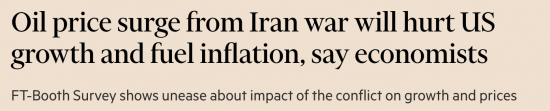
As they then noted:
Soaring oil prices threaten to hit US growth, worsen inflation and keep the Federal Reserve from lowering interest rates, top economists have warned ahead of the central bank's first rate decision since the Iran war began.
US oil prices have jumped almost 50 per cent since the US and Israel struck Iran at the end of last month to about $95 a barrel, sending the costs of petrol and diesel at the pump surging higher.
The majority of academic economists polled by the Clark Center for Global Markets on behalf of the FT said that, if oil prices were to remain at $100 a barrel, slightly above their current level, US growth will decline markedly.
In another shocking finding, the poll indicated that these economists believed that a significant increase in oil prices would affect the US inflation rate.
As statements of the "bleedin' obvious" go, this article takes some beating. No one needed a PhD in economics to reach those conclusions, though it appears the US administration was unaware of the risk of such events.
The problem with this report is that, like so much of the news now, it so glaringly obviously misses the point. Supposed research has been put into finding out what is already known or is obvious, but no analysis of the consequences follows.
There is no questioning of what strategy might be adopted to deal with the situation, beyond suggesting that the Fed is now unlikely to cut interest rates. Doom and gloom is spread, and there is plenty enough of it to go around, but how the problem might be solved by, for example, by ending the war, changing taxes, creating Federal support programmes, releasing more oil reserves, or even, in the case of the USA, by blocking oil exports so that production may be diverted to domestic markets at government controlled prices; none of that is mentioned.
It is this absence of critical thinking in our media which I find so worrying at present, and an explanation for why so many people are alienated by the news.
Why, What, When, Where, Who, and How are the questions that the media is meant to answer? I would also add "Next". Right now, it seems that the media has forgotten to ask why, and it has certainly forgotten to ask the "what's next" question, and that is the one that everybody wants to know about.
Thanks for reading this post.
You can share this post on social media of your choice by clicking these icons:
There are links to this blog's glossary in the above post that explain technical terms used in it. Follow them for more explanations.
You can subscribe to this blog's daily email here.
And if you would like to support this blog you can, here:

 Buy me a coffee!

Might it be that the main stream media have a dominant, submerged purpose of serving the power groups of societies and so avoid applying critical, analytical, and lateral questioning and thinking to them and their interests?
Might this be an example of non-governmental regulatory capture by those who own main stream media outlets and so are members of the power groups?
P. S. Why is the controlling board of the B. B. C. without a perceptible democratic facet?
Maybe that is because polling 25 million people would be very expensive.
I don’t buy that its either too expensive or difficult, Richard.
BBC has list of its licence payers. The process to do a vote for BBC board wouldn’t be substantially different to voting for the board members of a professional body. It’s commonplace.
Oh come on, there is a massive difference between polling 200,000 members of a professional Institute and over 24 million people who pay a much smaller proportionate fee to the bbc for what they get. Do this by mail and I suspect that we would be sacrificing significant Programme output for the sake of a tiny participation in the resulting poll.
I really do think we have to be a little realistic about what we asked for, and this one is utterly unrealistic.
A possible compromise could be a variation on a People’s Assembly. Pick a random few thousand people to cast votes and decide on BBC leadership. Could that work?
How do you pick the people?
[…] I have already noted this morning, our media are complicit in this by failing to ask relevant questions as to what happens next in […]
Pedant Alert
Neither the US or any other producer can stop oil exports
US Refineries are adapted to run on ‘heavy’ crudes eg from Venezuela not the lighter crudes they are now producing. The refineries can be reconfigured but it takes time and money.
By contrast the UK using North Sea oil produces – from memory more petrol than we consume but we need to import Diesel/Heating Oil (Or the other way round)
But you get the idea
So it aint that simple…………….
This is a fine example of a newspaper holding back to align itself with its readers – no doubt thinking about its advertising revenue first?
At first it was all ‘gung-ho’ and ‘evil regimes’ I imagine, and now the Trump edifice is crumbling and ‘buyers remorse’ is settling in, then of course the FT will want to go with the ‘Oh shit, what has he done now’ thinking in the cold light of day.
Cynical does not come close describing it – nor does it describe how Trump now wants to put the people you love in harms way so that it is not only U.S. personnel that are being sent home in body bags for nothing. Trump wants us all to share the collateral damage of his stupidity.
There is an interesting article in the Telegraph by a psychotherapist called Jonathan Alpert, called ‘There’s a reason the Right seems more psychologically distressed than the Left’ (you can read it here). This is how he opens:
In my clinical practice, one pattern has become increasingly difficult to ignore. Among a subset of patients on the political Right, hostility toward political opponents goes beyond dislike or even hatred.
It sometimes takes the form of moralised fantasies about an opponent’s death, disappointment that Donald Trump’s shooter did not have better aim, or statements that certain public figures ‘deserve’ to be eliminated for the greater good. These remarks are rarely presented as literal intent. But they nevertheless offer a revealing glimpse into emotional regulation and psychological wellbeing.
It appears that the Right-leaning patient is quick to express his or her distress in aggressive ways:
What stands out is not only the content of these expressions, but their tone. They are often delivered with intense anger and no shame, as though such thoughts are an understandable or even justified response to the political moment. At no point does the patient see these reactions as excessive or out of control.
Similar behaviours can be observed in real life, too. I was walking around New York City in the summer after the ‘No Kings’ protests. I was looking at a heaping high pile of anti-Trump signs and a woman came up to me and said: “Aren’t these great?” My response: “I kinda like some of what Trump has done.” Her response: “WELL F— YOU THEN!”’
Conversely, those on the Left are more restrained:
You stated the title was “There’s a reason the Right seems more psychologically distressed than the Left”.
I’ve googled for the article and you got your political leanings the wrong way around. It is actually titled, “There’s a reason the LEFT seems more psychologically distressed than the RIGHT”.
So I am not sure what your comment is trying to say?
“This absence of critical thinking in our media” is mirrored in the US with an absence of organised opposition to Trump. It is partly due to the country not being a parliamentary democracy (and ceasing to be a functioning democracy ) but the Democrats don’t seem to have an alternative program and story to tell about where the country needs to go. A state funded health service would be popular according to my American contacts but only a variety of Obamacare seems to be discussed. Taxation of the billionaire class is another issue which is discussed but proposals are vague. Gun control has majority support but no policies are put forward. Support for Israel has fallen but few seem to be prepared to propose a new approach.
We know why these are opposed but they have overcome entrenched obstacles before with the Civil Rights legislation. We have seen mass opposition in Minnesota. They can do it.
I have argued that our future is with Europe but we also need the USA to live up to its best traditions
I agree with you that the USA is the best a semi democracy, and it is only that if the Democrats do function as a political party with its own views, and that does not appear to have happened for a long time. They need to get their act together and stop telling themselves a story which is entirely untrue.
The UK main stream media is only interested in peddling good news and parroting neoliberlism as the be all and end all.
In this conflict you would find it difficult using the UK media to work out that it’s not just oil and gas that comes from oil refining. There are the nitrates, sulphuric acid, polymers, diesel and all the other by products that are needed to run the modern world.
The utter lack of discussion about Israel’s falling munitions supply and damage caused by Iran. Where is Netanyahu?
The constant non questioning promoting the garbage spouted by Trump ” we have destroyed everything and taken out their leadership”.
As for stock markets, the war is being used to divert attention. When Trump gets to week six and Iran is still sending out drones and missiles perhaps then reality may intrude and a price readjustment will take place. Then expect” such a shock not expected” media story.
I agree with your sentiment about the equity & bond markets, but no-one ‘knows’ the future. There seems to be a distinct air of complacency (“Buy the Dips”) at the moment, ignoring to already present and now exacerbated energy crisis, emerging supply chain issues, the worrying outlook for food production and water security. Cash remains a decent investment ‘idea’ IMHO, as, perhaps, do the energy efficiency & infrastructure sectors. We shall see, but many of our clients are decidedly nervous (with good reason) and are increasingly thinking about and acting upon their long-term income needs as the most important thing in their financial lives.
When all the dust settles, it would be amusing to see the reaction of the US Administration if countries who have had their populations adversely affected by the Iran War made claims to reparations to be paid by the US and Israel in recompense for their reckless actions.
I know… pigs might fly, but it’d be an interesting move!
Nearly all of the media is now just a mouthpiece for billionaire owners looking to push their agendas. My primary source for current affairs these days is things like The New Agents with Emily Maitlis and Jon Sopel. I don’t always agree with them but at least you get “grown up” thinking. One thing I’ve also noticed is that there seem to be quite a few European based news media outlets that are much better at critical thinking/questioning than anything US or UK based.
Lewis Goodall is the best member of that team
I now rely on Private Eye for a balanced view on events… and also a good laugh, or at least a chuckle!
Diesel moves everything around. From Bloomberg
“The average price of diesel has now risen above $5 per gallon, pushing up supply chain costs and setting the stage for broader inflation. The spike is hitting farmers, truckers and construction firms. BloombergNEF analysis shows that with $5 diesel, these industries must this week spend around $6.1 billion on fuel, compared to just $4.5 billion ahead of the war, a 35% increase.”
I’ll keep on arranging RPI-linked pension annuities where appropriate!
Spot on Richard . I’ve become obsessed about BBC in particular – and as you say, its lack of ‘critical thinking’. Their so-called editorial guidelines entirely seem to miss the point – its all about ‘balance’ or ‘opinion’, rather than trying to get to the truth – . If they do report the truth, they still have to balance it with an opinion or an untruth – as with the ten years platforming Nigel Lawson’s denial of climate change against the science.<p>
Once they have platformed two opposing points of view they think their job is done – absolutely no curiosity or investigative journalistic probing of which view , if either , is the truth. This isn’t going to change while the government appoints its management, and decides the licence fee. BBC would have to become a truly independent ‘public service broadcaster’ which, as Tom Mills’ book shows – it has never been.<p>
As for the other main stream media – owned by billionaire tax exiles – they will never ask Richard’s “what’s next” question, unless it serves their billionaire class interests. But what government will ban billionaire tax exiles from owning our main media?<p>
We are in a hell of a mess.
Manufacturing consent seems to be the order of the day of our timid media. Don’t put your head above the parapet otherwise you will lose your job, house, sanity……..
Chris Hedges on YouTube or via podcasts with his interviewees throw a very different and credible impression of the war. A very interesting one last week was with Alastair Cooke. Both of them have spent time in Iran and Israel and give a far more potentially devastating outcome for the Western alliances the longer it continues.
An excellent piece from Tim Watkins – I can see the decline in my local Morrison’s in Wells – low-morale staff (and not enough of them), dirty and under-stocked shelves. Perhaps the answer is to further encourage community shops like we are luck to have in our village. These enable good value due to low profit margins, they don’t have any debt, are mainly manned by volunteers, and have access to great product ranges (Suma, for instance) at very competitive prices.
Supermarket slowdown
I agree that the mainstream media are failing us Richard – they have been doing so for years. But that is not their primary purpose. Their job is to manufacture public consent for the excesses of the oligarchs that own them and the governments they fund. The BBC has been successfully neutered by successive governments that feared its independence. It’s active support for Israel throughout the ongoing genocide is ample proof that it now serves the same interests as the rest of the mainstream media.
I would be very interested in hearing your further thoughts on the question of “Next”. I agree no-one seems to be talking about it. Why has Trump not stopped the war already? It’s going badly for the USA, but I doubt Iran will just stop themselves now if the US did stop. Israel probably won’t stop anyway. I think this war really could spell the end for Trump, in which case your point about the failure of the Democrats to step up becomes very important.
I dream of a Mamdani presidency with Polanski as PM here. From Hope into Action!
Regards…Bob
🙂
“The BBC Board is appointed by H. M. The King on the advice of government ministers. Specifically, the Chair and non-executive members for the U. K. nations are appointed on the recommendation of the Secretary of State for Culture, Media and Sport.” [AI Overview]
Might such appointments by a cross-party set of M. P.s introduce a low cost element of democracy to the appointment of the B.B.C. Board which might help it to better represent and serve the generality of the citizens of the U. K.?
I would suggest a process that involves representation from a wide range of groups and nominees within society to ensure that fair representation arises. I see the reason for democracy the BBC but I cannot see justification in holding a general election for the appointment of trustees. This is what is reflected in the whole of government accounts, which is a true and fair view of what really happened.
Good “alternative media” quote from Ann Pettifor published just now.
“Central banks should be supporting investors and consumers by keeping interest rates low as governments, entrepreneurs and consumers grapple with the consequences of Trump’s ‘war of choice’. Low rates could help boost confidence that things will get better. Second, with low rates governments could use fiscal policy to invest and spend and thereby increase the disposable incomes and profits of those suffering from the long-running ‘affordability crisis’.
It’s common sense. And yet not only do we have to endure Trump’s “Operation of Epic Fury’, a ‘war of choice’ – we are also expected to endure the ideological dogma that central banks are ‘independent’ and therefore cannot use low rates and macroeconomic policy to support democratically-mandated government investment and stimulus at this time of a catastrophic Middle East war, and global private sector weakness.
As I argued in my last post, this war will be transformative. And the global economy is ripe for transformation.”
On this, I agree with Ann.