
Everyone is told that economic growth is the key to prosperity.
But what if a significant part of GDP, the number politicians obsess about, is based on a transaction that never actually happens?
Around 10% of UK GDP is made up of something called “imputed rent.” This is the imaginary rent homeowners are assumed to pay themselves for living in their own homes.
No money changes hands.
No market transaction takes place.
But the figure still appears in national income statistics.
In this video, I explain:
- why imputed rent exists in national accounts
- why around £275 billion of UK GDP is based on this assumption
- why GDP ignores huge amounts of real value creation such as childcare, care work and volunteering, and
- why building economic policy around GDP growth is deeply misleading.
If GDP counts invented transactions but ignores real work that keeps society functioning, we need to ask a serious question:
Why do we treat GDP growth as the ultimate measure of economic success?
This is the audio version:
This is the transcript:
Everyone in politics keeps talking about GDP growth. We are told that if GDP, our gross domestic product, grows, everything will be better: wages, public services, living standards, the lot.
But there's a fact that almost nobody ever mentions, which is that about 10%, £1 in every £10 of UK GDP, is completely fictional. It is money that nobody pays, nobody receives, and the transactions it refers to never take place.
It's about imputed rent, the rent homeowners are assumed to pay themselves for living in their own homes. But here's the question. If one tenth of GDP is a totally invented number, why are we obsessing about growing it?
Let's be clear. This is not a conspiracy. The accountants who are preparing this data are doing exactly what national accounting rules tell them to do, but the result is still quite extraordinary. Politicians, commentators, and economists obsess about increasing GDP, yet a huge part of what they're measuring is not an economic transaction at all. It's simply an estimate of what homeowners might pay themselves if they had to rent their own homes, but they don't. All of that raises an uncomfortable question. If a large part of GDP is constructed like this, how reliable is the rest of it, and why are we fixated with it?
Let's look at the data.
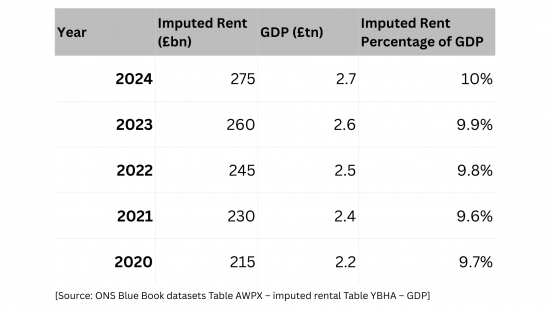
In 2024, £275 billion of imputed rent was included in our national GDP. Now that GDP, our gross domestic product or national income, was £2.7 trillion in the year, that's £2,700 billion, and so almost exactly 10% of our GDP was made up of this fantasy number. It's much the same in earlier years. There's data on the screen for 2020 to 2023, and what you'll see is a mysterious fact that the figure for imputed rent goes up by exactly £15 billion each year, which is very odd, and that the percentage figure is always around this 10% number; it varies between 9.6% and 10%.
What we're seeing is that there is this massive amount of rent, which is not paid, included in GDP.
Now, let's be clear. Rent paid by tenants is included in GDP, and homeowners do not pay rent; they don't need to. But the people who prepare the national accounts want to include a figure for what the rent would've been if they had paid. The assumption then is that the homeowners pay rent to themselves. This is done so we do not distort GDP, depending upon the ratio of people renting and buying their own homes. But that ratio has not changed dramatically over the years, and it is not important to the economy.
Just to understand it like this. That £275 billion of supposed national income in 2024 did not represent any money being paid. There were no market transactions. That figure only exists because a national accounting rule says it should, and this imaginary transaction is then counted as part of that economic output.
Now, if that's the case, what would happen if we didn't count this number? Let's be clear about that as well. If we didn't include that 10% of imputed rent in our GDP, nothing would change in the real economy. Not a single job would be lost. No income would be. No production would be lost. The economy would be exactly the same, only the data would change.
And there's another important question that follows on from that, and that is that if we can invent some transactions for data reasons, why shouldn't we add some other figures into GDP as well? Why don't we inflate the figure to reflect other transactions, which don't involve money, but which do take place?
What about including the value of unpaid childcare, the value of charity and voluntary work, the value of looking after elderly relatives at home, or even the value of doing your own housework instead of paying someone to do it? All of these clearly create real value in the economy, but they're not included in GDP.
That reveals something important. GDP does not measure the value created in our society. In this way, it's totally misleading. All it does is measure transactions recorded in markets. If money changes hands, GDP counts it, well, except for imputed rents, where it makes a figure up. Everywhere else, anything that is not paid for simply doesn't count, and that's not good enough because those things have real value.
The logic becomes really rather surreal around this. If you care for your own children, clean your own home, look after your own elderly parents, or volunteer in your community, according to GDP, you've done nothing of worth. On the other hand, if you live in your own home, apparently, you have created worth. How bizarre is that?
This tells us something important about what GDP really measures. It's claimed that GDP is a measure of prosperity and economic success, and national progress, but in reality, GDP is just a constructed accounting framework that is based on rules and conventions and which is entirely focused on market transactions.
The whole point of GDP is to encourage us, in effect, to outsource everything. Outsource your childcare, and GDP goes up; do it yourself, and it doesn't. Outsource caring for your parents, and GDP goes up; do it yourself, and it doesn't. All of this is absurd because it doesn't tell us about real well-being or where real value is being created yet, governments obsess about GDP growth. They obsess about quarterly GDP numbers. They obsess about league tables of GDP performance. But if GDP includes large estimates, invented transactions, and excludes huge amounts of real value creation, then chasing GDP growth is a very strange policy goal.
This matters because GDP shapes policy. Governments justify their decisions based upon increasing GDP and protecting growth. But if GDP is a partial and deeply distorted measure of economic activity, then policy built around it will also be distorted, and we will get very strange economic outcomes. In fact, we are.
Three conclusions follow from that. First, GDP is not a straightforward measure of economic output.
Second, a significant part of GDP is based on accounting assumptions and not real transactions.
Third, GDP ignores many of the activities that actually make our society function.
So, treating GDP growth as the ultimate economic goal makes very little sense when GDP counts the rents we don't pay, but ignores the actual work that we do that keeps society alive.
Instead of obsessing about GDP, we should be asking something more important. Things like how secure are people's lives, and how good are our public services? Plus, do people live in decent housing, and are we protecting the environment, or are we reducing inequality? Those are real economic goals with real economic outcomes that would change the well-being of people. They matter far more than the growth of this accounting construct called GDP.
So here's the question I want to leave you with. If GDP includes inverted transactions like imputed rent, but excludes huge amounts of real value creation in society, why do we treat GDP growth as the ultimate measure of success? And if GDP is the wrong target, what should replace it?
Let me know your thoughts in the comments below. And if you found this video useful, please like it, subscribe, and share it, because understanding how the economy is measured is the first step to changing how it works.
Thanks for reading this post.
You can share this post on social media of your choice by clicking these icons:
There are links to this blog's glossary in the above post that explain technical terms used in it. Follow them for more explanations.
You can subscribe to this blog's daily email here.
And if you would like to support this blog you can, here:

 Buy me a coffee!

There’s a lot of fiction about in government accounts.
Apparently the government owes the Bank of England hundreds of billions of pounds for gilts held by the bank of England. This is also fiction, just like notional rent from homeowners contribution to GDP, because the government owns the Bank of England. Nothing would change in the economy, nothing at all, if those gilts were cancelled, as they should have been when they were purchased by the bank of England.
And the, apparently, the government can have an overdraft with the Bank of England which it owns. Another fiction.
No wonder people are disillusioned with the government when you can’t believe the official figures the present. 🙂
This intra government debt disappears in the whole of government accounts which reveals it for the total fiction that it is
What you describe is pure testicular material isn’t it? In effect we are only of value if we have a disposable income. Lack that and you are made invisible just as Rachael Reeves has pointed out that Labour are not the party of people on benefits.
In addition, being able to outsource everything – even fixing your own car, is to me about creating, sustaining and celebrating rent seeking. But the kicker is you have to have the disposable income to outsource (cue schemes where you can pay monthly etc).
My experience of outsourcing in the public sector is as follows. You have highly paid officers and directors outsourcing their jobs to the point where you think ‘What are you actually doing, what are you bringing to the party on your wage?’
As a result you have less control over quality, there is less internal staff development going on and less investment in quality and capacity of the org’ you are managing. My honest opinion? The people who outsource are just bloody lazy. I see this all of the time. We’ve had planning officers on short term contracts under outsourcing making decisions on schemes, and then disappearing and being unable to progress them until the next incumbent comes in. I think even councils have been hollowed out by the same logic that they are no good unless they are using staff from the private sector because of course, THEIR in-house costs are seen as a drain on society. But make no mistake, the whole thing is set up to propel people towards the market and to rent seeking.
Thanks
Dear Pilgrim
a bit late in the day but I had a conversation with a gentleman who had worked for a District Council Housing Dept.
The Dept was ALMOed Arms length Management Organisation ( or if it acts like the private sector it must be better). The new “directors’ were fond of saying ‘you guys don’t have experience of the real world’. Within a few years he was the last one left.
But as problems came up, they would ask ‘what did you use to do?’
Experience is a valuable commodity. Discounted for ideology was my impression.
Yes imputed rent is a nonsense. In a previous job I excluded it from the data as it was rather meaningless. If included it gave the impression that the Real estate sector was very important to the economy when in reality most of the output never existed. The other anomaly in GDP data is that oil and gas are recorded offshore which again distorts the data.
Noted
Well, quite. GDP is just one number, and a flawed one at that. There is the great RFK quote. “it measures everything in short, except that which makes life worthwhile”
It also tells us nothing about distribution. You could have increasing GDP when a small gilded class get increasingly richer, while millions of people continue to live in poverty. Or GDP can rise as population rises, but each person may be poorer on average.
I’d suggest that no single economic number should be enshrined as an object of veneration. You need a balanced scorecard. GDP per capita might be in there. Also distribution, perhaps Gini or something better. And wellbeing or “happiness”.
Much to agree with
In addition to that of course not all the activity captured by GDP represents real ‘value’
As I am sure your wife will agree there is an awful lot of perfectly avoidable harm that ends up in A&E all recorded in GDP
Agreed
By that logic, the government should let employees pay for domestic help etc as a tax deductible so it’s paid from gross salary.
This would encourage that outsourcing, boosting GDP, and create jobs, reducing benefit payments.
It could also provide more gig opportunities to allow lower income people to make ends meet more readily, and make it easier for parents – particularly mothers – to balance the costs of some additional support against their income from returning to work.
I’m sorry, but that makes no sense.
A good review of the lunacies of “GDP” – the fake measure of our economic wellbeing that is so disconnected from reality – the idol worshipped by Chancellors at the expense of the rest of us.
Some info on the voluntary sector from the HoL library.
https://lordslibrary.parliament.uk/voluntary-and-community-sector-contribution-to-society/
I used to write to my former Tory MP about this pre 2018, but am out of date now.
About £18bn pa. contribution to economy, said to be 0.8% GDP. (2021) – I suspect this excludes all the unpaid care carried out within families, whether or not supported by social security pittances.
Most of the stats look a bit vague. I can’t see any reference to third sector physical assets, including a lot of sq metreage of religious real estate, much of it multipurpse and used for community benefit during the week.
The article includes some depressingly vague word salads from Labour ministers about resets, frameworks and covenants.
More info here https://www.communityfoundation.org.uk/wp-content/uploads/2022/11/Third-Sector-Trends-in-England-and-Wales-2022-structure-purpose-energy-and-impact-November-2022.pdf
I think society would notice if all 3rd sector activity ceased tomorrow, and all 3rd sector buildings were closed and locked up. If every food bank, benefit advice centre and night shelter closed, some of our cities and towns would become quite unstable.
I don’t think resets, frameworks and covenants quite cut it.
“GDP” belongs in the dustbin.
🙂
You have to wonder how many people in the main stream media have even the faintest idea what GDP is and how it originated. They all treat it as some undeniable truth when in reality they demonstrate that GDP really means Grossly Distorted Poppycock.
Great video. It’s absurd that we measure this. I had no idea. GDP is an even worse metric than I thought.
I’d like to add that the new thumbnail style really “pops”. Good stuff.
I gave up on GDP when it was confirmed to me that if someone produces 10 units that sell for £10 each that is £100 for GDP, but if the producer reduces their output to 5 units and, because of the scarcity, the price increases to £25 each, GDP has increased by 25%. So the less we produce the greater the growth. The accounting world is mad.
There is a lot of truth in what you say
I’m always concerned about GDP when so few people understand, or even know of the other estimates in the National Accounts.
The UK Office for National Statistics (ONS) has long included estimates of smuggling (alcohol and tobacco) in the GDP figures.
In September 2014, the ONS began incorporating estimates for prostitution (£5.3 billion) and illicit drug dealing (£4.4 billion) into the national accounts.
It uses “demand-side” approaches for drugs (estimating usage) and “supply-side” approaches for prostitution (estimating the number of sex workers, client frequency, and average charges).
Truly the Office for National Statistics is better than the police for identifying crime! The figures are not even close to those for imputed rent, but perhaps they could be / should be incorporated in policing targets…
Alternatively, depending on your predilections, perhaps the ONS has unwittingly built a “happiness” index into GDP!
Their figures for the shadow economy are far too small. I was told this by Eurostat
Isn’t another problem with this “imputed rent” double counting – after all, if you are homeowner rather than spending your money on rent to yourself, you will actually be spending it out in the economy which also gets added to GDP!
An argument I saw (I think on a Government website) said it was introduced to make us look better compared to Germany where many more rent than own.
The last is true
Many years ago the Irish GDP, in one year, suddenly increased by 24.5%. I found out that an airline purchased a large order of aeroplanes and booked the purchase in Ireland to save taxes. In fact this prompted be to get interested economics and after much searching found this blog.