
Regular commentator on this blog, Mark Meldon, drew this report to my attention.
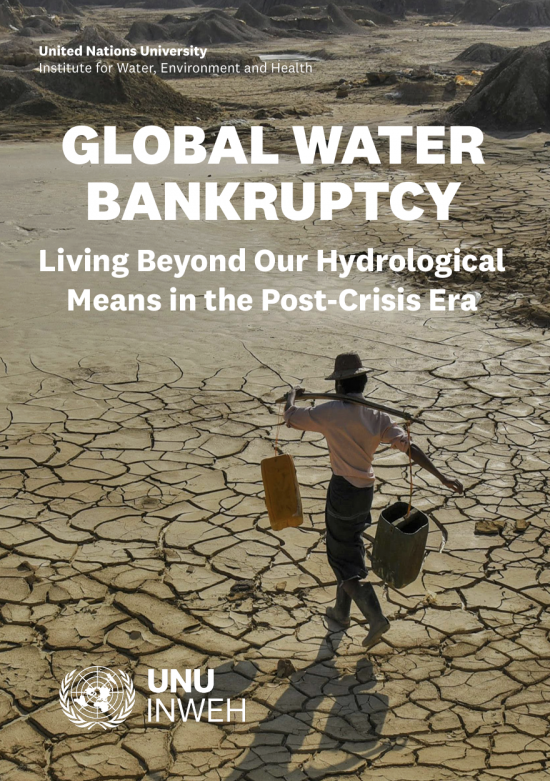
I think the most appropriate thing I can do is share the summary from the report, which is stark in its assessment and diagnosis.
Whilst the world's greatest superpower is intent on making everything about geopolitics worse right now, the worrying thing is that their efforts to destroy the human race will pale into insignificance compared to the threats that the lack of water will create if life is to survive on this planet.
Our impending water crisis shows that we have to change the way we manage our lives, that we must learn to live with what we've got, and that we must recognise that there really is a limit to what we might have.
The Planet Has Entered the Global Water Bankruptcy Era
The planet has entered the Global Water Bankruptcy era. In many basins and aquifers, long-term water use has exceeded renewable inflows and safe depletion limits, and parts of the water and natural capital—rivers, lakes, aquifers, wetlands, soils, and glaciers—have been damaged beyond realistic prospects of full recovery.
Billions remain water insecure. Nearly three-quarters of the world's population lives in countries classified as water-insecure or critically water-insecure. Around 2.2 billion people still lack safely managed drinking water, 3.5 billion lack safely managed sanitation, and about 4 billion experience severe water scarcity for at least one month a year.
Surface Waters Are Shrinking
Surface waters are shrinking at scale. A growing number of major rivers now fail to reach the sea or fall below environmental flow needs for significant parts of the year.
More than half of the world's large lakes have lost water since the early 1990s, affecting around one-quarter of the global population that depends directly on them for water security.
Wetlands Have Been Liquidated
Wetlands have been liquidated on a continental scale.
Over the past five decades, the world has lost roughly 410 million hectares of natural wetlands—almost the land area of the European Union—including an estimated 177 million hectares of inland marshes and swamps, roughly the size of Libya or seven times the area of the United Kingdom.
The loss of ecosystem services from these wetlands is valued at over US$5.1 trillion, roughly equivalent to the combined annual GDP of about 135 of the world's poorest countries.
Groundwater Depletion and Land Subsidence
Groundwater depletion and land subsidence are widespread and often irreversible.
Groundwater now provides about 50% of global domestic water use and over 40% of irrigation water, tying both drinking water security and food production directly to rapidly depleting aquifers.
Around 70% of the world's major aquifers show long-term declining trends.
Excessive groundwater extraction has already contributed to significant land subsidence over more than 6 million square kilometres—almost 5% of the global land area—including over 200,000 square kilometres of urban and densely populated zones where close to 2 billion people live.
In some locations, land is sinking by up to 25 centimetres per year, permanently reducing storage capacity and increasing flood risk.
Cryosphere Loss Is Liquidating “Water Savings”
Cryosphere loss is liquidating critical “water savings”.
The world, in multiple locations, has already lost more than 30% of its glacier mass since 1970.
Several low and mid-latitude mountain ranges risk losing functional glaciers within decades, undermining the long-term security of hundreds of millions of people who rely on glacier and snowmelt-fed rivers for drinking water, irrigation, and hydropower.
Agricultural Heartlands Are Running Down Water Capital
Agricultural heartlands are running down their water capital.
Roughly 70% of global freshwater withdrawals are used for agriculture.
Around 3 billion people and more than half of the world's food production are located in areas where total water storage, including surface water, soil moisture, snow, ice, and groundwater, is already declining or unstable.
More than 170 million hectares of irrigated cropland - roughly the combined land area of France, Spain, Germany and Italy - are under high or very high water stress.
Land and Soil Degradation
Land and soil degradation are amplifying water-related risks.
More than half of global agricultural land is now moderately or severely degraded, reducing soil moisture retention and pushing drylands toward desertification.
Salinisation alone has degraded roughly 82 million hectares of rainfed cropland and 24 million hectares of irrigated cropland - together more than 100 million hectares of cropland - eroding yields in some of the world's key breadbaskets.
Drought Is Increasingly Anthropogenic
Drought is increasingly anthropogenic and extremely costly.
Over 1.8 billion people were living under drought conditions in 2022–2023.
Drought-related damages, intensified by land degradation, groundwater depletion and climate change rather than rainfall deficits alone, already amount to about US$307 billion per year worldwide—larger than the annual GDP of almost three-quarters of UN Member States.
Water Quality Is Reducing the Usable Resource Base
Water quality degradation is shrinking the truly usable resource base.
In many basins, pollution from untreated or inadequately treated wastewater, agricultural runoff, industrial and mining effluents, and salinisation means that a growing share of water is no longer safe or economically viable for drinking, food production or ecosystems—even where nominal volumes have not yet declined dramatically.
The Planetary Freshwater Boundary Has Been Transgressed
The planetary freshwater boundary has been transgressed.
Global evidence shows that two important elements of the freshwater cycle—“blue water” (surface and groundwater) and “green water” (soil moisture)—have been pushed beyond a safe operating space, alongside planetary boundaries for climate, biosphere integrity, and land systems.
Existing Governance Is Not Fit for Purpose
Existing governance and agendas are no longer fit for purpose.
In many basins, the sum of legal water rights, informal expectations and development promises far exceeds degraded hydrological carrying capacity in the absence of effective governance institutions to address water bankruptcy.
The current global agenda focused primarily on WASH (Water, Sanitation, and Hygiene), incremental efficiency gains and generic IWRM (Integrated Water Resources Management) prescriptions is insufficient to address structural overshoot, irreversibility and the rising risks of social instability and conflict associated with water bankruptcy.
Thanks for reading this post.
You can share this post on social media of your choice by clicking these icons:
There are links to this blog's glossary in the above post that explain technical terms used in it. Follow them for more explanations.
You can subscribe to this blog's daily email here.
And if you would like to support this blog you can, here:

 Buy me a coffee!

The Molecule That Made Us | Water Documentary Series
This series was broadcast by the BBC a couple of years ago.
It is a measure of how far ‘civilisation’ has fallen that it fails to prioritise the most fundamental element of life. How insignificant will power and wealth and all the great technological advances appear as we contemplate empty rivers and reservoirs and the steady desertification of once green fields. I am constantly stunned by this failure in leadership and renders both the system and its denizens moribund.
Oh, has the edit window changed?
This is one topic where in my view Kate Raworth and her Doughnut Economics gets the framing of political economy correct. We should be trying to meet human needs within planetary boundaries.
The alternative is literally unsustainable. Water, climate, pollution, biodiversity, land use, all still heading in the wrong direction. We court environmental collapse and human disaster.
The edit window has changed. I hope it is better.
I will be adding Kate Raworth to my economic questions series.
While trump and Iran destroy oil and gas in the Gulf.
Have a look at Lake Mead and the water supply for America’s West coast and Mexico.
They will have to stop hydro generation and hence water to a huge population.
There was a G’ article on Turkey & sinkholes in its most productive farming area. The sinkholes were due to………too much pumping of ground water. Med’ is drying out etc etc.
One of the characters in the Michael Lewis book ‘The Big Short’ – Michael Burry – who made a huge fortune on mortgage backed securities because he worked out that they were heading for disaster and he could make a lot of money by betting against them – is now investing in water. At the end of the dramatisation of the film the ‘Big Short’ it tells you he is investing in water supplies. And he is.
Burry is ‘disaster capitalism’ in action. Burry extracts value (or should we say ‘made up value’) in markets where he sees things going wrong and positions himself to make money out of it for his investment fund. Visit this website: https://guideforinvestment.com/why-does-michael-burry-invest-in-water/
Watch out for a security alert – but read the page. Water scarcity is a area for ‘investment’ and ‘growth’. Yeah – right. What sort of growth? What sort of investment? Cui bono? Who benefits? The sort of growth Rachael from accounts talks about? Who will – by their machinations – be in charge of fresh water in the world, in the world of people like Michael Burry? Who is going to position themselves in the supply chain of life giving fresh water? Who will monopolise it?
And the more our governments feign a lack of their money, the more the opportunities for the market will increase and that includes opportunities for exploitation of you, me and the rest of the world.
‘Fucked up’ does not even begin describe this. A man looking for disaster positioning himself to make a killing at our expense like he did in 2008 and then posing as a saviour? And what might happen if that opportunity is threatened by someone in politics (we wish) actually doing something about it? What might Burry’s fund do then? Whom might it offer political donations to in political parties in order to ‘do nothing’ and ensure that his fund is right where it needs to be when the shit hits the fan? It’s called ‘market making’ in places like Goldman Sachs. Exploitation of water supplies has already been happening in under developed countries, and the developed West is next.
This needs watching because it is a real threat and it is really bad.
I don’t disagree. But.
Diamonds. Worth bugger all now that we can make them. Used to be worth lots cos of scarcity – dig em out of the ground etc.
Water. No shortage of it – not seen the oceans shrinking (they are rising I understand).
Solar-powered de-salination. Obvs not a cheap as the stuff that falls from the sky but in hot & sunny places this could deliver what is needed for agriculture (&/or clean up sewage water (doable)). Thing is, the narrative remains neo-libtard, markets fix things, hence matey. The other sad thing is the Israelis are masters of minimising water usage for ag’. Instead of pressing the loud pedal on this, they erm….. well I think you know the story.
Thanks for posting this. I hadn’t realised just how far we all are into water poverty. Just because it rains here in UK and we get local flooding, it doesn’t mean we can waste water. May I suggest that we need to place water conservation within the purview of caring.
Israel desalinates roughly 800 million cubic metres (MCM) of water annually and pumps water into the Sea of Galilee to maintain the Jordan valley water system. It’s still building desalination plants, with a new one coming on stream (no pun intended) of another 100 MCM next year. California desalinates a tenth of Israel’s volume, despite having over 4 times the population (and 8 times the GDP). If it got its collective finger out on desalination, California wouldn’t need to take so much from the Colorado.
It’s next desalination plant (Doheny Ocean) will give 7 MCM, on a far smaller scale. In 2022, California Coastal Commission voted against a new 70 MCM plant, because it might raise the price of water. There’s a bright spot for California in a series of small sub-sea systems (Oceanwell project) that may deliver 85 MCM by 2030. Relative to Israel it should be aiming at around 3 to 4 billion cubic metres, so it still has some way to go.
Arizona would like to work with Sonora on desalination. It has actively made overtures, but the current leadership of the Mexican state doesn’t want to. Arizona is arguing for a one-for-one swap, building a desalination plant in Mexico and taking the same amount of water out of the Colorado from Sonora’s allocation. That’s just greedy. Sonora gains nothing, and it’s Mexico that would have to deal with the issues of brine disposal and potential ecological changes. Worse of all it won’t help the current Colorado over-allocation problem one iota.
I think that the point I’m making is that fresh water supplies in the face of rising seas need to be publicly funded by the State. To leave these to the market is a really bad idea. Period.
Today on Radio 4, some bloke who runs a pub in Derbyshire has had a borehole drilled under his land to access a natural aquifer which he is pumping fresh water out of to sell bottled water at £15-£20 to rich numpties in the area. He seems to think the water is his! He is not even thinking of downstream flows at all. No double entry book keeping there! It’s take, take, take!
It is the same with all this AI that needs water to keep it cool, no doubt we’ll need more water if we develop nuclear as well. What will be left to drink and how much will it cost?
Desalination is a great technology and it should be embraced in places where it’s needed and energy is cheap to do it. That and easy planning permissions for unsubsidised water projects and prices.
https://www.theguardian.com/environment/2026/feb/21/nobel-laureate-omar-yaghi-invents-machine-that-harvests-water-from-dry-air
I thought this was something to be cheerful about. Not an answer to global resource misuse, but it can be deployed quickly in areas where infrastructure is missing, and avoids downsides of desalination.
When I read this, I noted the number of people likely to be exposed to serious drought in the not-so-distant future (half the population of the planet) and the judgement that in many areas the water supply can probably no longer be restored by any means whatever, and it felt to me that this crisis is possibly worse for the future of humanity than even the climate crisis.
As for the (lack of) interest of those in power, I am also reminded of the head of an AI company who once remarked that there was a real possibility of AI ending the human race, but that there would be some good business to be done on the way…
Paul
It’s a story I’ve been following for several years with respect to water management in the Middle East. Yes, that’s not just Israel and Palestine.
For example, a 0.5 metre rise in the Med will flood the Nile delta – home to a quarter of Egypt’s population and a quarter of its grain acreage.
Jordan hosts one of the highest shares of refugees per capita worldwide, with over 1.3 million Syrians (around 630,000+ registered) and over 2.3 million registered Palestine refugees as of 2025–2026. It is also the most water-poor country in the Middle East. Much of its water is sourced from the Sea of Galilee, which it shares with Israel.
Three 2021 links with more background than I have room for:
https://www.timesofisrael.com/is-israel-burying-its-head-in-sand-as-climate-change-makes-mideast-a-hot-mess/
https://www.timesofisrael.com/jordan-faces-critical-drought-but-many-warn-the-worst-is-yet-to-come/
https://time.com/6051323/palestinians-israel-conflict-climate-change/
Thanks
Need to be as cautious about this as “the dessication of humanity” as about claims of bee-apocalypse causing “planetary suffocation”.
It appears currently habitable areas are likely to become uninhabitable as the availability of groundwater reduces. It’s unclear what sort of timescales we’re talking about though and that’s very important.
Wealthy Western countries, from what’s written, are likely to be more affected by over-extraction with industry and cities. Changing weather patterns will also redirect rainfall making areas uninhabitable (areas of Portugal, I recall are currently being affected this way).
Drought in regions of Africa is not due to over-extraction, it’s due to lack of rain not industrial-scale over-extraction and it’s a bit confusing when the article conflates the two different issues. It’s also poor writing to imply a “global apocalypse”. Planet Earth has just as much water, most of it as oceanic brine, but just as much of it is evaporated and sits in cloud and rains for freshwater. The difficulty is that with climate change, it falls in different places. This makes once habitable areas uninhabitable – but equally, uninhabitable areas become habitable.
On a planetary scale there’s no shortage of water, but there is developing local shortages which can also be addressed in the longer term by moving away from those places. If a city like London, say, dries out it won’t be a surprise panic, it’ll just mean it’s no use living there.
When I read these comments it helps against the fatalism of climate change. Yes, water supply is dwindling, but it can be repaired if we change our trajectory. We have the innovation, the resources. What we need, as the book Why Nations Fail puts it, is a political structure that incentivizes care to the weakest. An age of unprecedented Global Cooperation must be upon us by the next century, we already have global organizations, we have the communication networks, but not like what they are now. We need change to happen, a change on the global economic system.
Recent findings have discovered that the estimates for sea level rise are all wrong and will be far worse. Meanwhile, some political parties are running on policies directly opposing climate action. Nothing will be done until people start dying in numbers people can’t ignore, then it will be too late, and our leaders will likely turn to cruelty to mitigate the harm they previously enabled.
It was interesting that in Chris Hedges Report on the war against Iran, one of the subjects covered was the risk of attacks on desalination plants. Israel wanted to destroy those in Iran but Trump has vetoed that. Israel has 5 of them but Iran hasn’t targeted them yet.
It beggars belief what we have done to the planet, but it is even scarier to think about what we could yet do.
Regards…Bob