
Regular commentator on this blog, Mark Meldon, drew this report to my attention.
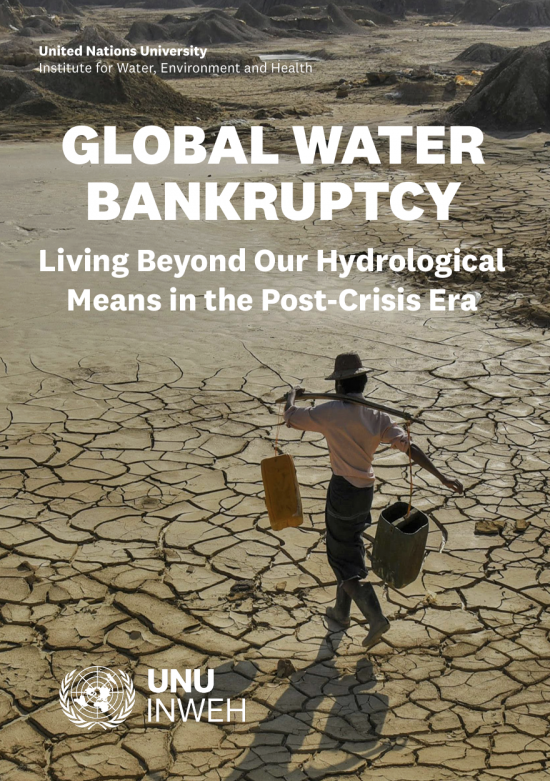
I think the most appropriate thing I can do is share the summary from the report, which is stark in its assessment and diagnosis.
Whilst the world's greatest superpower is intent on making everything about geopolitics worse right now, the worrying thing is that their efforts to destroy the human race will pale into insignificance compared to the threats that the lack of water will create if life is to survive on this planet.
Our impending water crisis shows that we have to change the way we manage our lives, that we must learn to live with what we've got, and that we must recognise that there really is a limit to what we might have.
The Planet Has Entered the Global Water Bankruptcy Era
The planet has entered the Global Water Bankruptcy era. In many basins and aquifers, long-term water use has exceeded renewable inflows and safe depletion limits, and parts of the water and natural capital—rivers, lakes, aquifers, wetlands, soils, and glaciers—have been damaged beyond realistic prospects of full recovery.
Billions remain water insecure. Nearly three-quarters of the world's population lives in countries classified as water-insecure or critically water-insecure. Around 2.2 billion people still lack safely managed drinking water, 3.5 billion lack safely managed sanitation, and about 4 billion experience severe water scarcity for at least one month a year.
Surface Waters Are Shrinking
Surface waters are shrinking at scale. A growing number of major rivers now fail to reach the sea or fall below environmental flow needs for significant parts of the year.
More than half of the world's large lakes have lost water since the early 1990s, affecting around one-quarter of the global population that depends directly on them for water security.
Wetlands Have Been Liquidated
Wetlands have been liquidated on a continental scale.
Over the past five decades, the world has lost roughly 410 million hectares of natural wetlands—almost the land area of the European Union—including an estimated 177 million hectares of inland marshes and swamps, roughly the size of Libya or seven times the area of the United Kingdom.
The loss of ecosystem services from these wetlands is valued at over US$5.1 trillion, roughly equivalent to the combined annual GDP of about 135 of the world's poorest countries.
Groundwater Depletion and Land Subsidence
Groundwater depletion and land subsidence are widespread and often irreversible.
Groundwater now provides about 50% of global domestic water use and over 40% of irrigation water, tying both drinking water security and food production directly to rapidly depleting aquifers.
Around 70% of the world's major aquifers show long-term declining trends.
Excessive groundwater extraction has already contributed to significant land subsidence over more than 6 million square kilometres—almost 5% of the global land area—including over 200,000 square kilometres of urban and densely populated zones where close to 2 billion people live.
In some locations, land is sinking by up to 25 centimetres per year, permanently reducing storage capacity and increasing flood risk.
Cryosphere Loss Is Liquidating “Water Savings”
Cryosphere loss is liquidating critical “water savings”.
The world, in multiple locations, has already lost more than 30% of its glacier mass since 1970.
Several low and mid-latitude mountain ranges risk losing functional glaciers within decades, undermining the long-term security of hundreds of millions of people who rely on glacier and snowmelt-fed rivers for drinking water, irrigation, and hydropower.
Agricultural Heartlands Are Running Down Water Capital
Agricultural heartlands are running down their water capital.
Roughly 70% of global freshwater withdrawals are used for agriculture.
Around 3 billion people and more than half of the world's food production are located in areas where total water storage, including surface water, soil moisture, snow, ice, and groundwater, is already declining or unstable.
More than 170 million hectares of irrigated cropland - roughly the combined land area of France, Spain, Germany and Italy - are under high or very high water stress.
Land and Soil Degradation
Land and soil degradation are amplifying water-related risks.
More than half of global agricultural land is now moderately or severely degraded, reducing soil moisture retention and pushing drylands toward desertification.
Salinisation alone has degraded roughly 82 million hectares of rainfed cropland and 24 million hectares of irrigated cropland - together more than 100 million hectares of cropland - eroding yields in some of the world's key breadbaskets.
Drought Is Increasingly Anthropogenic
Drought is increasingly anthropogenic and extremely costly.
Over 1.8 billion people were living under drought conditions in 2022–2023.
Drought-related damages, intensified by land degradation, groundwater depletion and climate change rather than rainfall deficits alone, already amount to about US$307 billion per year worldwide—larger than the annual GDP of almost three-quarters of UN Member States.
Water Quality Is Reducing the Usable Resource Base
Water quality degradation is shrinking the truly usable resource base.
In many basins, pollution from untreated or inadequately treated wastewater, agricultural runoff, industrial and mining effluents, and salinisation means that a growing share of water is no longer safe or economically viable for drinking, food production or ecosystems—even where nominal volumes have not yet declined dramatically.
The Planetary Freshwater Boundary Has Been Transgressed
The planetary freshwater boundary has been transgressed.
Global evidence shows that two important elements of the freshwater cycle—“blue water” (surface and groundwater) and “green water” (soil moisture)—have been pushed beyond a safe operating space, alongside planetary boundaries for climate, biosphere integrity, and land systems.
Existing Governance Is Not Fit for Purpose
Existing governance and agendas are no longer fit for purpose.
In many basins, the sum of legal water rights, informal expectations and development promises far exceeds degraded hydrological carrying capacity in the absence of effective governance institutions to address water bankruptcy.
The current global agenda focused primarily on WASH (Water, Sanitation, and Hygiene), incremental efficiency gains and generic IWRM (Integrated Water Resources Management) prescriptions is insufficient to address structural overshoot, irreversibility and the rising risks of social instability and conflict associated with water bankruptcy.
Thanks for reading this post.
You can share this post on social media of your choice by clicking these icons:
There are links to this blog's glossary in the above post that explain technical terms used in it. Follow them for more explanations.
You can subscribe to this blog's daily email here.
And if you would like to support this blog you can, here:

 Buy me a coffee!

The Molecule That Made Us | Water Documentary Series
This series was broadcast by the BBC a couple of years ago.
It is a measure of how far ‘civilisation’ has fallen that it fails to prioritise the most fundamental element of life. How insignificant will power and wealth and all the great technological advances appear as we contemplate empty rivers and reservoirs and the steady desertification of once green fields. I am constantly stunned by this failure in leadership and renders both the system and its denizens moribund.
Oh, has the edit window changed?
This is one topic where in my view Kate Raworth and her Doughnut Economics gets the framing of political economy correct. We should be trying to meet human needs within planetary boundaries.
The alternative is literally unsustainable. Water, climate, pollution, biodiversity, land use, all still heading in the wrong direction. We court environmental collapse and human disaster.
The edit window has changed. I hope it is better.
I will be adding Kate Raworth to my economic questions series.
While trump and Iran destroy oil and gas in the Gulf.
Have a look at Lake Mead and the water supply for America’s West coast and Mexico.
They will have to stop hydro generation and hence water to a huge population.