
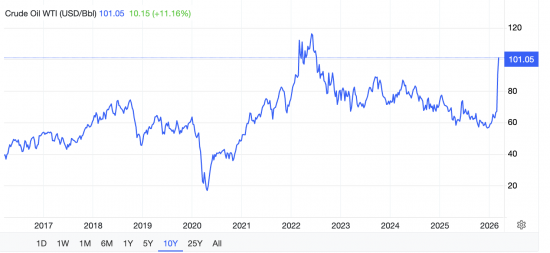
This chart comes from Trading Economics this morning and is already out of date because I gather that since I took the screenshot, the oil price has now reached $110 per barrel:
The FT presents broadly similar information:
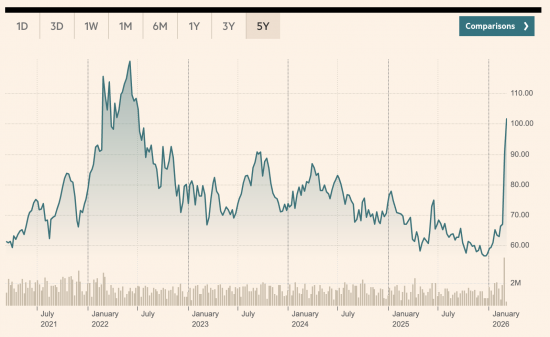
The reason for showing the change is to emphasise two things. Firstly, there is the absolute price increase, with the price of oil increasing from around $65 per barrel to more than $100 a barrel in only a few days. The second is to show how exceptional this rate of change is. The increase is occurring at a faster rate than in 2022. We do not know where it will end as yet, but I suspect that it is nowhere near its peak at present.
The economic fallout of this for everyone in the UK and around the world is going to be staggering.
There is one thing that we do know now. This is that the exceptional profits that oil companies made in 2022 will recur. I sincerely hope that somebody has a plan to increase the tax rate on them to deal with this. The case for a windfall tax is going to be overwhelming. We need such a tax, and we need it now. There can be no justification for private sector gain at this moment at cost to the people of the world from enormous economic disruption.
Thanks for reading this post.
You can share this post on social media of your choice by clicking these icons:
There are links to this blog's glossary in the above post that explain technical terms used in it. Follow them for more explanations.
You can subscribe to this blog's daily email here.
And if you would like to support this blog you can, here:

 Buy me a coffee!

And a windfall tax on gas too, in view of your earlier post. The gas price will have a serious knock-on effect on electricity prices as well.
It’s another package of reasons why the Government needs to get itself into crisis management mode. It’s so obvious. Why isn’t it happening?
Who actually gets that money Richard? Presumably there are separate entities along the supply chain all the way through from producers to the traders, and not all will be getting windfall profits, or do they?. Our government should make sure all the gougers along the chain ‘pay us back’.
Hopefully, Clive Parry can give a bit of insight as to how the booty is carved up between the actors.
From past evidence a great deal of the game will go to the oil producing companies. Shell, BP and others had extraordinary profits in 2022 and thereafter. Where they split the gains two is a good question. They will probably attribute them to intermediate trading operations who will probably avoid UK taxation as a result.
Sorry, no expert on energy supply but I think Richard is correct – the lion’s share of the gains go to the oil drilling companies who now just sell their oil at a higher price with no (material) rise in costs. Everyone else just has to accept that price as an “input cost” (and that would include the refining divisions of large oil companies) and try and pass on the higher prices down the chain. However, in practice, the volatility in the market allows refiners, distributors (and some others) to squeeze out higher margins – see how the petrol price shoots up but only declines slowly – leaving consumers to foot the bill.
How do we tax these players in a better way? I am not sure.
All I would say is that the arbitrary nature of a windfall tax does not appeal – a better tax regime that operates well at all oil price levels would be much preferred. However, I suspect that a windfall tax is the least worst option, in practice…. and certainly the only option in the short term.
One answer is to use unitary apportionment formula tax calculation is a way of contributing the tax base to countries so that locations which use oil benefit is much from profits generated as to those which produce oil. Country by country reporting, which I created would facilitate this process
Agree. Won’t happen, Reeves & Starmer are creatures of the mega corps & will do what their masters say – & thus windfall taxes won’t happen, after all, post May they are on the job market and one does not upset potential employers.
Not discussed: the buying of oil & gas futures – which cushions the impact of oil & gas price rises & allows even more money to be made.
This sounds like a plan to tax foreigners. There’s no new UK oil or gas exploration and the amount of production already out there is diminishing.
Don’t be stupid. It is about txaing excess profits made here. What is wrong with that?
Well said Richard. Re: effect of fuel price rises on the economy and cost of living I think you previously (Ukraine crisis?) advocated temporary reductions in VAT and fuel duty. Would this also be appropriate now?
Yes. We are planning a video on this, but I was not feeling up to it this morning. My voice is sounding pretty rough.
Not forgetting of course those who will make a fortune from share values exploding upwards. Can you put a windfall tax on shareholder dividends?
I wonder how many had prior knowledge or ‘hunches’ that the prices would rise as much and placed their bets on the energy companies earlier this year or towards the end of last year?
I bet Venezuela is laughing it’s socks off now.
Unsurprisingly, one of the big winners with this price rise will be Russia, which needed $90/barrel for its balance of payments to break even. Could that be the real reason for this war?
A silly comment…Harbour Energy, based in Aberdeen, reported an effective tax rate of 106% on its North Sea operations for 2025,.. are you want more tax?
That was deferred tax
And yes that was a very silly comment