
The New York Times has just reported:
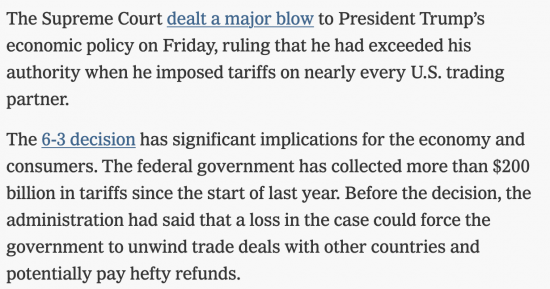
Let me contextualise this. The decision does not prove there is a god, but it does seem a little short of a miracle given the makeup of the Supreme Court, who must have known the consequences of their decision.
Trump's economic policy now lies in tatters.
Whose chosen method of economic warfare has been denied to him.
The cost of reparations is going to be considerable - and you can be sure the claims for losses will now pile in.
And if he can lose on this, confidence in what else he plans will be lost.
Of course, one should not overextrapolate a decision, but at the same time, why not? The whole logic of his administration is torn apart by this decision because what it makes clear is that there might still be a rule of law in the USA, and Trump cannot do whatever he wishes.
I do live in hope.
Has crunch time come for Trump?
And for the dollar?
What next? An Epstein trial? That could change things altogether.
Thanks for reading this post.
You can share this post on social media of your choice by clicking these icons:
There are links to this blog's glossary in the above post that explain technical terms used in it. Follow them for more explanations.
You can subscribe to this blog's daily email here.
And if you would like to support this blog you can, here:

 Buy me a coffee!

Yes… but I fear for those that might be in his cross-hairs as he looks for a distraction. Iran?
Agreed
The Court has ruled that the Administration exceeded its authority in relying on the International Emergency Economic Powers Act (IEEPA) to enact tariffs on most countries’ imports. In April 2025, Trump declared the U.S. trade deficit a “national emergency.” Attorneys for the administration have cited that declaration as the legal basis for invoking IEEPA, which allows the president to respond to “unusual and extraordinary threats” when a national emergency has been declared.
The IEEPA was passed in 1977. In the 50 years since its passage, the law has never been used by a president to impose tariffs. By the administration’s own admission, the trade deficit cited by Trump has persisted for nearly 50 years, which fact undermines Trump’s claim that there is an “unusual and extraordinary” trade emergency.
The law authorizes the president to “regulate … importation” during a declared national emergency, but it does not use the word “tariffs.”
Under the U.S. Constitution, Congress has the authority to enact tariffs, not the administration. “The Framers gave that power to ‘Congress alone’ — notwithstanding the obvious foreign affairs implications of tariffs,” Chief Justice John Roberts wrote for the majority. “And whatever may be said of other powers that implicate foreign affairs, we would not expect Congress to relinquish its tariff power through vague language, or without careful limits.”
Results so far: Companies heavily exposed to tariffs, such as retailers and appliance makers, immediately became some of the best performing stocks of the day.
Will this Congress authorize tariffs? When you sprout wings and fly.
God has just told me he works in mysterious ways. And leaves us to work out HIs influence.
🙂
Me, too
Apparently three of the judges voting against his ability to levy tariffs were ones that he appointed.. does it mean they are finally seeing how some of their previous judgements that were seen to be partisan rather than strictly legal are destroying the reputation of the court and or finally seeing that trump is a losing proposition and its time to jump ship? Hope so.
When Trump didn’t like what international judges did on Israel, he subjected them to sanctions (banking, credit cards, travel etc).
https://www.aljazeera.com/news/2025/6/5/trump-administration-sanctions-international-criminal-court-judges
I wonder if he will try something similar with SCOTUS?
AS for the theological implications… I know nothing about how such decisions are made but… the overthrow of tyrants is a very big theme in scripture.
If only these Christo-fascists actually READ their scriptures, they might be a bit less arrogant about their so-called power. For example, didn’t Trump check Ezekiel 28:1-18 before all this tarrif/trade nonsense? Or Acts 12:1-23 (not for those with weak stomachs), on the limitations of temporal power?
More rich pickings for the tort lawyers.
🙂
I wonder if it was just plain self interest somewhere that resulted in this turn of events? It’s a funny old world at the moment for sure.
If I were ‘God’ I’d be so disappointed that I’d want nothing to do with any of it.
The rules are there – written down. Abide by them. It’s simple. Or should be.
What is a concern is that 3 out of 9 judges support Trump!
Research on Supreme Court Justices Brett Kavanaugh and Clarence Thomas will be illuminating.
The man child is reacting like all spoilt children who have never been told no.
He is looking to use other laws and statutes to apply tariffs to the rest of the world without going to the House. At least one of these options only allows the tariffs to stay in place for 150 days before they have to be voted on in the House.
At what point will this become a contempt of court? If it is , will it meet the threshold of a high crime or misdemeanour required for impeachment?
Today’s analysis by Robert Reich explains the significance of the Supreme Court’s 6-3 decision. https://robertreich.substack.com/p/the-supreme-courts-tariff-decision
To quote in part: This is a big decision. It goes far beyond merely interpreting the 1997 International Emergency Economic Powers Act not to give Trump the power over tariffs that he claims to have. It reaffirms a basic constitutional principle about the division and separation of powers between Congress and the president.
On its face, this decision clarifies that Trump cannot decide on his own not to spend money Congress has authorized and appropriated — such as the funds for U.S.A.I.D. he refused to spend. And he cannot on his own decide to go to war.
Trump has no authority on his own to impose tariffs because the Constitution gives that authority to Congress.
…
Nor, by this same Supreme Court logic, does Trump have authority to go to war because Article I, Section 8, Clause 11 of the Constitution grants Congress the power to “declare War … and make Rules concerning Captures on Land and Water” — and Congress would not have delegated this highly consequential power to a president through ambiguous language.
…
The press has reported on yesterday’s Supreme Court decision as if it were only about tariffs. Wrong. It’s far bigger and even more important.
Note that the decision was written by Chief Justice John Roberts — the same justice who wrote the Court’s 2024 decision in Trump v. United States, another 6 to 3 decision in which the Court ruled that former presidents have absolute immunity for actions taken within their core constitutional powers and at least presumptive immunity for all other official acts.
… A president has immunity for actions taken within his core constitutional powers. But a president has no authority to take core powers that the Constitution gives to Congress.
…
In these two decisions, the Chief Justice and five of his colleagues on the Court have laid out a roadmap for what they see as the boundary separating the power of the president from the powers of Congress, and what they will decide about future cases along that boundary.
Trump will pay no heed, of course. He accepts no limits to his power and has shown no respect for the Constitution, Congress, the Supreme Court, or the rule of law.
I agree with him
Everything is feeling a tad apocalyptic today. Is the US drifting towards civil war? It looks like that to me. But perhaps I just need a good night’s sleep.
The real test is probably yet to come.
The Supreme Corrupt has had a year to do something to rein him in and has not done so. The tariffs were always constitutionally illegal and his pretext for imposing them patently nonsensical – all the court has done is finally acknowledge their illegality. It has not struck anything down.
Trump will now bend other laws to allow him to continue with tariffs without congressional approval and to make the point that he is above the law and does not have to defer to those with constitutional authority. The uncertainty arising from his abuse of tariffs will continue. His response of announcing the imposition of a global 10% tariff makes that clear, as does his denigration of the court and its members following their decision.
We need to wait to see if his follow-up actions are opposed/halted by the court before assuming there has been any actual change.
Please understand how the U.S. Supreme Court functions in the judicial structure of the United States. https://supremecourthistory.org/how-the-court-works/types-of-cases-the-court-hears/
Not sure of the point you are trying to make here:
Before this week’s IEEPA decision, the Supreme Court had already been invited to weigh in on Trump’s tariffs but chose not to take those cases, leaving the lower‑court rulings (which upheld his authority) in place.
The key example involves Trump’s 2018 steel and aluminum tariffs imposed under section 232 of the Trade Expansion Act of 1962. Importers challenged those tariffs in the Court of International Trade and then in the Federal Circuit, arguing that section 232 was an unconstitutional delegation of Congress’s power over trade and tariffs. The lower courts rejected those arguments and upheld the statute and the tariffs. After losing in the Federal Circuit, the challengers filed a petition for certiorari asking the Supreme Court to take the case and rule on the legality of Trump’s tariffs and the breadth of section 232. The Supreme Court denied cert, meaning it refused to hear the case and let the lower‑court decisions stand.
Similarly, elements of Trump’s China tariffs and other trade measures under section 301 and related statutes generated litigation. Those cases focused more on whether the administration had followed the procedural and statutory requirements than on a broad constitutional attack, but again, when petitions or potential petitions existed, the Court did not step in to revisit the underlying tariff authority.
The Court has had multiple opportunities to uphold the law, which it declined to use.
Any cases that address the limits of presidential authority will come up from lower courts and will not be in the current term calendar.
What is John Roberts thinking? He’s thinking about judicial independence. There’s likely to be another retirement this year. He wants to keep his authority. He’s looking at the composition of the Senate. Whom will the president nominate and what will that fight look like.
I’m not sure it’s possible to have a completely independent judiciary, but clearly it’s very important to try. In the US, they haven’t, and that’s one of the things that is enabling Trump to destroy his country.
In the United States, the procedure for seating a new Supreme Court justice is as follows. The president nominates someone. The person is scrutinized by the FBI. His or her family members are interviewed, including any ex-spouses. If the person passes review, the Senate holds hearings on the person. The person is deposed by the Senate. The Senate confirms the nominee. If it appears that the nominee does not have the votes for confirmation, the president can withdraw the person’s name. See, for examples, Robert Bork and Merrick Garland.
This is clearly a highly politicized process and not the way to create an independent judiciary. However, it’s not possible to do any better with our Constitution and our culture.
As to the Court’s decision in Learning Resources v. Trump, I have been reading Justice Roberts’ decision and I recommend doing so to understand his thinking. He says “We have long expressed “reluctan[ce] to read into ambiguous statutory text” extraordinary delegations of Congress’s powers.” He then cites 3 cases that demonstrate his Court’s reluctance. One is “In West Virginia v. EPA, we declined to read authorization to determine the “best system of emission reduction” as a delegation of power to force a nationwide transition away from the use of coal.” This appears to be a political attitude of John Roberts. Congress created EPA in 1970 to make science-based decisions to control pollution from different sources. https://en.wikipedia.org/wiki/United_States_Environmental_Protection_Agency . (I worked at EPA in the 1980’s.) So Roberts is saying that the court had not approved of Congress’ delegation of power to EPA to force a transition away from coal. But that’s EPA’s job. And suing EPA for failure to regulate pollutants is a national sport. I’ve been involved in one of those suits.
So in the recent past, this Court has screwed the world. In this instance, Roberts’ decision built on a house of cards benefits the world but Trump is ignoring it anyway.
Here we are, trapped in a device of our own making.