
As the FT reports this morning:
A record share of people in the UK say taxes and public spending should be cut, according to a leading survey that highlights a widening political divide.
Three charts support the data they note, which has been published in the latest British Social Attitudes report, published today by the National Centre for Social Research.
The first is this:
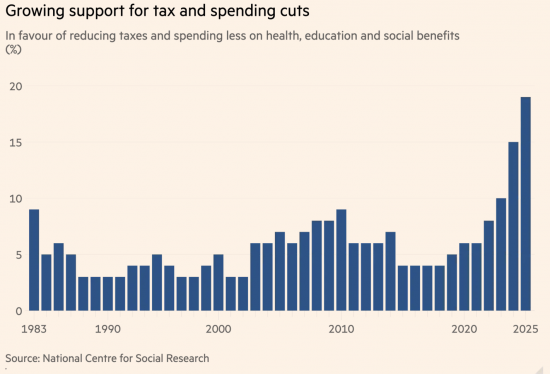
There is a marked disquiet about public spending, which is apparently growing rapidly.
The second is this:
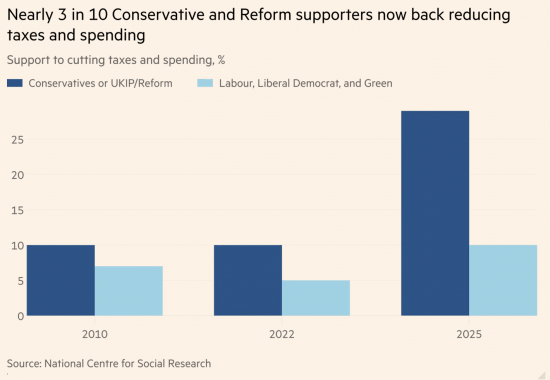
The noted disquiet exists across supporters of all parties, but is most obvious amongst those who are supporters of the Conservatives and Reform.
The third chart explains why this might be the case:
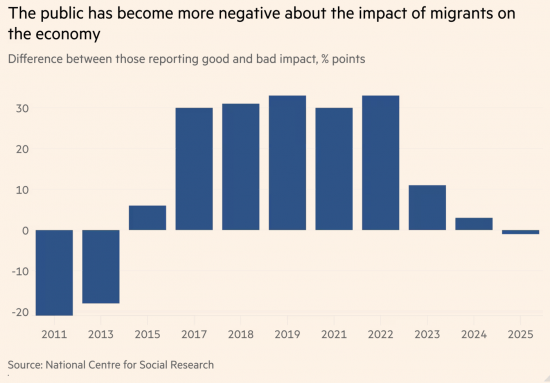
Even though the evidence is overwhelming that migration makes a net positive contribution to UK society, this is not believed, and concern over migration is creating hostility to increased public spending.
The consequences are clear.
First, the deliberate politics of destruction promoted by neoliberal parties, but most especially exploited by Reform, is being seen in action here. The toxic narrative that it promotes around migration, based quite deliberately on a politics of hate, is being used to undermine arguments around the benefits of the state, with a consequent decidedly perverse outcome. This will mean that most of the spending cuts they desire will, in fact, impact most heavily on those most likely to support Reform. This is, of course, not by chance: the leaders of Reform do not just hate migrants; they also hate their own supporters amongst groups with lower income and wealth because the creation of social division and inequality around these issues is a deliberate part of their policy.
Second, nothing that is happening in politics elsewhere is doing anything to counter these narratives at present, unless you look beyond the mainstream parties. The Greens are obviously an exception, as are Plaid Cymru, whilst the SNP government in Scotland has shown, through its actions, that it is serious about equality in a way that no party in England or Wales has yet done in practice. The corrosive attacks on government spending by all mainstream parties are having consequences that will be profoundly uncomfortable for the sake of division within our society or for the prospects of those who are suffering within it.
Third, we most definitely need a politics for people, based around a politics of care that provides funding for a better future.
Thanks for reading this post.
You can share this post on social media of your choice by clicking these icons:
There are links to this blog's glossary in the above post that explain technical terms used in it. Follow them for more explanations.
You can subscribe to this blog's daily email here.
And if you would like to support this blog you can, here:

 Buy me a coffee!

[…] the context of the post I have just made, showing that Reform voters are very keen to cut state spending, it is really quite ironic to note […]
I suspect that things like the Covid frauds, HS2 and the Ferry Fiasco are making people concerned about where public money is going.
What I suggest we do need is to make sure public money is well spent and there are several very public examples where – conveniently it hasnt been.
Worrying; and should prompt us all to make more effort to knock some sense into our friends, neighbours and colleagues! I wonder how many of the people supporting reduced state expenditure would still support it if it meant they would no longer be able to receive a state pension or disability benefit or free medical care or indeed road repairs?
The right question
I would not underestimate the impact of targeted or algorithmic social media. Several of my political friends are in ‘local’ and ‘interest’ groups under pseudonym accounts, monitoring the incessant anti-migrant drivel. Mostly bots and some prolific posters, all playing the ‘migrant destroying our way of life’ fascism. I had to quit a trail runners group that abruptly turned into a hate-fest, and admins had to ban several people in our Friends of Chasewater group.
We have a site called “Love Ely” on Facebook that seems to me to be far too much about “Hate Ely”.
Might the self-harming, confidently held, soio-economic ignorance of Reform supporters be encouraged by a mass education set up and main stream media, not least the B. B. C.’s news and derivatives department which, indirectly and directly, teaches and feeds socio-economic ignorance and non-questioming attitudes?
I think you know the answer to that one.
The standard response on why are things so bad? Blame it on immigrants and “bloody foreigners”.
Public services are poorly funded, at crisis point, cutting them will make it worse. Which will hit the areas that believe Deform will stop immigration.
The UK politicians can “care” and fund services properly. But it’s too much for them because it is screamed by the media, finance, industry ” we can’t afford it, oh, but we need subsidies to thrive”. Think pubs, the pension industry , drug companies etc.
Today it is announced that LINO will be giving local authorities £5bn to cover 90% of the debts run up by special educational needs financing. Why not 100%. The crisis was caused by the UK government not funding it properly in the first place.
But no steer is still committed to cutting this funding in the still proposed review. Another self made crisis on the way.
Typical, not a solution, just a very short term sticking plaster.
Worcester (a Reform-run council) has obtained government consent to put up council tax by – wait for it – 9% in April.
https://www.theguardian.com/uk-news/2026/feb/09/reform-worcestershire-council-tax-england-largest-rise
That needs discussing on every omnibus in the country.
Look at the actual numbers on the charts. The first could equally be presented as “81% are NOT in favour of reducing taxes and spending less on health, education, and social benefits”. Even chart 2, “More than 70% of Conservative and Reform supporters are NOT in favour of cutting taxes”. But I can’t make head or tail of chart 3, except that it looks as though opinion on migrants is pretty evenly balanced at the moment. In fact, then, these charts don’t say what the headings imply. Looked at my way, they imply a massive majority in favour of the care economy, from all parties.
Correct, and thank you.
So depressing , but not surprising, given the relentless messaging , saying directly or not very subtly suggesting, that ‘welfare’ spending is ballooning, ‘welfare spending’ is harming the economy, ‘welfare spending’ means loading debt on our children and grandchildren, ‘welfare spending’ is going on luxury hotels for migrants and £400 taxi rides for migrants visiting a doctor..
This dance of death, this romance we have with the terminal is unabated.
It’s beyond contempt.
noting that last year
“YouGov polling for The Times shows a third (33%) would like overall levels to stay roughly where they are, while a similar 30% would like to see an increase in spending on public services, even if this means an increases in taxes. A smaller 17% of the public would choose tax cuts at the expense of spending.”
https://yougov.co.uk/politics/articles/52312-where-do-britons-stand-on-tax-and-spending-ahead-of-the-2025-spending-review
Have peoples views changed dramatically in 6 months or is it a dodgy Telegraph poll
It is a reasonably reputable think tank.
The suggestion is big change is happening.
Interesting report here
https://www.theguardian.com/environment/2026/feb/10/rethinking-economics-student-academic-organisation-changing-education
The times they may be a changing…………….
I am trying to do the same thing with Accounting Streams.