
We have suffered the curse of racist politics in this country for too long. Racism is bad enough, and too common. Racist politics is worse. It systemically embeds discrimination in our society, giving it the appearance of acceptability and, simultaneously, over time, making prejudice appear acceptable, state-backed, and even to be enforced by action. All of that is anathema to what I will call the politics of care.
I should point out, though, that racist politics did not arrive in this country with Nigel Farage. I can recall people's horror at Enoch Powell's speeches in the 60s and 70s, and the unified revulsion amongst political leaders at what he had to say, which sent him into effective political exile in Northern Ireland, where he was embraced by Unionists when no one else would.
I do also, of course, recall the National Front and the BNP, and the toxicity of all that they had to say, plus the thuggery with which they were associated.
I also well recall the power of music and other media in rejecting their racism. So many bands, from The Specials onwards, did so much to highlight the importance of community and integration. I was a fan then, and now, not just of the music, which was really good, but also of what they were saying. It mattered, and they changed the shape of our society and empowered, in the process, those who opposed the violence of racism and racists.
For a while, we could have thought that racism played no part in British politics, any more than other forms of discrimination appeared to do for a while. But we were lulled into a sense of false security, and maybe we let our guard down, because there always have been, and I suspect there always will be, those who base their political preferences on exclusion rather than inclusion, and on discrimination rather than shared humanity. For them, politics based on a totally false form of patriotism has always seemed to matter despite the fact that in a country based upon its capacity to manage open borders, the free flow of people, and the embrace of difference, to claim that patriotism is about a culture that has no singular origin, but which actually reflects a multiplicity of identities, is straightforwardly fake, manufactured, and toxic.
The sad fact is that no one has done more to promote this fakery than Nigel Farage. I know he claims he is not racist. He often refers to the inclusion in his team of people who are not white, Christian, male, or who are of what the vast majority of his supporters would believe to be of an English background, as evidence of this. But it is notable that these exceptions appear to share other characteristics, of which the most commonplace are hypocrisy, an ability to climb greasy poles, and being in possession of a lust for both wealth and power, in which quest they have succeeded, letting Farage overlook those characteristics that are otherwise his basis for discrimination.
It was Farage who created the narratives that rejected our shared European heritage.
It was Farage who rejected the idea that we had obligations to refugees, from wherever they came.
It was Farage who created the idea that there was a uniformity to Englishness, when no such thing exists.
It was Farage who turned this into a political mantra based on hate of others - who he clearly identifies as migrants - when he has no other political philosophy to offer. Let's not pretend otherwise.
But of course, Farage has not been the only exponent of this type of politics. This sentiment has always been alive and well on the right wing of US politics, more so than it ever has been here, and whilst he did not create this sentiment there any more than Farage did here, Trump has become the perfect example of an exponent of this art, with his tireless attacks on migrants. In power, he has also turned it into a vicious form of politics from which millions have suffered, directly or through fear. Nowhere has this been seen more obviously than in Minneapolis.
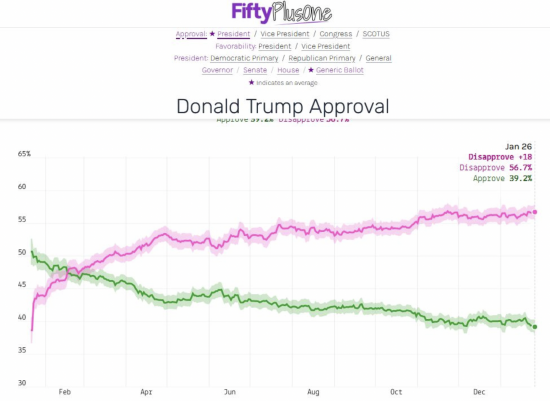
Now there is a backlash. There is no better source of data on this in the USA than G. Elliot Morris in his Strength in Numbers blog, which I recommend. As he noted this week, Trump's popularity is collapsing:
This, though, is not the most important piece of data he notes. Instead, this chart helps reveal that:
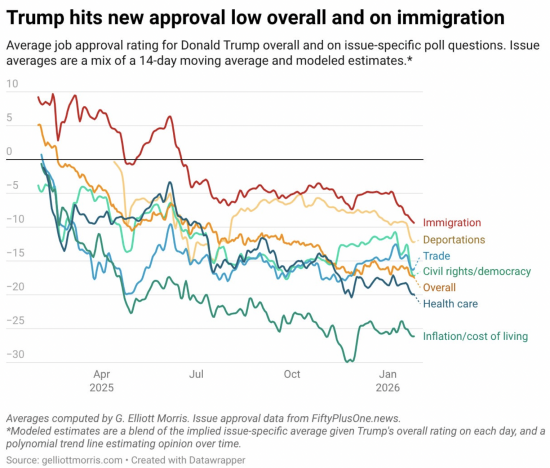
Support for Trump on immigration is declining rapidly. But it is support for ICE (the Immigration and Customs Enforcement agency) where the change in sentiment is most telling:
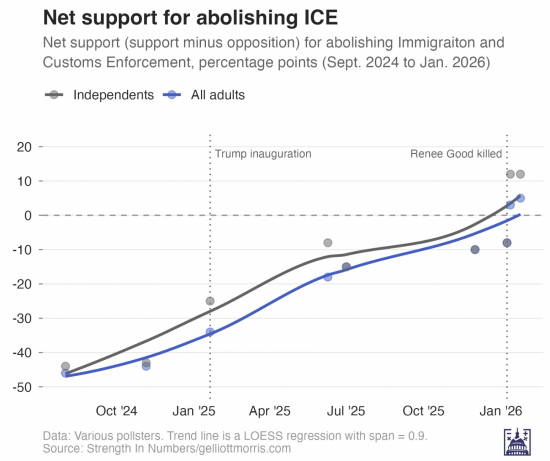
When Trump was elected in the autumn of 2024, there was strong support for ICE. The question was about support for its abolition, so a negative count indicates support. That support has now collapsed. Overall support for the abolition of ICE now exists. The shift in sentiment is near enough 50%, and as G. Elliott Morris notes, you have to go back to the Vietnam War era to find another shift in sentiment on government policy of this scale, and that took longer than this change in support for CE has.
Why is this relevant? Because I think what it shows is that support for politics based on anti-migration rhetoric works when there is no serious action to back it up, but when faced with the reality that real people suffer badly as a result of that policy, three things happen.
First, the opponents of the policy are emboldened to challenge it.
Second, they actually take action to defend civil and human rights, putting themselves in harm's way to achieve that goal if need be.
Third, faced with the reality of violence by the state, even the support of those who think they have a problem with migrants withers: they become disoriented and confused by what they witness, and see the conflict between what they have been told is acceptable to think and the reality of the violence required to deliver the policy they have supported.
I am not, of course, suggesting that all those who are racist or who support violent action to remove migrants change their minds on that issue: to do so would be absurd, because clearly that is not the case. What I am instead saying is that there are sufficient grounds to suggest that there is a substantial change in overall public sentiment on this issue, which, in turn, is reflected in considerable swings in political support for those proposing such policies.
The impact of this is real.
It shows that citizens' power to protest matters.
It shows that convictions around social justice can sway opinion.
It shows that compassion works.
But more than that, it exposes the flakiness of the narrative that those who seek power on the basis of racist rhetoric, and little else. When it becomes clear that a person's migrant status is not the issue, and that the reality is that the rhetoric is all about hate, and not about the reality of lives, contributions made, communities and care, then that hate can fall away.
What does that leave, in that case? The obvious question is: now that this has been exposed in the States and the reality that Trump is being forced to back down is clear, what now for Farage? What has he got to say on this issue now? And how will he seek to differentiate himself from what Trump is doing when all that he has promoted has come from the same policy, of creating race-based divisions to provide the pathway to power?
The answer is, of course, I cannot know. But to presume that there will be no consequence would be wrong. People will notice. The only questions are when, how, and with what consequence. But there is one thing we can be sure of, which is that Trump's actions do not sell Farage's narratives. And that means there might just be a silver lining from the violence and deaths that have needlessly happened. Others might just be saved as a result.
Thanks for reading this post.
You can share this post on social media of your choice by clicking these icons:
There are links to this blog's glossary in the above post that explain technical terms used in it. Follow them for more explanations.
You can subscribe to this blog's daily email here.
And if you would like to support this blog you can, here:

 Buy me a coffee!

The backlash in the U.K. is towards its effective “open borders” policy that’s why Reform are flying high. And you are wrong to call anyone who votes for them racist. It is not racist to control immigration. That is where you have lost the narrative and disconnect with the general public.
I have not lost the narrative.
Nor am I disconnected.
Of course there is economic anger as well – and justifiably, as I prove time and again.
But Reform is built on racism – the blame of others for the situation we are in. Please don’t make a fool of yourself by denying it. That is not possible.
“Of course there is economic anger as well – and justifiably, as I prove time and again.”
There is the disconnect. It is not economic anger that propels Reform it is the “open borders” policy on immigration. End of story,
Well, if it is not economic anger it can only be racism.
You rather destroy your own argument.
And there is no “open borders” polucy. Why do you want to lie about that?
There is summat else wrt tRump that won’t sell Fart-rage’s narratives:
https://www.politico.eu/article/donald-trump-florida-robert-fico-eu-summit-nato/
I don’t like Fico but it is now clear that tRump is going mad, literally.
Which leaves an open question: has labrokes opened a book as to when the men in white coats come and wheel him away. When, not if.
Conforting thought (not): this wazzock (tRump) has his finger on the red button.
I hope this is not too off topic – but basically we are talking about somebody that was always unblanced and is now basically mad. His racism was always foundational to his “character”,
I read that piece a few minutes ago.
It’s usefulness is it say what is true: Trump is mad, and that may be irreversible medically now.
US commentators are clear that the midterms will be marked by interference in pro Democrat areas on the excuse of emergency powers but that in any case the Senate is now powerless as the intention of Project 2025 to move to presidential control is nearly complete with the capture of the Supreme Court, DOJ, FBI and other arms of government.
Farage will claim that nothing like that could happen here but will not desist from his overall push to disparage immigrants and blame them for our economic woes. He is well supported by the Neo-Con network based in the US and Europe who will be coaching him on the way to deal with inconvenient news from the US.
Some will fall away but resentment always needs a target and Starmer is doing little to reduce the resentment caused by his failure make improvements in the lives of those constantly failed by our politicians. I would love to believe people’s eyes would be opened by Farage’s association with Trump but I fear reason is not the operating factor here.
Fortunately, I don’t think that’s true.
The House and Senate have been all too compliant. A conservative-leaning Supreme Court has set new precedent giving the President new powers.
But there are limits. The Supreme Court looks unwilling to side with Trump about his actions against the Federal Reserve, seemingly recognising partly that they may have gifted too much power to the President but also that if they continue then when a Democrat is next in power then their positions may be at risk. Naked self-interest may be the one piece that limits complete capitulation there.
Then there’s the Republicans that depend on the support of the NRA. They’re not going along with the narrative around ICE right now, so there are areas where they cannot back Trump.
The Epstein Transparency Act also showed that there can be a point where Republicans won’t side with Trump. And that hasn’t gone away, much as Trump has seemingly thrown various things forwards to get discussion away from it.
The threats to Greenland also proved to be a clear policy failure for Trump – Republican representatives again were heard to voice outright rejection of threats to take it by force, and Trump has had to back down.
Trump has moved faster from democracy to autocracy than historic examples, certainly, and apparently learned from the first administration that he needed to have sycophants in leadership roles who recognise their dependence on being in his good graces over competent people.
This may cause collapse, but ultimately Trump’s own health may be the end. As a cult of personality, it is the unthinking, unwavering support for Trump alone that’s keeping things together. JD Vance doesn’t have nearly the same support. If and when Trump dies or has sufficiently serious a medical event for the 25th Amendment to be invoked, then it’s hard to see Vance having the ability to keep going on the same path.
With the threat of a Trump-supported opposition in a primary, more Republicans in the House and Senate would be willing to object. Note that the Senate and House have really only failed to claim their authority over the Presidency in their designated areas – they haven’t been formally handed over. That would allow them to reclaim them as an when they regain their courage.
I find myself asking:
Reform are obsessed with regular news conferences, at which they are not challenged robustly enough by journalists. How can this be changed?
How can we most effectively challenge the Reform supporters we know (they come in many different flavours/demographic groups and often already realise that Fa***e is dodgy, “but we need to do something about …(insert yr prejudice here).”
If Fa***e has peaked too early, then at the same time as ensuring his fall, we have a more urgent but less obvious problem, of preventing the survival of the neoliberal status-quo, as represented by non-Reform mainstream parties – yet we need them to defeat Reform where Reform is strong. This problem looks different in the Celtic Fringe – but it is real there too.
I want PR and the public execution by hanging, drawing, & quartering, of “the household analogy”, as key commitments for 2029, along with as much “politics of care” as we can get in one general election (with the May local and devolved national elections a good opportunity to build local bases for promoting and challenging local candidates and party structures about their attitude to classic neoliberal shibboleths and their conversion to a politics of care.
Meanwhile, billions of £££s will be covertly spent via algorithms and party bungs to maintain the power of the already powerful and smear the opposition.
I’m thinking hard about social media and Richard’s challenge to get out there and do some evangelism.
I have a tune in my head, from Dad’s Army.
“Who do you think you are kidding Mr …..(insert name of party leader here), if you think old England’s done?” etc. One verse per target.
Someone needs to write it.
The critical factors regarding theUK’s racist policies is how the Daily Mail, GB News and Tufton Street stink tanks deal with Trump’s excesses, and how subtly they can still promote divisive rhetoric and distancing themselves from Washington.
The BBC colluding with the ‘all migrants come here in small boats’ by its daily announcements over two years of ‘how many boats today’. I saw a poll which suggested a majority of people think migrants all come on small boats and that migration is still going up despite it dropping like a stone.
And BBC does not ever ask even mildly of Farage whether he ever considers that his Brexit has cost £150bn GDP or whatever the latest estimate is .
The racist cancer has spread well beyond ReformUK – – leading Tories proclaim it – and Starmer/Mahmood seem happy to engage on Farage’s chosen ground.
Chris Packham tracing the history of Punk on R4 – had a good piece on how the music and demos helped to se off the BNP and NF (‘NF=No Fun’).
Much to agree with
There is a very nasty strain of English racism that is being stoked by the main stream media and deform.
Take the front page of today’s Times ” Fake jobs for sale to cheat system on migrant visas”.
With three large photographs of the alleged fixers, who surprise, surprise are non white.
Various quotes from worthies “prosecute”.
I suspect that the Home Office is not able to check the visas due to lack of staff. The staff are suffering from the latest mantra “do more with less”.
The UK has created the asylum mess all by itself but does not want to be seen to lose face by processing applications either in the country of origin or an adjoining state.
No steer, Rachel and the genius repeat ” we can’t afford it”. Rather than expanding state funding to improve health, education, sensible job creation to help the non elite 90% they are wilfully continuing austerity which continues to make the current situation worse.
Agreed the UK must change tack to a caring for all culture and associated spending or the UK faces a rapid decline into English fascism.
See the latest from the Home Secretary, in an interview with the great AI guru Blair, extolling how AI surveillance will control ” criminals” and as a by product the rest of us, following her police roll out of face recognition software that is know to be very biased.
On 22 October 1979 – when I was 16 – I saw the Two-Tone Tour at Exeter University with a bunch of friends, one of whom was the only black kid at my rural school in Devon. Interestingly, he never heard or was subjected to much (if anything) in the way of racist comments. The concert was inspirational and has stayed with me ever since. Whilst not perfect, we were a nice bunch of kids as sixth-form students and I’m not relying on rose-tinted spectacles.
Roll forward to a rugby match my 16-year old son played at Wiveliscombe in Somerset in 2013. Our hooker was a black kid and, much to our team’s horror, was subject to racist slurs and chanting right from the off – by the parent spectators in the main! To be fair to the retired army officer referee, he blew his whistle and threatened to award the match to our team if the appalling barracking continued. We were all really shocked – but the young lad merely said something like don’t worry about it, it happens all the time.
So, what changed in the 34 years between the two events? We can all guess, and I’m sure we will be right.
Thanks
Shocking
And too much like life experience for many, I suspect