
As the Guardian reported last night:
The price of gold has jumped above $5,000 an ounce for the first time as Donald Trump's chaotic policies and proclamations drive more investors to seek safe harbour in the precious metal.
Gold reached a record high of $5,100 (£3,723) on Monday morning, before easing back to settle up 2.2% at $5,091.
This marks a historic milestone driven by political volatility and economic fundamentals. So what is going on?
First, there is the Trump factor. The fact is that the gold rally follows a cascade of destabilising policy moves from Trump. The multiple moves, prevarications and (so far) retreats over Greenland, the military operation targeting Venezuelan President Nicolás Maduro, threats to the Federal Reserve, and more have all destabilised market sentiment. Mark Carney's description of Trump's moves as creating a geopolitical rupture has been noticed, not least because it was one thing that could be believed.
Second, there is the resulting flight to safety. The reality is that investors are, as a consequence, abandoning US and other government bonds, currencies, and maybe shares, and are currently viewing gold as a refuge from market chaos. This classic flight-to-safety pattern reflects deep uncertainty about global trade relationships and, in particular, the stability of US foreign policy.
Third, there are serious economic underpinnings to all this. Three issues amplify the gold rally. They are:
- A weakening dollar
- Inflation that might be running above expectations, and
- Potential Federal Reserve rate cuts.
In addition, speculation yesterday about US intervention to support the Japanese yen, which is showing signs of real volatility amid an election with unpredictable consequences, only added to the uncertainty, creating a febrile situation.
Fourth, the gold boom has been historic in scale, creating its own subnarrative. To contextualise this, what has been surprising is the speed and magnitude of what is happening. Gold has increased by 15% so far in 2026, following a 65% gain in 2025. Silver has also increased in value, surpassing $100 per ounce, underscoring broad-based demand for precious metals. This is unprecedented, as this chart from the Royal Mint on the gold price, expressed in sterling, shows:
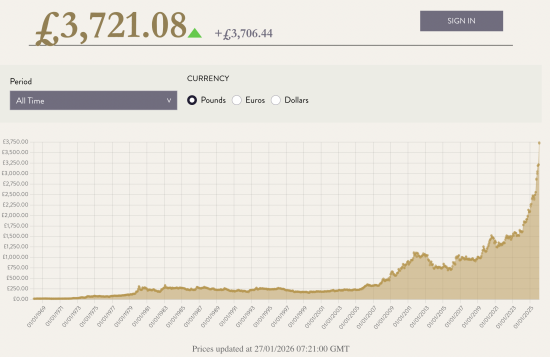
So what is happening? It's almost certainly fair to conclude that this is not merely a market fluctuation, but a confidence crisis. Investors are pricing in profound uncertainty about American policy coherence and global economic stability. This need not be a sign that the global recession is beginning, but the signs are not good. I have talked about a forthcoming crash for a long time. The financial markets seem to be sharing that sentiment now. The discomfort might very soon get much worse.
Thanks for reading this post.
You can share this post on social media of your choice by clicking these icons:
There are links to this blog's glossary in the above post that explain technical terms used in it. Follow them for more explanations.
You can subscribe to this blog's daily email here.
And if you would like to support this blog you can, here:

 Buy me a coffee!

[…] the second time this morning, I repeat my warning: the shocks of 2026 have hardly begun as yet. The financial crash has not yet […]
Hi Richard,
The story around precious metal trading often leaves me quite confused. Most online articles describe traders as ‘moving to safe assets’ amid market uncertainty. When I look back over time, the price of these metals also plummets during a financial crash. Additionally the variance in the price of some metals, like silver, appears to be very high and potentially higher than other normal commodities. I am struggling to understand why they are desribed as ‘safe’, what aspect of them makes them safe? I appreciate that the trades might be part of a larger collection of coupled trades designed to hedge their position.
Cheers Sammy
They aren’t safe.
In effect, some of them are near worthless, but for sentiment. But sentiment says they’re safe, so for a while they are, until they aren’t. There is no logic to this.
Q: If the meteoric rise in gold is caused by a flight from other assets, why is the US Stock Market close to all time highs and US Treasury yields reasonably stable? Surely, gold buyers must be selling something…. and if they are, who is buying it?
A: I don’t know.
… but here are a few thoughts.
First, for every buyer there must be a seller. If I am strongly motivated to buy 1oz of gold I have to find someone who owns 1 oz of gold and persuade them to part with it – and I do that by offering lots of money. Equally, I need to sell my US Treasury bond to someone (in order to have the cash to buy the gold) and to persuade someone to take it off my hands, I have to offer it cheaply. So, the amount of USTs or gold does not change…. but the price does. Gold up, USTs down.
Second, the gold market is small; half is jewelry – so not easily tradeable, a quarter is held by Central banks who do not quickly alter their gold holding policy. The US stock market and the US bond market are each twice the size of the total amount of gold in existence. So, a pretty small switch out of USTs or US Stocks may have little impact in those markets but an outsized impact in gold – as we are now seeing.
Third, if there has to be a buyer for every seller, how come everything goes up sometimes? If I buy a UST, I “sell” a dollar… and those dollars are being created at USD1.7trn a year by the government (the budget deficit, although this, less any QE, is mopped up by UST issuance) and private credit creation (bank lending). Ultimately, it is this process of credit creation/destruction that drives all markets from a macro perspective.
Third, if you bought gold at the peak in 1980 as a hedge against inflation it took 20 years to to reach that (nominal) price again and it was not until 2024 that you broke even on inflation adjusted terms. So, are we 1977 (av. gold price $150) or the 1980 peak of $850?
They are selling dollars.
Agreed re shares.
And there is evidence – I noted it here recently – that on paper silver exceeds physical inventory. I am sure that is true of gold. Physical settlement might not be possible right now. So, this is speculation over a tiny number of claims. But it has media impact. There need be no direct impact on much bigger indices but it still creates news.
My apologies for piggy-backing on this article but since it mentions Venezuela, I feel I must alert readers to a fascinating and important eye witness account posted by Craig Murray from Caracas, ‘Being there – in Venezuela’