
I was at Welney today.
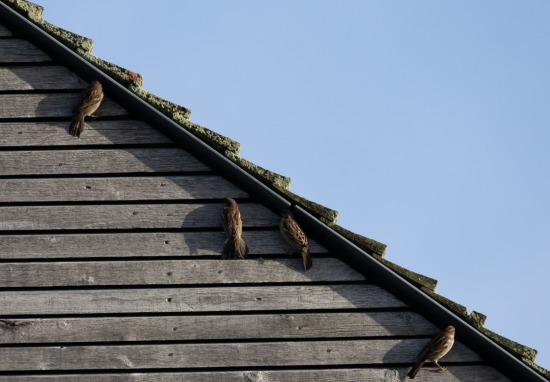
These were some of the hundreds of sparrows who literally cling to the visitor centre at the reserve at this time of the year. Most are house sparrows, but there are also tree sparrows.
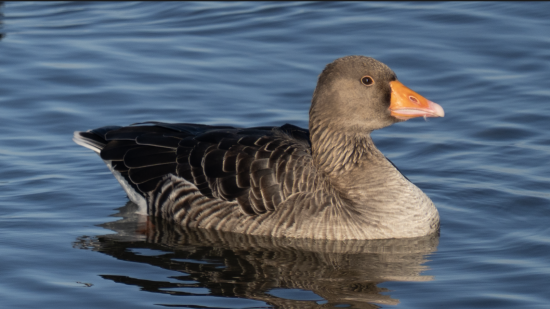
Much of the site is currently flooded: it is on the Ouse Washes, which are designed to hold winter floodwaters. This greylag goose was unfussed:
The greylags did not have the goose interest to themselves alone. The back two here are the very much rarer Eurasian white-fronted goose, whiuch summer in the Russian Arctic tundra. These were the stars of the day.
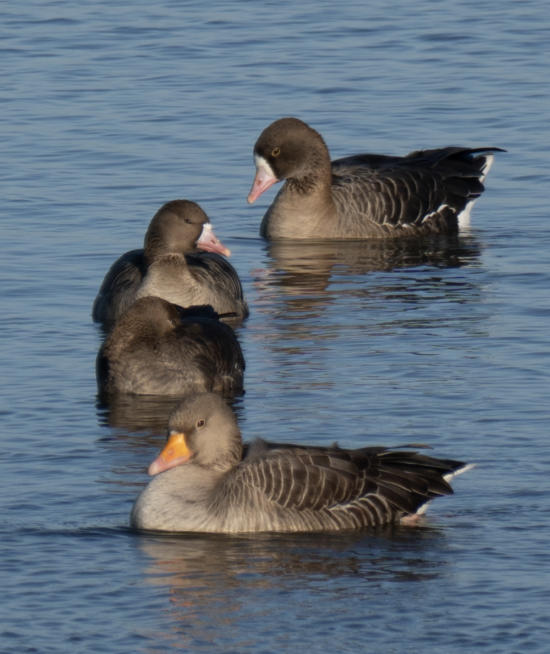
The Greenland variety has a much more orange bill. I admit the photo has been enlarged as much as I can push it.
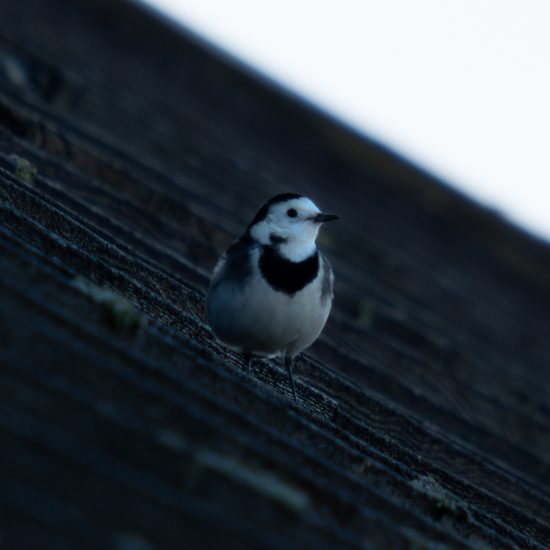
But the moodiest picture of the day was by Thomas, who joined me this morning. This is a pied wagtail on the roof of the visitor centre, taken from the bridge that permits access to the main observatory:
Time was well spent, I think.
Thanks for reading this post.
You can share this post on social media of your choice by clicking these icons:
There are links to this blog's glossary in the above post that explain technical terms used in it. Follow them for more explanations.
You can subscribe to this blog's daily email here.
And if you would like to support this blog you can, here:

 Buy me a coffee!

Time birding is always time well spent. I had a great day just looking in the garden and saw, amazingly, 5 tree sparrows in a bush. Once in a blue moon in a garden like ours. Simply lovely.
I like them, a lot.
It still astonishes me to think of the hundreds of house sparrows that used to surround us in our streets, yards and gardens in the 1950s and 1960s. Today, in the north of England, they genuinely are a rarity. Over the border in Scotland, as far as I can see, it seems to be business as usual for sparrows. Very odd…
That said, for the last two years, a pair of sparrows have nested in the same place under the east-facing eaves of our 115 year-old house. The slates and gutters are regularly checked so I’m not sure how they manage to go in and out. Stranger still, I think they may be tree sparrows. We are surrounded by thousands of trees in our neighbourhood, thanks to the gallant efforts of Washington Development Corporation in the 1970s, but the one sparrow I got a really close look at last year, near one of our windows, had remarkably russet brown head feathers. Of course, it may not have been one of my “lodgers” but I’m pretty sure that particular bird was far too clean-looking to be a house sparrow. But then, why would a tree sparrow not take advantage of all those nearby trees?
I’m going to get the binoculars (and camera, Richard) ready this year, to double check. Another thing, they only seemed to raise one lot of young last summer. Thinking about it, I hope that pesky sparrowhawk wasn’t responsible for that!
Thabnks, John. Good luck with them. And if you see a tree sparrow – enjoy it. They are definitely rare now.
Lovely photos; time well spent indeed.
Yes, time well spent. Even if you don’t feel the immediate benefits. There’s something about open water that always calms the spirit
I miss sparrows. When I was a kid you’d leave the house in the morning and they were swarming all over the pavements. Parting like the Red Sea to let you through. At that time I think the law classified them as vermin.