
These are two related headlines from the FT, both from yesterday. Start with this:

Then, note this:
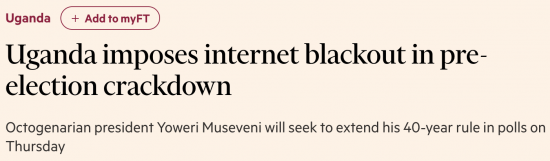
There is no coincidence here, at all, of course. When draconian politics wants to suppress debate, it has a new weapon to do so, and one that is immediately effective. It just turns off the internet, and the whole population affected is discombobulated as a result.
Let's be candid: that would be the consequence here, and let's not pretend it could not happen, because it very obviously could.
Do we need to worry about a world in which that might happen, and how we could communicate in that case, not least when traditional telecommunication networks have, very conveniently, disappeared? I am not listing it as a high priority right now. I am noting it as an issue. How could we communicate in that case?
Thanks for reading this post.
You can share this post on social media of your choice by clicking these icons:
There are links to this blog's glossary in the above post that explain technical terms used in it. Follow them for more explanations.
You can subscribe to this blog's daily email here.
And if you would like to support this blog you can, here:

 Buy me a coffee!

Add to that of course ‘Satnav’
There is so much that is dependant on the US controlled GPS there is GLONASS but thats Russian & I am not sure what the current situation is with Galileo the EU system.
This is of course a ‘defence’ issue & there are also a variety of natural and human risks to satellite based systems
All the ‘land based’ electronic systems – Loran & Decca have been turned off
When my son was playing in a children’s football club, we had a telephone tree – if match details changed or there was a cancellation, we had two people to ring. We had the whole tree printed out, so if someone didn’t answer, you skipped over and rang their two people too. Losing group chat and online networks reduces speed and reach considerably, but other networks are possible. But not speedy. And businesses would grind to a halt, unless they had their own systems. Radio hams? What is star link? The satellites are still there, it’s the equipment…
I am sure historians have much to tell us- and before the internet, the lapel badge was much in evidence, telling us something about a person before we engaged in conversation.
I have of course quills, ink and paper, plus a few pigeons of course…. but has Denmark’s state postal service not just recently stopped delivering letters? Only parcels now…
It is something to consider, your question. It would be hard to restore contact quickly if the internet was disrupted.
Star link is Musk’s satellite internet service.
In Sweden, most local data comms networks are owned by local gov. Services, including internet, can have access to the firbre. Local gov, having local control, with local info servers, gets partly around the problem of national control. The point of TCP/IP is that if one node goes down, others can handle the traffic. The service “Pirate Bay” also illustrates how data (in this case films, software etc) can be distributed in the teeth of opposition by most governments. Local control of local wires is the 1st step. Then maximally distributed services, DNS etc. It is doable but goes against the current trend: everybody has a google e-mail address etc. (the “security services” would of course go bonkers & probably haul up the “what about the paedophiles” flag – well quite – ……remind me how things are going with Twitter/X & Grok).
Do we need to worry about a world in which that might happen?
Well, I came aceoss this a while back – it has been under serious discussion in Europe.
Trump can pull the plug on the internet, and Europe can’t do anything about it.
The fatal vulnerability is Europe’s near-total dependency on U.S. cloud providers.
https://www.politico.eu/article/donald-trump-eu-internet-europe-us-trade-war-data-cyber/
How much it applies to UK? I suspect it does.
I think a full internet switch off in the UK would be too disruptive for the government to consider. Were effectively a cashless society and every cash machine and every card reader works online.
It’s not just personal communication is business, commerce, logistics everything.
But a limited shutdown or heavy restriction could be done.
“…not least when traditional telecommunication networks have, very conveniently, disappeared…”.
I’m quite sure the means existed to make those traditional networks “turn off” whenever the government wanted – perhaps in those days it would have been unimaginable for them to want or need or dare to do it, but I’m sure the means existed. And it was certainly trivial to listen to conversations then – unencrypted analogue lines. Nowadays encryption is much more prevalent.
As for “they can just turn it off” – which part of it is in the governments hands? Isn’t everything effectively in private corporate hands? Surely the operators at either the ISP or Openreach level would just go to court?
I am sure the powers exist. Covid regulation allowed just about anything.
Given the shite that I see on the internet, I’d love it to be closed down.
Give me a good old fashioned landline any day of the week, and a real person at the end of it, some stamps and writing paper too.
Our dependence on the internet does now leave us very vulnerable to attacks but we have an even greater dependence on the electricity supply. If this is compromised all our services will quickly come to a stop – banking, food shopping, transport, telephones, heating and, of course, the internet.
Recent winter storms have given us a taste of this here in Devon.
The military/industrial complex demands greater spending on bombs, aircraft carriers and extra troops but all we need to do is turn off the electricity.
Good point RJP, lots of damage to energy infrastructure in Russian war on Ukraine, for eg. But if govt wants to, or is leaned on, switches can be thrown. I think Richard’s advice to get a few tins and some oil in the cupboard is sound. But people my generation never have a bare cupboard.
We have a store cupboard. We like to eat fresh, but basics never go amiss.
Yes, and there are many adversaries eyeing up our critical infrastructure. Still, I’m sure we’re doing the same to them…