
I posted this on Twitter (X) last night:
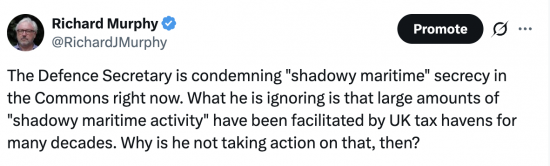
I posted after listening to John Healey MP, our defence secretary, talking in the House of Commons. He was, of course, referring to the tanker that had been renamed and reregistered this week when sailing, without a cargo, from the Caribbean to Russia, and which was boarded by US troops, apparently airlifted from UK bases yesterday, with the active support of UK naval forces.
I question the validity of that action: it looks very like piracy to me. The ship was sailing in international waters when seized. The intention of the seizure appears to be to bring the crew to trial in the USA for sanctions breaking. If that was happening, I would condemn the crime, but the arrests and seizure of the vessel still appear to lack conformity with international law. The US attitude now appears to be that anyone can be arrested anywhere by them, and the UK appears to be endorsing that view by supporting that operation. I wonder what will happen when others apply that logic? The obvious question to ask is whether the right the US claims is peculiar to them, in which case it is not international law but organised thuggery and law breaking that is in operation, or whether it is universal, in which case, is anyone now safe?
Let me, however, return to the subject of my tweet. It has been well known for decades, and was documented by me in my 2010 book on tax havens, that essentially disposable tax haven companies, enjoying significant levels of opacity as to their operations, ownership and control, are widely used in shipping to limt the information available on the identity of those managing more marginal shipping fleets of vesels used for santion busting and other illict trades. The call for accountability on this issue has been going on for a long time, requiring proper corporate identities with open registers of beneficial ownerships and officers, as well as proper accounts on public record, but although the UK has the power to enforce this requirement in its Overseas Territories and the Crown Dependencies, in none of which are such things properly available, nothing is really happening to effect the required levels of openness.
If anyone wants to know why "shadowy maritime activity" is happening, it is because successive UK governments have facilitated it. We are to blame.
John Healey should acknowledge his guilt by association at the very least. And then it is time we closed such opportunities. Pigs might, however, fly of their own volition before that happens.
Comments
When commenting, please take note of this blog's comment policy, which is available here. Contravening this policy will result in comments being deleted before or after initial publication at the editor's sole discretion and without explanation being required or offered.
Thanks for reading this post.
You can share this post on social media of your choice by clicking these icons:
There are links to this blog's glossary in the above post that explain technical terms used in it. Follow them for more explanations.
You can subscribe to this blog's daily email here.
And if you would like to support this blog you can, here:

 Buy me a coffee!

Well said.
Honestly, the lack of self awareness…………………
False flagging has a lengthy history. Britain used to have the world’s largest merchant fleet. I remember my father, who was a ships chandler, observing in the 1960s that the dwindling number of British vessels he was supplying was because increasing numbers were now Liberian flagged. This he explained was because there were tax advantages in doing so.
There were tax advantages
And ones of secrecy too
… and England has had ‘form’ for centuries as plunderers and pirates, methinks. Oh yes, and empire too.
and Panamanian. Both Liberia and Panama use the US dollar alongside a local currency. Michael Hudson has explained why this is. It is where the profit is made in the trading of oil.
Richard,
Given your interest in Accountancy came from The Railways I am sure you would find Shipping just as fascinating. It seems that as soon as Limited Liability Companies could be set up in the UK there were an awful lot of ‘single ship’ companies – think SS Rustbucket Ltd and thats before you get to the difference between the inter war LMS Caledonian Steam Packet fleet and its ‘Directly Owned’ ships from what was the Glasgow and South Western fleet.
Anyway Car Number Plates have been in the news recently and quite frankly its a similar issue with usually ‘low value’ bulk ships being registered all over the place with few checks and safety certificates being issued by Classification Societies not Governments who are in competition to get business. Then of course there is a question of ‘Port State’ inspection so of the SS Rustbucket calls in at Lowestoft will the MCA (In the UK) check its seaworthy? If it calls in Ruritania then they may well not have the ability and/or inclination.
Then of course you can have the sailing round our coasts even of they dont call carrying all manner of potentially hazardous cargo’s or of course dragging their anchors through all manner of undersea cables pipelines etc………
Thanks.
Noted, and much to agree.
Thanks for another fog clearing observation. With regard to our contemptible tax haven economy… I have been listening to Starmer talking about giving the money from the sale of Chelsea football club to Ukraine. I think there is a lot more Russian money in Europe that some politicians there want to use for Ukraine? Does that seem like a good idea or are there reasons to be wary of this as another ‘decay’ of a rules based order? Could it greenlight politically motivated asset seizures from inconveniently uncooperative weaker countries in future? Maybe we already do that… Additionally though, is there likely to be much more Russian money in the tax havens the UK continues to condone and shelter than in the visible UK economy? Do such seizures therefore represent a performative type of moralistic asset seizure rather than a genuine attack on shady money of all kinds and Russian money in particular in this instance? Or is such a seizure still a constructive democratic assertion of sovereignty over finance? I find myself with mixed feelings even though this strikes me as extremely important. It would be wonderful if the ‘shadow fleet’ question really could be turned into the the ‘shadow banking’ question in public discourse. Could we find common cause with progressive American politicians and American citizens here? I think I remember reading in a book about Bretton Woods that the US used to be very angry about British secret/shady banking practices?
Your ambivalence is justified. Seizing sanctioned Russian assets may be defensible, but selective, highly visible actions risk becoming performative if the wider tax-haven and shadow-banking system remains untouched. That weakens the rule-based order rather than strengthening it. The real democratic issue is consistency: sovereignty over finance means tackling all illicit and hidden capital, not just politically convenient targets. Turning “shadow fleets” into a public debate about shadow banking could create real common cause, including with progressive voices in the US.
What your post really exposes, Richard, is that “shadowy maritime activity” isn’t an accident of the high seas — it’s the predictable outcome of an institutional architecture built to make opacity profitable. Flags of convenience, single‑ship companies, beneficial‑ownership secrecy, and the UK’s tolerance of offshore jurisdictions all serve the same purpose: to create a zone where accountability cannot reach.
Once that infrastructure exists, it will be used for whatever activity most benefits from invisibility — sanctions evasion, tax avoidance, labour exploitation, environmental shortcuts, or simply the ability to walk away from liability when something goes wrong. The sea just happens to be the place where the incentives are most concentrated.
That’s why the legality of the US action matters less than the underlying system that made the ship untraceable in the first place. If we build a global framework that rewards opacity, we shouldn’t be surprised when states start acting unilaterally in the vacuum it creates. The real solution isn’t more naval drama; it’s dismantling the secrecy structures that make “shadowy” activity possible at all.
Until the UK confronts the role of its own corporate and offshore regimes, we will keep seeing these crises play out — and we will keep pretending they are maritime problems rather than governance problems.
There’s an important distinction to be made between internationally applicable UN Sanctions, and nationally applicable US sanctions. The latter only has legal force in US territories and coastal waters. However the US is pulling its usual trick of applying its national sanctions globally. It has no legal right to do this. These recent actions constitute piracy. And UK is a participant in these piratical acts.
There are no UN Sanctions on Russia. After all Russia would veto any put to UNSC.
Our media are also complicit in this piracy by never reporting whether the sanctions they go on about are UN or US, or making clear the distinction between the two.
Noted.
Very good point.