
Yesterday was the solstice, and after a couple of days of brilliant light, it was a bit dull, with a light northerly wind, which did not stop us getting out birdwatching at WWT Welney, our most regular spot at present.
One pleasure of knowing the place quite well is being able to explain it to others, who are usually keen to learn what they are looking at.
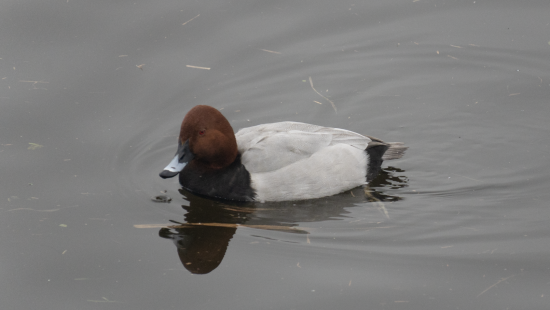
Yesterday, the most obvious duck to be seen was the pochard, which is nationally on the red list as an endangered bird, but of which Welney has large numbers in winter. This is the male:
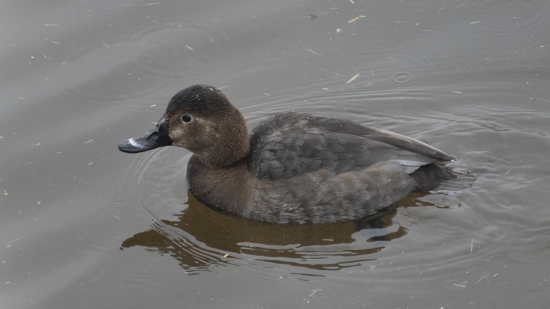
And this is the duller female, who are much less often seen, as most of them winter in Spain, returning to the breeding grounds only after the males have built several nests to impress them, meaning the males do not migrate so far, so they can get back earlier:
And then, as is one of the pleasures of birdwatching, you search through several hundred birds and find an oddity, like this:
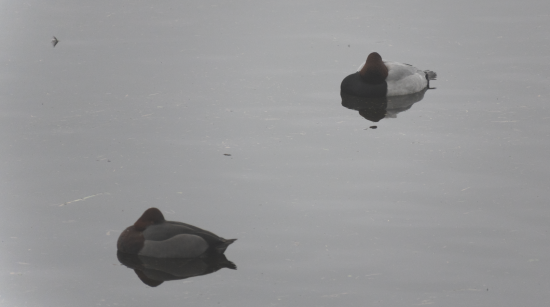
I know it's not a great shot, but what looks like a pochard in front is not what it seems, as is apparent when comparing it with the similarly posed male behind it. It is actually a male cross between a pochard and a ferruginous duck, which is very much browner, hence the odd colouring. It was fun to point that one out.
It was not all ducks, though. Walking to the north of the reserve, there was this male stonechat:
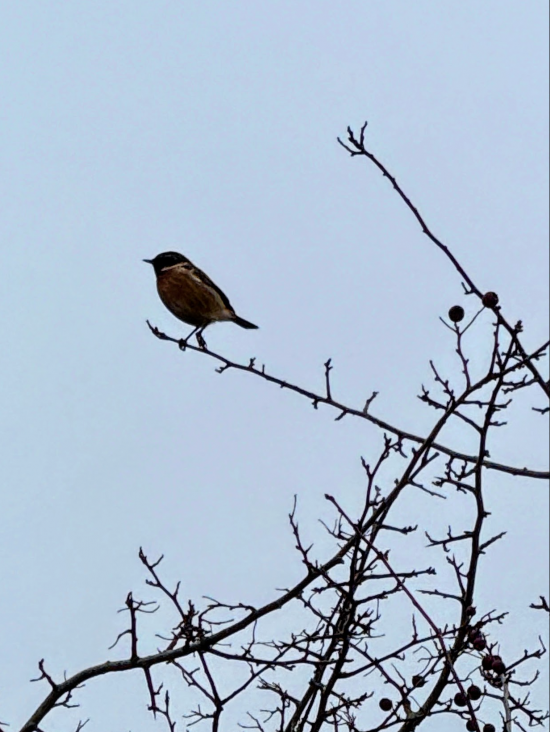
They are almost always seen in pairs, and we saw the female on Saturday, but yesterday, only the male put in an appearance, posed as usual near the top of a tree, but it still took me by surprise, so that was a phone shot.
Time spent birdwatching is when I am most relaxed, and when many ideas also emerge. I admit having Welney nearby is a real privilege, as is knowing the place quite well, and enjoying the company of many of the people who make the place work, the coffee shop included.
Comments
When commenting, please take note of this blog's comment policy, which is available here. Contravening this policy will result in comments being deleted before or after initial publication at the editor's sole discretion and without explanation being required or offered.
Thanks for reading this post.
You can share this post on social media of your choice by clicking these icons:
There are links to this blog's glossary in the above post that explain technical terms used in it. Follow them for more explanations.
You can subscribe to this blog's daily email here.
And if you would like to support this blog you can, here:

 Buy me a coffee!

Yesterday I watched the live stream from Newgrange in Ireland. It is just over 5000 years old, older than the Pyramids and Stonehenge. It is large construction and on the winter solstice the rays of rising sun penetrate to the inner chamber.
The people of that time put in a lot of time and labour to construct it. It may have been useful for timing planting but that could be done more easily. They did it because they saw themselves as part of the universe and that they had a place in it. It was something, no doubt, that involved the whole community.
Life had a significance beyond having enough cattle, food, fuel and firewood etc
It is an affirmation of what it means to be human. It was a rejection of pleoexia. Our ancestors knew a thing or two.
Have you been?
It is spectacular.
unfortunately not.
I took school parties to West Kennet and Stonehenge in the 1970s.
And in Jersey we have la Hogue Bie which is even older. I was there a few years ago. One has bend over to walk into it. It didn’t seem so long when I was younger!
I’ve been watching lesser black backed gulls recently. They suddenly arrived about a month after we got back from Bwlchtocyn. So I assume they are winter migrants. I love seeing them on a very windy day, they really look as if they’re enjoying riding the wind and going with the gusts! And while they may be “lesser” they’re really HUGE birds. Apparently the greater black backed gulls have pink leg. The lesser’s legs are yellow.
Seen fewer magpies than usual – just a singleton most days at present. One for sorrow – hope not! They’re very agile birds, been watching them landing on the vertical pebble dash on a house across the road, and pecking upwards under the roof guttering. Perhaps to feed on spiders?
Yesterday I spotted a wonderful skein of geese, headed in the direction of Sefton Park Lake. Husband saw them there later when he went for a walk. There’s a cafe by the lake, and the birds congregate around it (especially pigeons), hoping for scraps.
Only other interesting wildlife I see from my eyrie is a squirrel who comes and climbs to the tippy top of a tree. Then comes down face forward – looks pretty scary to me, good thing I’m not a squirrel!
Looking forward to seeing the sparrows coming to feed their babes under the rooves of the next door houses. Apparently they mate for life, and come back to the same nests every year. I do love sparrows – my mum used to read me a story about one called Chippybobby who travelled to Africa with his friend Swallow, and made friends with a hippopotamus! Tears when he said goodbye to Hippo, as he’d never fly that far again.
Misty moisty day here so far in Liverpool. Can just make out The Wirral across the Mersey, but can’t see Wales at all. On clear days I can see the A55 coast road, and on very clear days can see all the way to Snowdon.
Thanks for the update Maggie.
I hope you have a good Christmas.
Thank you for the birds, and thanks for the mention of the livestream, which I have found, and will play next year if I remember 🙂
I enjoyed the Newgrange video, there is clearly much to see in the Boyle area. I expected to see the finger of sunlight move across the floor, so I think they didn’t get enough sun for a livestream. I shall seek it out next year.