
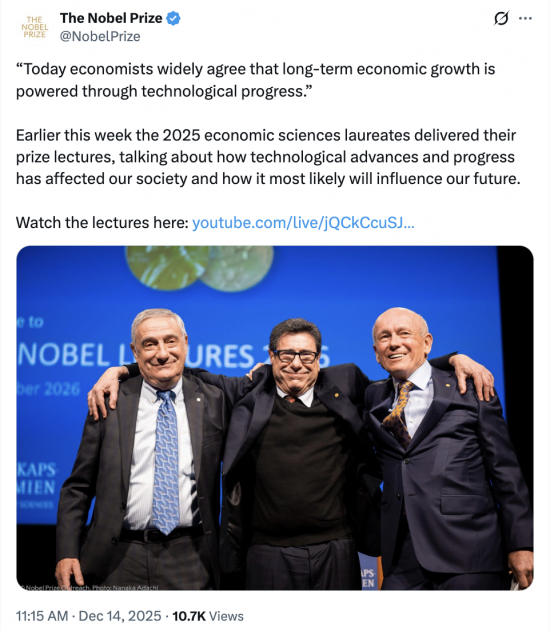
The Nobel Prize Committee has posted this on Twitter (X):
So here are my questions:
- Has technological growth run its course, then, as growth clearly has?
- How could growth do anything but run out on a finite planet?
- Doesn't growth depend on the equitable distribution of the gains from growth?
- Has there been an equitable sharing of gains from growth of late?
- If not, what are the consequences?
- How are those consequences addressed?
- What happens if growth:
- is intended to destroy jobs?
- does actually destroy jobs?
- denies resources such as water and power to those who will be left in absolute need as a result?
- threatens the future viability of life on much of Earth, at the very least?
Answering those questions could be worth a Nobel prize.
Suggesting “Today economists widely agree that long-term economic growth is powered through technological progress” looks horribly like another dud Nobel prize to me.
Comments
When commenting, please take note of this blog's comment policy, which is available here. Contravening this policy will result in comments being deleted before or after initial publication at the editor's sole discretion and without explanation being required or offered.
Thanks for reading this post.
You can share this post on social media of your choice by clicking these icons:
There are links to this blog's glossary in the above post that explain technical terms used in it. Follow them for more explanations.
You can subscribe to this blog's daily email here.
And if you would like to support this blog you can, here:

 Buy me a coffee!

That reminds me of Exodus Ch 5, when the Egyptians, under Pharaoh’s direction, upped the brick production quota required from their Israeli slave force, but stopped supplying them with straw, meaning that much of their working day was spent trying to find straw rather than making bricks.
Pyramid growth stalled.
Pharaoh, like modern economists wasn’t open to reason.
It’s worth remembering that he, according to the story, soon came to a watery end, as the Israeli work force started a 40yr long hike around the Sinai desert.
The field of economics has always been an attempt to justify the unjustifiable.
We need to move from a system of competition & exchange logic to one of cooperation & mutual aid.
technology, including AI, is already destroying jobs. There are many people, especially amongst the young, who are highly qualified, who want to work in a meaningful job, but who cannot find appropriate employment – such a sad waste of talent. Do you believe that any of these science laureates could (or would) answer your questions?
I doubt it….
I could….
exactly!
“especially amongst the young, who are highly qualified, who want to work in a meaningful job”
In truth, if they were replaced by current AI then the jobs were not that meaningful, often, entry-level professional jobs doing what their more experienced colleagues think of as donkey work and don’t want to. However, if all their entry-level professional jobs are replaced by AI, then where will they get future experienced staff from? They probably need to rethink the nature of their graduate entry jobs for their own benefit, if nothing else.
Robert B I don’t disagree on replacement of entry level graduate jobs, but I do on the others. It’s not all about graduates. No-one should have to do ‘donkey work’ for a long time if they don’t want to. But starting as a tea boy has disappeared as an entry level job for someone with few qualifications ( for whatever reason) and in an enlightened environment, that person can find out if they like the company, and the employer can find out what makes the young person tick. I’ve also worked with people who need a stress-free job that doesn’t demand too much of them. I’m getting that way myself – took the ‘mum route’ and could not get back into my old line of work. The problem with the admin and similar is that they heap too much on you, and say you must multi-task. That’s why I moved to care work.
The pay of course, in all these jobs, is poor. Would that the government would subsidise pay for jobs needed by those who work for small businesses supplying local services, who want to employ people, and stop subsidising jobs in big corporations who are planning how to reduce their workforce.
Thanks.
Wise.
The way growth is measured- usually GDP- is arguably the worst possible way to do it since it only considers economic output or the income produced from that output. That is tradition, not common sense.
For many years, various people, economists and other organisations have suggested using other factors such as living standards, income distribution and quality of life. These may be more difficult to quantify than GDP alone, but they are surely more indicative of our growth as a nation of contented citizens.
What’s it all about anyway? No use having increased output, if it isn’t fairly shared out. In that case, more growth might mean more misery for most and happiness for a fortunate minority.
I’m fairly sure this subject has been well covered here over the years with due scepticism towards growth as increase in GDP only.
Look at the glossary on GDP.
Thanks
all changed withthe industrial revolution. It is now the IT revolution, You haveto fit .simple Your skills have to fit
I wonder if an IgNoble might be more appropriate
https://en.wikipedia.org/wiki/List_of_Ig_Nobel_Prize_winners
My favourite is at the bottom of the list of 1996 winners
Take something as well known as the Haber process which consumes enormous amounts of energy to make the nitrogen based fertilisers which account for an estimated one half the world’s population being alive and living a life longer than ever to boot.
Now imagine a brilliant UK engineer coming up with a way to make the same amount of fertiliser using half the energy, or using free intermittent energy – the Nobel winners mentioned above would say well done to that lad.
Would you also say ‘what an achievement’?
That would depend on the environmental impact.
Or, you could try sustainable methods that work (that are not focused on agri profits):
Improved soil techniques focus on increasing organic matter, reducing disturbance, and diversifying crops, using methods like cover cropping, crop rotation, no-till/low-tillage, composting/manure application, and mulching, to build soil health, retain water, prevent erosion, and enhance fertility naturally, often combined with tech like soil sensors and targeted irrigation.
My view is that this is just another bunch of economists going way beyond their brief.
I mean – who did not know that? Of course human beings have increased their technological know how over the years.
What this announcement does is state the bleeding obvious only to make the arrival of AI for example look like any other advancement human beings have created.
But the truth of the matter is that AI and the tech that drives social media etc., is much more potentially dangerous than anything before it. It is dangerous towards making a living; to democracy; to privacy and is in the hands of too few people.
This post is nothing other than reactionary in my view because it paints technology as inevitable without worrying too much about who owns it and to what use do they put it.
Long ago I was involved in a programme at MIT looking at the impact of technology on organisations. This was in the late 80s. The fundamental conclusion was that the real advances come from changes to how work is done, people’s’ skills and roles, and organisation which technology might enable. So get everything else right first before applying technology. Just throwing tech at the problem can make things worse, as numerous failed IT projects confirm. (Been there, done that).
Famously Toyota transformed auto manufacturing by getting the right balance between what people could do best and tech. Notably they pushed a lot of power and autonomy to people on the line. Meanwhile GM were convinced they could get rid of people and just have robots, and failed dismally. They have never caught up..
Economists know next to nothing about how real organisations work and how work is done in practice. Those OBR productivity figures are pure fiction.
Technological growth has stalled, in my opinion. Tech companies just sell us products created by the public sector in the last century, with the only innovation being that they are locked down behind paywalls and copyright laws. Finance has eaten progress, pulling in talent that could be more beneficial elsewhere. We can’t even maintain our infrastructure, as it has become a rentier source for some landlord or another. No new reservoirs since the 1970’s, power stations being used long past their lifespans, every last drop of profit squeezed until collapse, with the debris handed back to the public.
A wonderful new machine does the jobs of 100 workers.
The 100 workers are “let go”.
The owner of the machine gets the wages of the 100 workers for himself.
100 more workers are left to compete for 100 fewer jobs, helping drive down wages.
Technology as a perfect driver of inequality.
Better still, invisible to conventional economics.
Second order effects Michael.
Your scenario only applies to the first owner of the machine.