
Yesterday's video on 12 questions on MMT had a poll linked to it, which was not reproduced on this blog (my mistake).
This was the poll and the results:
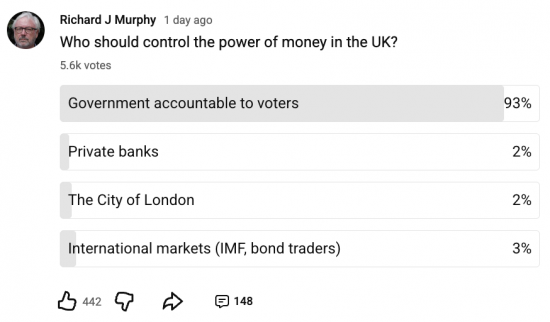 I know all the arguments about this not being representative, and that the questions are not comprehensive, but I do think that the massive vote in favour of government control is surprising and suggests that there would be considerable enthusiasm for any political party that:
- Suggested state control of the Bank of England
- Limited the power of private banks
At the very least, there is an appetite for reform. Any politician ignoring that would be making a serious mistake: people want democratic control of the City and money. And why shouldn't they? After all, money creation is one of the reserved powers of the state. It should exercise it better.
Comments
When commenting, please take note of this blog's comment policy, which is available here. Contravening this policy will result in comments being deleted before or after initial publication at the editor's sole discretion and without explanation being required or offered.s
Thanks for reading this post.
You can share this post on social media of your choice by clicking these icons:
There are links to this blog's glossary in the above post that explain technical terms used in it. Follow them for more explanations.
You can subscribe to this blog's daily email here.
And if you would like to support this blog you can, here:

 Buy me a coffee!

Given the gov’ owns the BoE, it has de-facto control – but makes a bit of a fan-dance pretending the BoE is “independent” (“cos after all we can’t upset the bond markets can we?”). Given the de-facto stuff, how to ensure that BoE and gov’ work in the interests of UK citizens, not the City of London. This begs the question – who should sit on the board of the BoE? It also begs the question on its meetings with City orgs. Idea – why not make “catch-up meetings with the likes of Goldman Sachs” public and televised – what’s not to like?
🙂
Only sanitised versions of meetings made available?
Democracy and capitalism are incompatible.
“The bottom line is that while Friedman’s economic model is capable of being partially imposed under democracy, authoritarian conditions are required for the implementation of its true vision. For economic shock therapy to be applied without restraint—as it was in Chile in the seventies, China in the late eighties, Russia
in the nineties and the U.S. after September 11, 2001—some sort of additional major collective trauma has always been required, one that either temporarily suspended democratic practices or blocked them entirely”.
Source: The Shock Doctrine: The Rise of Disaster Capitalism by Naomi Klein
https://amzn.eu/d/fAmspcx
But capitalism is not Friedman alone, or economic shock doctrine, per se
Accepted.
Easiest to see that human beings have Communitarian (state) and Libertarian (market) sides to their natures and these need to be carefully balanced.
In regard to democratic control over money I’ve just started reading the book “Imperialism” by J. A. Hobson and in his Introduction he quotes Cecil Rhodes as follows:-
“My cherished idea is a solution for the social problem, i.e. in order to save the 40,000,000 inhabitants of the United Kingdom from a bloody civil war, we colonial statesmen must acquire new lands to settle the surplus population, to provide new markets for the goods produced by them in the factories and mines … if you want to avoid civil war, you must become imperialists.”
Ghastly
Indeed!
The need for markets or die , was a view widely held in the US, Germany and in other parts of Europe , and Japan.
Lenin thought Imperialism was the highest stage of capitalism.
It has a lot to answer for.
In defence of Grace Blakely this is what she advocated in her 2019 book “Stolen”.
And I advocated it in 2008. So?
So you seem to have something in common. If you have seen the film “Nae Pasaran” then you can see why the “class struggle” narrative has not lost its relevance. It was shown on BBC Scotland last night. I watched it again having first seen it when first released a few years ago. Its a story of the violent crushing of democracy by powerful elites and of the power of solidarity – the Chile story
This is getting boring, Jim.
This is not a releavnt political narrative that is in any way useful in the UK at present. If you think it is, you need to go elsewhere and play with thsoe who seek politial purity but who are terrified of delivering realchange.
I deal with what will create change. End of debate.
So why does she downgrade the importance of MMT when clearly it points out that “money creation is one of the reserved powers of the state” to quote Richard?
In a recent appearance on the Alistair Campbell/Rory Stewart YT channel ‘The Rest is Politics’, Zack Polanski touched on the issue of democratic control of the money supply when talking about government debt and challenging orthodox fiscal constraints: https://www.youtube.com/watch?v=_DC2MHOiUf0
As far as I am aware he is the only UK politician currently making anything like arguments in support of MMT in the public arena. In doing so he is bravely attempting to change the narrative about public spending and the money supply, arguing for bringing financial sovereignty back to democratic government rather than letting the bond markets or conventional fiscal rules dictate public spending. However, in this video I think it is fair to say that he struggled to always make coherent points in the face of a barrage of the usual neoliberal nonsense. What should he have said to best challenge the dominant paradigm in a high pressure interview scenario such as this?
I think I have written that maybe 1,000 times here.
Why not look at yesterday’s video?
I did! And having followed your blog for many years, I have no doubt seen your thoughts on this a 1000 times. That last sentence was intended as a rhetorical, self-reflective question. What was interesting about the response to that interview (several other channels analysed it) was how it prompted a lot of discussion about how such ideas could be more effectively aired in public debate. Not just by Zack but, putting ourselves in his shoes, what would we say if we found ourselves trying to promote or defend sane economics? Not everyone (including, on the evidence of that interview, Zack Polanski) has all the right things to say on the tip of their tongue, however much they may support an idea in theory.
Why also does Grace Blakely think China, a Marxist state, encouraged the development of market capitalism there?
It didn’t – China made a transition from a centrally planned economy to a state directed mixed economy – it isn’t appropriate to describe that as “market capitalism”.
I think this is a conversation that has run its course here.
One of the biggest assemblers of iphones in China is FoxConn otherwise known as the Tawainese company Hon Hai Precision Industry Co., Ltd. You can buy shares in this company. By your twisted logic Jim Osborne this, however, is nothing to do with market capitalism! As Richard says we’re done!
Yes indeed – democratic control.
But ‘Democratic control’ is becoming quite problematic – given the manifest weakness of constitutional safeguards against capture of democratic institutions by powerful vested interests. Political parties taken over by illegally , (and sometimes foreign) funded factions, and with main information sources controlled by global corporates.
We have an elected dictatorship , implemented using a corrupt mafia-like whipping system and every executive order Trump signs off is ‘democratic’ even if illegal – because he was elected.
We really do need a Commission on the Constitution COTC to remove dark money from politics, phoney 2nd jobs, bribery for honours, peerages etc etc.
Arms length bodies like BBC NHS UHSA BoE need public terms of reference and made free from corrupt influence by the executive – no political appointments. Science is being contaminated in this way (tow the line or you wont get funded’) . UKHSA cant say explicitly that Sars2cov is airborne – and needs clean air, not hand washing.
nes off
Mike Parr – now that is what I call ‘democracy’.
It’s instructive to look at the membership of the Monetary Policy Committee who make the interest rate decisions. Overwhelmingly they are academic economists and City folk. Where are the voices of the regions, local government, civil society or even real businesses, small and large?
Its little surprise that the interests of the City and finance are paramount and that the most conservative of mainstream economic thinking prevails
Much to agree with
Changing the make up of the MPC and widening the brief of the BofE would be a big start. That and splitting Treasury into a pure ‘accounting’ function and then a proper economic and industrial strategy departments.
And the City needs to be put back into its box. Glass Steagall 2.0 would be a start. That and rebuilding regional banking by making it part of their licence to operate