
Last week, I talked about the problem we have had with the YouTube algorithm and that we would need to make some changes. The response to some of those changes has been quite dramatic.
These are the view numbers for videos over the last three days:
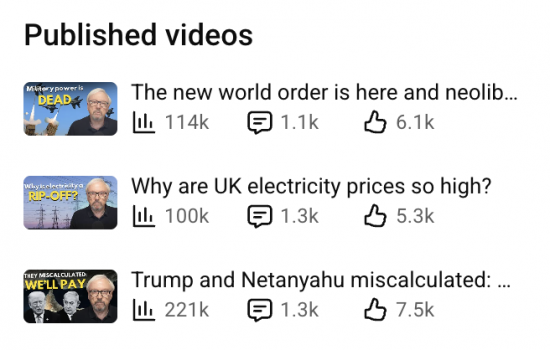
By any standards, those are good. 435,000 views in three days is something most YouTubers dream of.
There are more issues to reflect on as a result, partly around content, though I also think Thomas's new approach to thumbnails has helped a lot.
Thanks for watching, if you did.
Thanks for reading this post.
You can share this post on social media of your choice by clicking these icons:
There are links to this blog's glossary in the above post that explain technical terms used in it. Follow them for more explanations.
You can subscribe to this blog's daily email here.
And if you would like to support this blog you can, here:

 Buy me a coffee!

The one on why UK electricity prices are so high is interesting for these snippets:
– a flawed system is forcing households and businesses to pay far more than necessary
– The UK has some of the highest electricity prices in Europe
– The EU operates broadly the same system
Make it make sense then that it’s the system that is causing the high prices.
There’s an argument that the mix in our system is overweight are the two most unreliable energy sources and underweight on hydro and nuclear, but the argument that the system itself is the problem when every one else uses it. I have to say well done for turning that Youtube viewer algorithm to advantage, you do have to say that.
Europe seems to manage gas prices better than we do. But, they too are overpaying. Please do not overlook that point.
Utility* companies in the Florida are fairly well regulated as we have no choice who we purchase our electricity or natural gas from.
*Footnote: Cell phone and internet service are a totally different story.
Don’t know if you watch Laura Kuenssberg (wouldn’t blame you if you didn’t – can be very depressing) but this mornings guests, including the chairman of Centrica, and panelists including an energy ‘expert’ all seemed to agree with Kuenssberg that energy bills will inevitably rise significantly when the price cap runs out at the end of June, that targeted support should be provided for lower income families perhaps by introducing a lower Social Tariff, that new North Sea oil and gas licences should be granted and that defence spending will have to be increased immediately to protect the UK from Iranian missile attacks. And the funding for all of this would have to come from cuts in the welfare budget (of course) and increasing tax rates. Oh, and I think theyalso all agreed that interest rates would have to rise to keep inflation under control. Much the same nonsense was rolled out on BBC Breakfast yesterday morning when they invited an independent financial expert from a bank (can’t remember which one) to explain the difficulties the war would cause for our economy and cost of living. Have the BBC (not counting Jeremy Vine) ever invited you to provide expert commentary Richard?
What you describe is, unfortunately, a very familiar script.
A set of assumptions is presented as if it were common sense: energy prices must rise, interest rates must increase, public spending must be cut, and tax must rise to “pay for it”. What is missing is any serious discussion of alternatives.
There is nothing inevitable about energy prices rising in the way suggested. Prices are, in part, a policy choice — governments can regulate markets, cap prices, tax excess profits, or restructure supply. Nor is it inevitable that the response must be cuts to social security. That is a political decision, not an economic necessity.
Likewise, the idea that interest rates must rise assumes that inflation is driven by excess demand, when much of the current pressure is coming from energy and supply shocks.
What you are hearing is not neutral analysis. It is a particular economic narrative — one that prioritises markets, protects vested interests and limits the range of acceptable policy responses.
As for the BBC inviting alternative voices, that is, I suspect, part of the problem. The likes of Steve Keen and myself are not on the invitation list.
Thanks Richard. I think the news media are inviting Zack Polanski and Green MPs onto news programmes more often now that the Greens are enjoying a surge in popularity. We can only hope they can get the message across. Enjoy the rest of your evening.
It’s all to brainwash us into meekly accepting the “inevitable” hadships ahead, hardships for those least able to cope with them, that is.
I have, just this morning, and not for the first time, written to Radio 4’s Today Programme (copied to World at One, PM, and World Tonight) challenging them on just this point.
Using your posts on electricity costs and interest rates as the basis, I have pointed to a couple of missed opportunities this morning to challenge the current approach, and to point out that they seem to use a framing entirely within the current orthodoxy.
This is not restricted to news programmes. Nick Robinson interviewed Nigel* Farage a while ago (on ‘Political Thinking’):
Farage: blah, blah… Britain is broken
Robinson: What do you mean?
Farage: Well, nothing works!
At which point Robinson glided past this and moved on to whatever came next. Thoroughly inadequate.
I will, though, if I may, and please do forgive me, pipe up quietly on the side of the BBC. While criticisms made here and elsewhere are fair, we need to point the finger at the cause, which is the control that the Tories have engineered since 2012, consisting of: defunding; putting their people in influential positions; setting the attack-dogs of the RW press on them (daily pieces designed to undermine); dark threats over future funding, charter etc. I see the BBC as the victim in an abusive, controlling relationship. It has worked well, though, the BBC are very cowed, and the current Labour administration seem not to be doing anything to reverse this. (Also, do any of the other ‘MSM’ do much or any better?)
*A man who brings shame to a very fine name.