
I am on my way to Edinburgh this morning. I am looking forward to Scotonomics tomorrow. I think that there might still be some tickets available for tomorrow, here.
I am also looking forward to a few days off after that, although there will still be videos and a few blogs coming out over that period.
Part of that process will be thinking about how we react to the issues I noted on Wednesday, related to the way the YouTube algorithm now works, driven by a demand for novelty.
Having read and initially summarised the comments on that issue posted on YouTube and the related poll there, I am grateful for the very strong positive feedback that we got. It seems that a great and many people like the content that we provide, its lack of flashiness, and the fact that we do concentrate on trying to explain the way in which things work in the real world.
Confusingly, among those who commented and took part in the poll, commentary on geopolitics seemed less interesting than economic deep dives. I say "confusingly" for a good reason. This was the traffic on yesterday's video on the economic consequences of the war in Iran, which was more geopolitical discussion than economic deep dive:
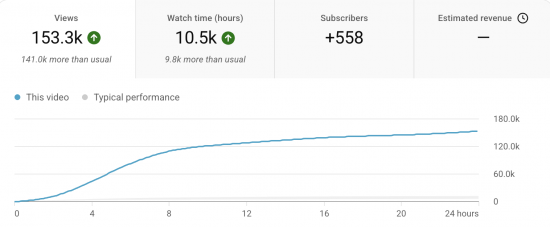
That volume of traffic was considerably above our normal rate at present. What it seems to say is that, as some people asked, we need to link economic ideas to the real world as often as possible.
The point is noted. There is a lot to think about. And given that Trump's government has now asked for $200 billion to pursue this war, whilst simultaneously reporting that it has cost $12.7 billion to date, the idea that it is going to end soon appears to be remote, even in their minds. Discussing the economic consequences of this war is, then, high on my priority list for thinking and writing about.
There are many such ideas, and almost all of them challenge the neoliberal framework that has got us into this mess, and which cannot get us out of it. As Keynes argued in 1941, you cannot rely on markets in wartime. Nor can we do so now. Questions around rationing, regulation, price controls, capital controls, taxation, changing consumption patterns and many supply arrangements, as well as new forms of international cooperation, should now be on our agenda. Accepting that oil companies can dictate our futures is the last thing we should be doing at present. People will die if we do.
That, however, is for later on. Right now, there are some miles to cover.
Thanks for reading this post.
You can share this post on social media of your choice by clicking these icons:
There are links to this blog's glossary in the above post that explain technical terms used in it. Follow them for more explanations.
You can subscribe to this blog's daily email here.
And if you would like to support this blog you can, here:

 Buy me a coffee!

Also travelling to Edinburgh for Scotonomics. Promises to be an interesting weekend.
Agreed, and travel safely
Charles Hugh Smith is on form, Richard. Have an enjoyable few days away, if you can.
Welcome to the Stockyard of Unaffordability
The war, like the 2008 crash and Covid, will force government to abandon their dishonest household analogy and their obsession with markets.
What we have to ensure is that everyone SEES that, and understands the big lies we get told so that there is no return to failed ideologies after the immediate crisis subsides.
Covid cracked the foundations of the household analogy. The economics of war should collapse it, and the myths of markets, completely.
My anxiety is about whether our weakened state infrastructure any longer has the resources and skills to pick up its responsibilities and lead us out of the chaos. We have to hope it does, because neoliberalism certainly can’t and wouldn’t, even if it could.
Every time I read about some dramatic response to the current oil crisis, I find myself thinking “that could have been done in response to the climate crisis”.
We really are led by donkeys!
We have to now talk about this issue all over again.
Strategically that is vital.
A further economic consequence is the use of AI in the war and the military’s trust in its believed infallibility.
To quote Curro Jimenez’s article in Naked Capitalism the US military use of AI concluded” that Iran was weeks away from producing not one but potentially five nuclear nuclear bombs. This dramatic assertion led to the war. Yet it was based on inference not verifiable facts”.
The same allegation has been made about the use of AI preparing targets which included an Iranian school.
The blind faith in AI as the future will increasingly economically impact in a global way. No jobs and in policing being targeted because you fit a profile. That is what is happening now.
The use of AI in this war shows that once it spreads to control the “proles” ( us) we will be the true slaves of neoliberalism.
‘Hope Scotland goes well Richard.
So far, so good. 🙂
Wish I could join.
Good luck.
Soarsa
So do I.
Ironically, I live in Edinburgh but will be on holiday (arranged long ago) in London.
I hope it goes well.
Thanks
It’s a beautiful morning here
Richard, I am writing about yr Youtube algorithm. I have access to yr presentations thru 2 mechanisms. #1 is thru my massive Tv, where I get yr presentations on a random basis. There does not seem to be any mechanism where I can indicate “likes”, or anything else — just on/off, program choice or volume. #2 is thru my laptop, where I concentrate Youtube use into Premier League game highlights. There is an option here to indicate “likes” or whatever, but I never use it. I am just highly selective, homing in on my favorite teams. I have latterly found yr programs on my Tv useful/enjoyable. I will select them preferentially in future in the hope that yr Youtube algorithm will pick me up as a fan. (There is just a side issue here. I am an Ozzie, living in Oz. Even so, I find that yr programs are nevertheless highly valuable.) Thanks. Ian
Thanks, Ian. You are right. Watching YouTube on a television removes many of the options available when watching it on a browser that is why I usually use a browser, but thanks for your support.