
It is monthly GDP data day from the Office for National Statistics. The percentage figures for the month (this data is always reported as percentage changes: it's as if the economy only trades in statistics and not in pounds) is as follows:
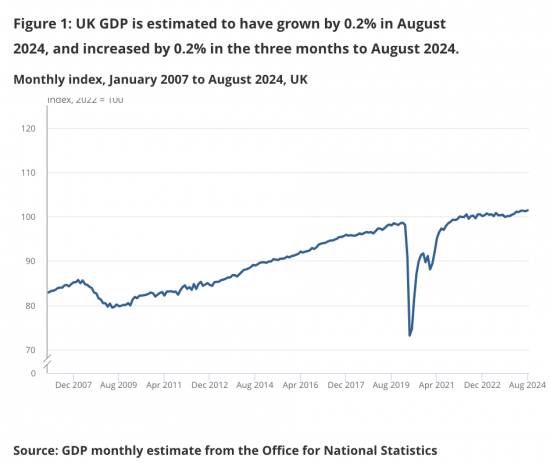
0.2 per cent growth in a month is neither here nor there, to be honest, and over three months, it is close to flatlining. If Rachel Reeves is relying on growth, she needs nothing short of a miracle right now.
But she should not rely on growth, anyway, because growth by itself tells us nothing about the quality of the economy. These charts tell us a little more:
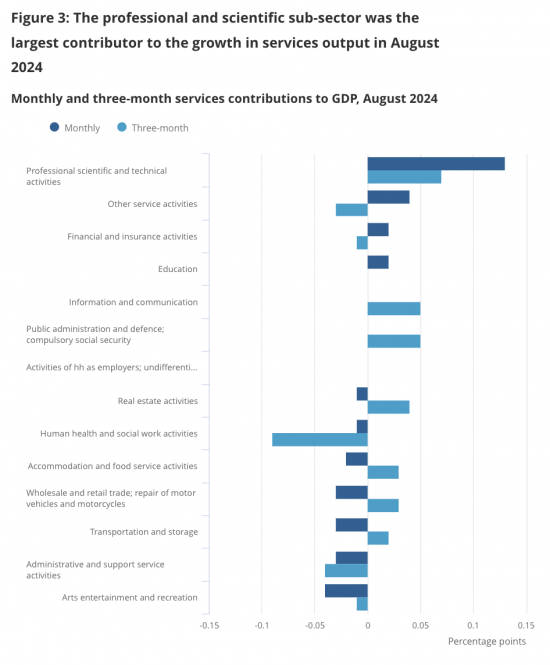
Look at health and social care on that chart: output fell. That does matter.
Then look at this one:
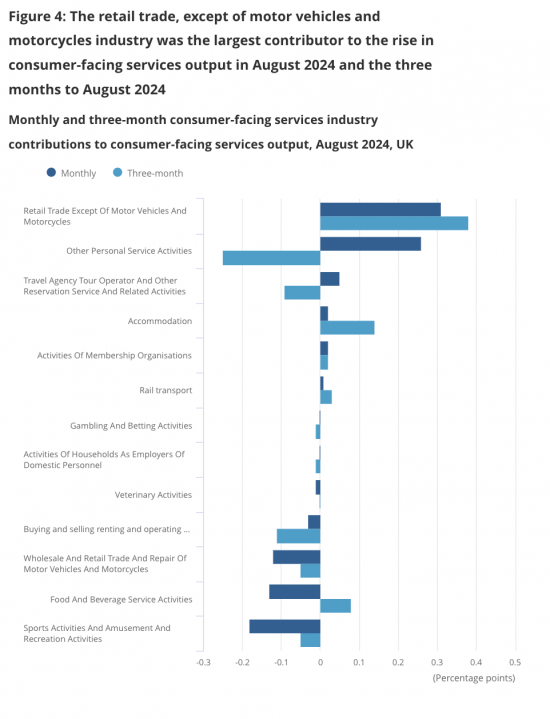
We're buying more 'stuff' to destroy the planet.
I'm not drawing major conclusions from data for a month, but looked at as a whole, this 'growth' says we're doing exactly the wrong things to meet real needs in our economy.
Thanks for reading this post.
You can share this post on social media of your choice by clicking these icons:
There are links to this blog's glossary in the above post that explain technical terms used in it. Follow them for more explanations.
You can subscribe to this blog's daily email here.
And if you would like to support this blog you can, here:

 Buy me a coffee!

How to measure what an economy is doing? GDP probably the worst metric.
Facts: loads of poorly paid McJobs (= non-jobs) & e.g. shortage of welders (strange but true), engineers, electricians, plumbers, professional builders (is this an oxymoron?) etc. Reason: LINO 1 & 2 and Tories failed to make sure that the educational system (study and work – you need both) was fit for purpose – multi-decadal problem.
Possible solution:
a) policy action to eliminate the Mcjobs e.g. minimum wage £20/hour?, go after the large corps ref tax that keep Mcjobs going – go after the execs – personally – make life miserable for them.
b) spend to train the people needed for an economy worthy of the name. (& ignore GDP data – it carries little info).
Won’t happen under LINO 2 – because the current LINO crop are far too stupid, doctrinaire etc & lobbied to death. (answer to lobbying – ALL meetings ministers/MPs/lobbyists are live-streamed – failure is a criminal offense.
Much to agree with
Should we not be looking at GDP per head?
Three days ago the ONS reported that the population of the UK had grown by about 1% between mid 2022 and mid 2023. The population growth rate is probably similar this year.
Taking this into account, GDP per head is, at best, static and probably falling.
A population that is growing but,on average, people are getting poorer is not great. 🙁
We should be….
This growth is in fact a decline
Well, we’ve bought another car – another second hand one, a hybrid because work dictates I need one and we have kids to move around at Uni. The old one (we had to have two at one stage) is on its last legs.
The only guilty pleasure I have is books to be honest (and the odd set of guitar strings).
Books last a lifetime
My wife moans about books lasting forever because the space they take up……………
I sort of know that feeling
Those book cases you see in the videos are only a part of the total
Yes – same here about books.
And Abe books for second hand books – irresistible!
I fear so…..
I am a regular
Shame it is part of Amazon (I believe)
I had to build an extension to house my 20 thousand books, about one third are e-books, about one quarter are technical, the novels are a mixture of science fiction and fantasy. It helps that I am a speed reader. Fantasy is for gloomy days although a mixture of the two are my favorite at the moment.
20,000? Wow….
I am but a beginner
In recent history all of the “growth” in Western economies is at the top end of town so an increase in GDP equates to an increase in inequality.
Reeves has said that growth is a “national mission” and would “see economic growth as the solution to the UK’s problems of underfunded public services and falling standards of living amongst working people.” (FT Advisor June)
How much “growth” would it require to sort underfunded public services, fix black holes and all the rest? Nobody thinks growth is going to be anything spectacular. The IMF thinks we would need growth of 2.6% simply to avoid extra tax rises and spending cuts.
So how much growth does she thinks she’ll achieve to invest in collapsing public services and how long will it take to achieve it? This is magical thinking, not serious economics.
This growth you can see, Rachel, is it in the room with us now?
I despair of how vice-like the NeoCons have most of us in their grip.
Any form af a New Green Deal – it’s an economic treasure-chest that no government seems to want to open.
Changing/adapting our manufacturing infrastucture has to be a task overseen by govenments, ideally at supra-national level.
But that in itself is a massive financial opportunity. Massive.
Why won’t governments see this?
The question is rhetorical – we all understand how powerful current lobbies are.
many years ago Richard Douthwaite made the point that the GDP on the West Coast of Ireland was almost at 3rd World levels but the standard of living clearly wasnt.
the reason being of course that much was done without money, for example if a couple were getting married the friends and family would build them a house usually on family owned land.
So most people lived in nice well built modern homes they owned outright – think of the amount of money that they didnt need to earn as a result.
Growth is a fairly meaningless measure, agreed. We were always getting told by the Tories that there was growth until COVID hit, but our living standards still fell year on year because we never saw any of that growth. All growth has meant for decades is that the person who owns the business you work for is getting richer.
I’m often torn between wanting something closer to a steady-state economy ideally, but I tend to see economic growth that focuses on building up productive labour capacity, key green industries and strong public services as likely necessary for climate adaptation. So it’s a case of balancing the two goals in environmental politics and which is the cart and which is the horse in achieving Green New Deal style policies. Growth probably will have to come first before the blinkered neoliberal obsession with it fades away, and monetarism is especially bad at realising happier and fitter workers tend to be the backbone of any reliably growing economy. The way Rachel Reeves is framing it all about borrowing first and taxes second for whatever investment can be had, really shows us the bizarre result of when zombified Keynesianism mixes with neoliberal dogma.