
The media has been providing some, what feels like far from complete, insights into the claims and counterclaims about the Iran peace deal, and the supposed circumstances around its negotiation.
The Washington Post did, perhaps, provide the most direct observation on the ultimatum that led to the US back down, saying in a newsletter:
The president's ultimatum drew condemnation across the political spectrum and intensified open debate about his credibility, morality and sanity.
The BBC, which is having a very bad war, covered Pete Hesgeth's claim that the USA had won with a "capital V victory", and that Iran had begged for a ceasefire.
The FT did, I suspect, report something much closer to the truth when saying:
The White House pushed the idea of a temporary ceasefire with Iran even as Donald Trump escalated threats against the Islamic republic and claimed it was “begging” for a deal, according to people familiar with the talks.
For weeks the Trump administration was leaning on Islamabad to convince the Iranians to agree a pause in fighting where it would reopen the Strait of Hormuz, the people said. Pakistan's crucial role, as a Muslim-majority neighbour and intermediary, was to sell it to Tehran.
There are very good reasons for thinking this to be true: it appears likely that the US has been running out of weaponry, getting through years of stockpiles of weapons in a manner that has reduced its military capacity for very many years to come, so diminished is its weapons production capacity as a consequence of its focus on high-tech, which has proved itself unable to deliver victory in this war.
The New York Times summarises the situation rather well in a newsletter this morning. It says:
The cease-fire between the United States and Iran is already looking shaky.
As explanation, it added:
Israel conducted heavy strikes yesterday on densely populated areas of Lebanon, killing at least 182 people and wounding more than 800 in the deadliest day of the war so far. The Lebanese president called it a “massacre.” Israel said it was targeting Hezbollah.
Gulf countries, meanwhile, reported a barrage of attacks from Iran. The status of the Strait of Hormuz — the swift reopening of which was supposedly the point of the cease-fire — was not clear.
There's a lot of uncertainty about what might happen over the next few days. Talks between U.S. and Iranian officials are set to take place in Islamabad this weekend.
And just to throw some further confusion into the scene, White House press secretary Karoline Leavitt has been in action peddling misinformation as hard as Pete Hesgeth does. In little-noted comments, which were covered by The Hill in the USA, it is reported that:
Amid the tenuous two-week ceasefire between the U.S. and Iran, it is unclear what exactly is in the 10-point plan from the Iranian government that President Trump deemed a “workable basis” on which to negotiate.
While the Iranian government publicly released a 10-point proposal Wednesday, White House press secretary Karoline Leavitt said later that day it does not match the latest plan from Tehran that the Trump administration agreed to.
What we are being asked to believe is that the supposed negotiations are unrelated to the documents released, which have been claimed to be the foundation for them. They do, instead, apparently relate to a completely different set of proposals about which the world knows nothing. At this point, I would refer you back to the opening quote from the Washington Post, which suggested that:
The president's ultimatum drew condemnation across the political spectrum and intensified open debate about his credibility, morality and sanity.
I added the emphasis this time. If a reasonable working definition of sanity is that it is being out of touch with reality, then I think what we saw from the Trump administration yesterday was clear evidence of its collective insanity, as demonstrated by Pete Hesgeth, Karoline Leavitt and others. They are asking us to believe that the US is in control of an agenda when the Trump administration has clearly lost all touch with the reality of what is going on in the war that it started, whilst simultaneously failing in every one of its military objectives.
In light of this, I think the poll results on my own videos yesterday are telling. This is from YouTube, where so far 14,400 have voted out of the 88,000 people who watched yesterday afternoon's video:

On this blog, the belief that a solution is available offering lasting peace seems to be just as scarce, even if the numbers voting are somewhat smaller:
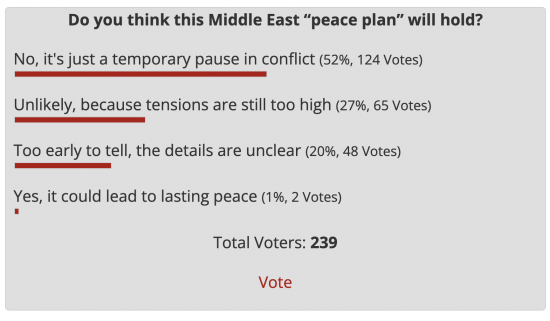
So, what should we conclude? The evidence appears to be overwhelming. No one appears to think that Trump really accepted an Iranian peace plan as the basis for negotiations on Tuesday night. Almost anyone, with any sense, realises that Trump grabbed the fig leaf that he was offered by Iran, which, from their point of view, prevented a lethal bombardment, for which we should be grateful, and which, from Trump's point of view, let him off the hook of delivering genocide, which even he must have known would have been unforgivable, whilst simultaneously claiming a victory when no such thing has happened outside the fevered imaginations of a few White House insiders.
What happens next? That is the real question. What we can be sure of is that, to use a turn of phrase borrowed from opera, "the fat lady has not sung as yet". This war, and its consequences, are not over.
Thanks for reading this post.
You can share this post on social media of your choice by clicking these icons:
There are links to this blog's glossary in the above post that explain technical terms used in it. Follow them for more explanations.
You can subscribe to this blog's daily email here.
And if you would like to support this blog you can, here:

 Buy me a coffee!

I see Yvette Cooper wants the Strait of Hormuz to be toll free. I doubt somehow that she will be able to keep the costs of this war down for the UK. Another aspect of the misinformation has surely been the nature of the UK’s involvement in the conflict. Iran will pursue a case for reparations from the UK, not only the US. And they do seem to have some strong arguments.
Country Objectives
Gulf states: stop the Iranian drones, start exports flowing. Saudi Arabia: insulted by Trump and lost faith in ability of the USA to provide credible defense. Pivot to Ukraine.
Iran: stop US & Israel attacks on Iran. Stop the Israeli state from expanding into Lebanon.
Israel: try to inflict max damage on Iran, continue with territorial expansion into Lebanon (= take over Litani river = access to water).
USA/tRump: appear to be the winner. Reduce burning through missiles.
Israel through its actions in Gaza and now Lebanon is a terrorist state. The USA could stop it but probably won’t because of tRumps advisers, not least the zionist-jew Kushner (son-in-law to tRump) who has Israeli business interests (his Saudi business interests vapourised after the tRump comment wrt the Saudi crown prince & ass kissing). Which means that it is likely, after a short pause (Iran restocks with Russian drones?) the shooting restarts. The uncertainty is the Gulf States and Saudi Arabia – who will not be happy and may decide that Israel is part of the problem, not part of the solution. What they could do against the Israeli-terrorist-state is uncertain. If Iran targets electricity production in Saudi & the Gulf states, the summer could be very “uncomfortable”.
Who/what could stop all this? UK & Euros expel Israeli embassies and all Israeli citizens & close borders with Israel. That would stop the terrorist state in its tracks & Iran could then reach a peace deal. Won’t happen because zionists permeate all levels of government in Uk and EU.
Noted
I’d assumed the occupation of southern Lebanon to the Litani river was about creating a buffer zone (like the Golan Heights) and possibly empty space for future settlement (like the West Bank). I’ve not seen anyone mentioning water until now, but now you say it, that could be an additional motivation. It will be interesting to see if and when Israel instals pumps and pipes heading south.
I doubt a two week pause is going to make any material difference to the stocks of advanced weapons in the US but it is not clear to me how much industrial capacity remains in Iran. As a direct comparison, a Tomahawk missile costs around $40 million. A Shahed drone is about 1% of that, around $40,000. Wars often end up as battles of logistics, and quantity has a quality of its own. Would you rather have one expensive but very capable weapon, or a swarm of 100 smaller weapons?
I don’t doubt that the US could carpet Iranian cities with tonnes of dumb bombs if it wished but to what end? There are still debates about the pros and cons of bombing cities in the Second World War. Morale did not break, and war production was maintained for many years.
The main stream media in the US and UK is slavishly following the US state media line, promoting “success” and how so “bad” is the condition of Iran that the Iranian government cannot survive.
The US and Israel do not appear interested in ending the conflict unless Iran is utterly humiliated and broken.
Will Iran voluntarily accept this punishment? Of course not.
The US and Israel are still in the escalation trap, ramping up the violence with actions and words.
Many people are benefitting in the US from insider trading making obscene amounts of money.
The US tech bros, financial elites are in denial about the real economy, believing that the “hit” to the economy is just a blip and will not affect them.
Regrettably I do not expect the US and Israel to honour any cease fire or subsequent “peace” deal. They want to be seen to win big, even if it drags the rest of the world into a long depression.
I think your belief in the capacity of the USA to continue this war is misplaced. There is a video coming on this, probably tomorrow.
To some extent, I would argue that the current fragile ceasefire suits Iran more than the US. By most accounts, Iran is still in full command of the Straits and will not need to sink any shipping to remain so. They continue to exert economic leverage. It is this situation that he US most needs to change. Iran can retain its leverage currently without firing missiles.
On the other hand, the US will need to ramp up military attacks once again to exert its leverage over Iran, and this will very much look like the actions of an untrustworthy aggressor to the rest of the world. Regardless of whether Iran is in fact abiding by any terms they have agreed, their inherent position is stronger in this circumstance than the US.
To maintain pressure, Iran can simply let the status quo persist, where the US must take action to ratchet up pressure. At present, aside from Israel’s persistent attacks on Lebanon, Iran is under zero pressure to do anything more than it is currently doing. It is also extremely likely that no action the United States takes short of extreme military action will challenge Iranian control over the Straits. The US is cornered, and if anything the ceasefire in place makes it even harder for them to change that.
Broadly speaking, I agree, although I seriously doubt the capacity of the US to now continue with this war. The evidence is that it is running out of the physical means to do so.
Lots to agree with and some to disagree with.
But at the back of my mind is the problem of Israel – Yvette Cooper on R4 has just basically criticised Israeli attacks on Lebanon as contributing to escalation. This indicates that phony or not – the pause is being taken by some as an opportunity to calm things down.
But back to Israel. Is this where U.S. support for Israel in terms of materiel is going to be tested? Could the caustic partnership start to come apart? Is Israel’s behaviour a last gasp, to grab as much as they can before arms/money/support runs out?
What is also interesting is what sort of concoction will arise to deal with Iran’s claim that the Straits of Hormuz belong to them being broadcast this morning?
Insanity? Or pleonexia from Trump? I think he did not realise that he would need to wage total war on Iran to subjugate it. He’s made a huge mistake, which paradoxically we may be grateful for. Paradoxes abound in this conflict – America’s ‘loss’ of face or humanity’s triumph? Long term, who in the U.S. is now harbouring festering resentments that Trump did not carry through his threat? Who is angry about the U.S. ‘loss of face’ and what role do they have?
But you are right – there is more to come of something.
I have an American contact who is plugged into the discussions going on in the US military. It seems there was “a lot of pushback from the generals” against Trump. It doesn’t surprise me. Senator Mark Kelly of Arizona who had been a US Navy Captain, reminded service people they had a duty not obey illegal orders. Hegsith tried to get him demoted but a judge blocked it. The reaction against the Senator IMO shows they are worried about being confronted by people who have real experience of command and danger. Kelly was an astronaut.
Is it possible that, as the US weapons stock piles continue to diminish, the US will be forced to cut back on its supplies to Israel thus leaving the Netanyahu and his Zionist collaborators exposed?
Where you write:
“The BBC, which is having a very bad war, covered Pete Hesgeth’s claim that the USA had one with a “capital V victory”, and that Iran had begged for a ceasefire.”
I take it your mean “…the USA had won…” ?
I do. That was a dictation error: I use dictation software a lot, and that is one of the errors that can arise.
That takes me back to my first school when I was striving to learn to read (it took me a long time: always a slow learner). I had to write the word on the blackboard and got it wrong. I could not understand how one and won meant two different things.
Not unreasonably
We know that the US is short of munitions to prosecute this war; this means that some essential munitions used by Israel will be in short supply/unavailable. Israel wants to see Iran become “totally neutered”; ie no longer a threat. They have no interest in seeing this war stop and in my view will wish to use everything and anything the US can supply to prolong hostilities. Thus the Iranian condition to stop the fighting in Lebanon, I doubt will ever be met. Sadly, therefore, I believe the war has a lot further to go. If all available US munitions are being used in the Middle East, they can’t be used elsewhere in the world which will please other countries that are at odds with the US.
Can the US expand weapon production rapidly, affordably and effectively to meet demand? I suspect not.
When USA was brought ( against its will) into WW2 it rapidly increased munitions production. Could the same psychology apply today?
No, because the approach they used thenm was akin to Iran now (which works) and the neoliberal approach to defence has made massive scaling almost impossible due to over complexity
Agreed Richard that the US and Israel will not be able to maintain their military campaign at the current level for much longer. They will run out of bombs, missiles and working planes, boats shortly.
But I am afraid that there is every risk that Trump and Netanyahu will do one last massive hit attempting to knock Iran out. Will this work? On the current record, no.
Might Netanyahu use nuclear weapons against Iran? I would not rule it out. If this happens what might be the response of nuclear Russia, Pakistan? Who knows.
True peace negotiations depend on a degree of honesty, rationalism, and the desire to settle.
Do the US and Israel give any indication that they are prepared to negotiate to achieve peace? No, they want to utterly humiliate/destroy Iran.
Regrettably the rest of the world can pontificate as much as it likes but it is not able to achieve anything.
Why has China kept quiet? It has worked out that it is going to be the major beneficiary from this war and there is no need to gloat.
Is any country preparing for the new economics. I don’t see the UK doing anything positive. its still austerity and yes the King can repair the doomed “special ” relationship.
One small positive result of all this might be that the shortages created will of necessity reign back the absurd levels of consumption in the Western world.
Itnis more likely to create famine and gross inequality without rationing and higher taxes on those with wealth.
Agreed
Leaving ideology and morality aside for the moment, and just thinking of Israel as a viable economy – how is it placed nowadays?
How would it be placed, if the economic aid, trade, and weapons from abroad were reduced/ended/made conditional on civilised behaviour in the global community and adherence to the international laws to which it owed its very foundation??
Is an internationally isolated, or even blockaded Israel, a viable state? (food, finance, weapons, water, energy) We’ve seen what years of sanctions have done to Cuba, Venezuela, Gaza, and Iran).
How likely is it NOW that any current supporters of Israel would actually put the squeeze on them, rather than just make performative comments for public consumption (eg: Yvette Cooper, UK)?
Apart from the nukes, what real world leverage does Israel have (compared with Iran, say), to use against UK, EU, USA, if those countries said “enough is enough” to Netanyahu and the significant Israeli lobby, and started to turn off the tap, on the basis that a 78 year old “get out of jail free” card has finally been maxed out and expired?
Could such a thing happen? Or does even thinking it, make me a terrorist?
“what real world leverage does Israel have”……..Mossad & its inclination & ability & history of murdering those that actively work against Israeli interests. Obvs if the whole EU chucked out all Israelis and the Israeli embassies it would be difficult. But one country? If I was Sanchez, I’d be careful, “accidents” can (& have) happened. Israel was founded by terrorists (Irgun et al) and has used terrorism as a tool against any & all.
Looking at the statistics, it appears that Jews represent only 0.2% of the World’s population and those who support Netanyahu will be a much smaller number. It appears that he may have some hold over Trump to get his support but if he loses this, very few other countries would give Israel any meaningful cooperation.
While Israel has some very powerful financial backers, are they still supporting Netanyahu or will they quietly stand aside?
https://en.wikipedia.org/wiki/Jewish_population_by_country
Meanwhile the atrocities on the West Bank and in Palestine continue unabated and mostly unreported ….
[…] in Iran, in Israel, amongst US troops, in Gulf states and in the world far beyond the Gulf, where, as I have explained, the risk of famine this year is now high, and […]