
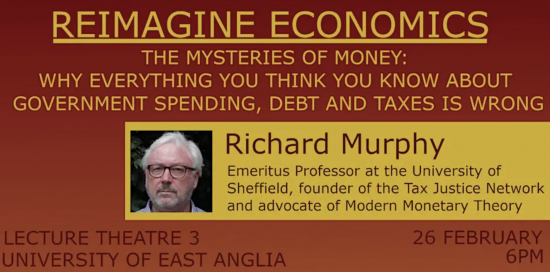
I know that my event in Cambridge on Saturday is fully booked, but I am doing another one tomorrow evening in Norwich.
It's not going to be as long. It will also cover quite different ground, based on the discussion I have had with the person who will interview me, with that interview representing the substance of the meeting. It is, however, a chance, if you happen to be in the area, to see me, listen to what I have to say in a different way from what I will be doing on Saturday, and ask some questions.
I also happen to know that whilst the event has quite good bookings, it's being held in a lecture theatre that could seat 300, and we haven't got that many coming, at least as yet. So, if you want to come along, please do, and this one is free thanks to support from the University of East Anglia.
And, as another reminder, if you are in Edinburgh on Saturday 21 March, so am I, at this event:
Specifically, I am doing this session:
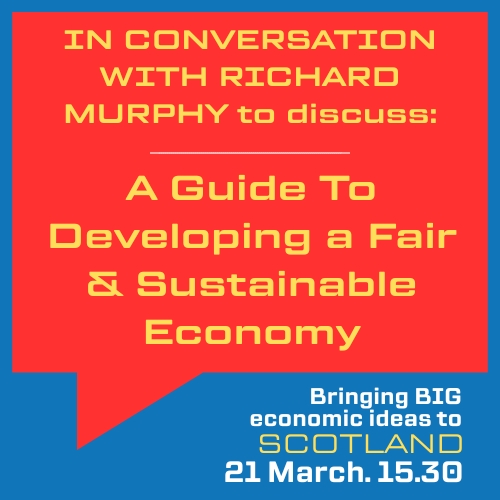
Tickets for my session can be purchased here, but the whole festival takes place in Edinburgh over the 19th to 21st March and is a unique, public-facing celebration of economic thinking designed to challenge, inform, and inspire. The full programme and tickets can be found here: www.scoteconfest.org. Give it a look, and I look forward to seeing you there, or online, because this event is being streamed.
Thanks for reading this post.
You can share this post on social media of your choice by clicking these icons:
There are links to this blog's glossary in the above post that explain technical terms used in it. Follow them for more explanations.
You can subscribe to this blog's daily email here.
And if you would like to support this blog you can, here:

 Buy me a coffee!

Interesting talk coming up in Frome
https://fromememorialtheatre.org.uk/shows/frome-kindness-festival-rob-hopkins/
Looks like you are not alone in talking about the politics care.
Rob was the founder of the Transition Towns movement
If you go, please write a report.
Good that you will be heard more widely. Do report on any audience questions that may be unexpected, thought-provoking, encouraging or even just plain depressing!
OK…
Will some or all of these events/highlights be available to watch in the near future on YouTube ?
Like many people, I don’t travel much these days. I don’t drive and public transport is unreliable and would involve overnight stays except in my local area (Durham).
I’m sure you’ve mentioned coming to the North East in the future, so I look forward to seeing you ‘in the flesh’ when you do. Inshallah.
I hope so..
Scotland will be
We are recording Saturday
Richard, it is good to see you out and about and shining a light on economics, money and tax. These might be questions for Cambridge on Saturday. Firstly, how can the rest of us help? Clearly, by raising awareness of your work, but also being as fluent as we can so that we can challenge the current system and shift to a better understanding of the reality of money and the economic choices. But is there anything else we should be doing? I suppose that is another way of asking what you see as the options for progressing this work. Secondly, how can these ideas be applied at a regional or county authority level? Along with many others, I work within a network of community groups, academia and local authorities at county (and in my area, soon to be Unitary) level and I’d be interested in clarifying how the economic knowledge you are sharing might work at a sub-national level, or do they mainly apply nationally?
I can’t see you on the list of attendees for Saturday, so try these.
First, how can you help? Three things matter most.
– Learn the language so you can challenge myths when you hear them, especially the household-budget story about government finance.
– Share the work: pass on blog posts, videos and short explanations, because ideas spread person-to-person far better than by lectures.
– And organise locally. Join or form discussion groups, trade unions, community campaigns or local party branches that will actually push for policies based on a politics of care. Ideas need institutions to carry them.
Second, on local and regional government. Councils are not currency issuers, so they do face financial limits. But they still have huge influence over our five forms of capital. They can invest in:
– housing quality,
– public health,
– transport,
– skills,
– energy efficiency and
– local procurement.
They can measure success by well-being and capital maintenance, not short-term cash targets. And they can campaign collectively for fair funding from Westminster, which is where monetary capacity really sits.
So the task is both national and local: challenge the narrative, build networks, and apply a politics of care wherever you have influence. That is how change begins.
We do have tickets for Saturday and have received your joining instructions, but in any case thanks for a thorough and helpful reply.
Ok!
See you then!