
Bitcoin has halved in value since October, and this is not a routine market correction. It is a crash.
In this video, I explain why crypto has no underlying value, why the collapse still has further to go, and why banks that lent money so people could speculate on Bitcoin are now exposed.
I also look at the growing fragility in stock markets and tech valuations, including AI, and explain why this could become a systemic crisis that makes 2008 look mild by comparison.
Trump promised that crypto and markets would make his supporters rich. If those bubbles burst, the political consequences could be just as severe as the financial ones.
This is not speculation. The evidence is now visible in the markets. And I stand by this analysis irrespective of yesterday's partial recovery in Bitcoin's value.
This is the audio version:
This is the transcript:
There's a crypto crash happening right now. Bitcoin has halved in price since October. Today, we are looking at the obvious follow-on question from that, which is, will Trump's bubble burst with crypto? But let's start with what has actually happened in the markets.
On Thursday, Bitcoin's price sank to $63,000 per Bitcoin. That's its lowest level in more than a year and a half of its all-time peak of $126,000 per Bitcoin in October 2025. And a month-long dip in cryptocurrency prices has tanked shares of companies that have increasingly invested in Bitcoin, dragging the banks into this whole scenario as well, because they used borrowed money to fund their Bitcoin acquisitions.
This, in turn, has exacerbated broader stock market jitters. Look at this chart.
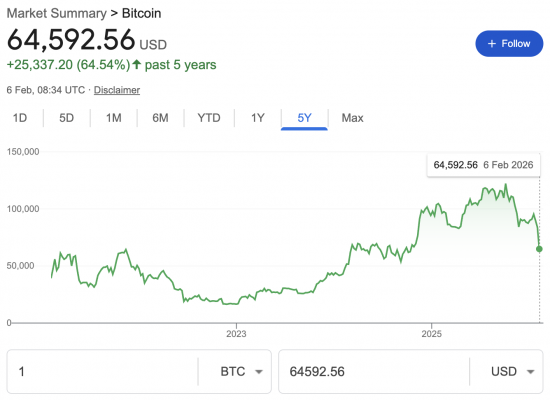
Note the trend. This is not an adjustment. This is a crash. That perpendicular decline on the right-hand side of the chart is an indication of a fundamental readjustment, and it's not looking good.
There are a number of obvious conclusions to draw.
First, this sham asset has a long way to fall as yet. There is literally no value to it. Can I repeat that? There is literally no value to Bitcoin. If you think there is, you are deeply mistaken.
This is an artificial creation that has never yet found a use. It was made in 2009, only two years after the iPhone was introduced. The iPhone had a purpose. It has a reason for being valued highly. Bitcoin has never found a purpose. It is meaningless, and this value is going to fall a lot further down the Y-axis on that chart than it is at present. It could be heading for zero. And this is not rhetoric. The reality is that almost nothing around the crypto market is going to be left at the end of this debacle. What we're seeing on that chart is not just a wobble; it is a collapse.
Second, this is a precursor. We're also seeing softness in the AI tech market. That softness will, I believe, turn into a rout. There is real value in AI. Let's be clear, I know that; that's true. But that only means that there will be a floor to any fall, it doesn't mean that there won't be a fall, and I think a halving in value there is also quite likely.
The likelihood is that banks will fail with Bitcoin and with a stock market crash, and those banks will have to be bailed out by governments. That's going to be mightily painful for the world because this is going to be worse than 2008 when it happens.
Third, as the crypto market crashes and as the stock markets look as though they're heading the same way, it would be great if Trump's fortunes went the same way. He always pitched his offering to both the crypto and stock markets. He said that he would increase the fortunes of those invested in them. That was his promise. That is what the MAGA believed. That is where the Americans put their money, as a consequence, and if both crash, we just have to hope his bubble bursts as well.
So today's question, will Trump's bubble burst with crypto, is not a speculative headline. The evidence from markets tells us that the crypto bubble is deflating, still has a long way to fall, and that this matters for markets because many people have their fortunes tied to the well-being of those valuations, including many of the world's banks, and politically and financially, they could be in trouble as well.
That is the argument you need to engage with now. Bubbles burst. This one will. We are going to have to deal with it. This is a crisis coming our way. I know I've said it before, but the evidence that the crisis is emerging is now very real. In fact, everything I've said has been justified by current events, and I cannot see at this moment Bitcoin changing direction for a long time to come, if ever. And I'm not alone because people have seen through the mythology, just as they're seeing through Trump.
The time has come to face the reckoning. We're going to have a crash. Now, we need a government and a set of ideas that is capable of dealing with it. That's the issue of our moment.
What do you think? There's a poll down below.
Poll
 Loading ...
Thanks for reading this post.
You can share this post on social media of your choice by clicking these icons:
There are links to this blog's glossary in the above post that explain technical terms used in it. Follow them for more explanations.
You can subscribe to this blog's daily email here.
And if you would like to support this blog you can, here:

 Buy me a coffee!

I don’t know how or if we could do this…..
But it would seem preferable if in some way the government could open a retail bank where every citizen can directly access an emergency overdraft…. Perhaps a certain amount interest free and anything over that at BoE base rate?
So that insolvent banks and wealth funds and even pension funds can be allowed to perform or fail according to their genuine value…. As espoused by capitalism and neoliberalism……
Does this seem catastrophic?
I feel like bailouts where the state via the BoE saves financial institutions mega corporations merely feeds into the ongoing idea that financialised capitalism is somehow the ‘source’ of our prosperity and needs saved…
When in fact it is the state and the central bank and productive industry and Labour both paid and unpaid that is the source of our real prosperity and security.
Would it be possible to set up state retail banks and state investment banks fast enough to lend to people and businesses who need saving and allow insolvent banks, speculative financiers, exploitative tech and AI to go bust…..?
Let’s reveal who is the real safety net in our society is and always has been….
I’m sure this phrase has been doing the rounds…. But let’s ‘make government great again’.
I have often called for this. We had this once. It was called the Girobank. Search that in the site.
Thanks…. I think I remember having a Giro Savings Account at the post office when I was a child. Looks like Girobank got bought and then closed by Alliance and Leicester.
There seems to be a plan from the Treasury, The FCA and the Payment Systems Regulator to create a UK retail payments system involving Pay.UK who currently deal with interbank transfers. It sounds like this would be the replacement for Visa rather than for retail banking…..
https://assets.publishing.service.gov.uk/media/690de7a247ad122f854627bf/PVDC_Strategy.pdf
Pay.UK website says it has it ‘guarantors’ rather than shareholders.
It also says that:
“We continue to welcome dialogue and input from all associations and trade bodies that support our aims and aspirations. Further information on how these groups can get involved can be obtained from enquiries@wearepay.uk. We will also continue to use our established engagement programme to encourage applications and, if deemed appropriate by the board, target specific sectors. The board reserves the right to limit Guarantor representation from some areas if it is felt that a particular sector, as a result of numbers, has undue influence and a broader range of views is being compromised as a result.”
https://www.wearepay.uk/who-we-are/our-organisation/guarantors/
Is there anybody who contributes to or comments on this website who could apply to be a guarantor? The only requirement seems to be that you must be a ‘legal person’.
Surely some differently minded economists, accountants and financial professionals getting in there would be a good idea?
It says they are looking for ‘balance’.
Of course this all looks quite long term….
I’m wondering about how the government could execute a rapid setup of government owned retail systems in response to the next crash….
Might it be easier just to buy a small existing retail bank to turn into a government retail bank?
Looks like we already have an investment bank in The National Wealth Fund which I will look into….
Pay.UK is not a bank – it is a payment systen.
The National Wealth Fund is a Labour shan: just a front for what is in effect a private equity fund.
We should have made the Royal Bank of Scotland the sdtater owned bank.
Bitcoin does have a purpose: it’s for dodging tax and laundering criminal proceeds.
Agreed
A negative worth
“First, this sham asset has a long way to fall as yet. There is literally no value to it.”
I think you are understating things. Crypto has value – but it is nefarious.
It can facilitate “hidden” transactions – ideal for dodgy / illicit deals. Drugs, arms, corruption payments, etc.
It can shield financial holdings from authorities – and support tax evasion.
It could be used to undermine sovereign currencies / governments. Ideal for the global mega rich who see no purpose in nation states.
OK.
It has negative value to society.
Yeah — you were being far too generous !! 🙂
Wonderful speech from the president of Iceland in 2013 at the World Economic Forum:
“Why do we consider the Banks the holy churches of our economies?”
He says a large financial sector drains talent out of the productive economy…..
https://www.youtube.com/watch?v=DXUr4PK07so
Apologies, I see this is more about the larger coming crash than specifically Bitcoin…
I suspect Bitcoin’s value will continue to go up and down, given that it is based entirely on ‘confidence’.
Sadly I think it will continue losing amateurs who can’t afford to lose their money quite a bit, and making those who can afford to sit back and harvest profits from the price fluctuations an income.
Perhaps the involvement of large investors like banks and wealth funds has changed this dynamic but that’s what I saw 5 or 10 years ago with ordinary people trading on their home PCs and smart-phones…..
This will be the subject of Wednesday’s video
Will Trump’s new Fed pick be sympathetic to bailing Trump’s crypto out or did Trump make a mountain of cash?
Trump will be in cash by now…
I know a bit about bond markets but nothing about bitcoin. I have spent time (more than I should) pondering Crypto and asked many folk (far brighter than me) to explain…. and I still don’t get it. So, of course, I think it is going to go down. Indeed, I felt vindicated in 2018 as it declined from 13,000 to 4,000, and in 2022 from 60,000 to 20,000…. but it then went to 120,000. I am wary of making predictions….. but I did vote “Bitcoin goes to zero”.
More relevant is what is the fall out from this. I don’t think we should look to the banks to show the strain (yet) – their direct exposure to Crypto is tiny and they have (roughly) three times as much capital as they did in 2008. So where?
The big change in the last decade or so is social and technical – anyone can trade using just the phone in their pocket and there is a whole generation of people for whom gambling is normalized – just look at the constant bombardment of adverts. (Covid also turbo charged this shift).
So, the losses are spread among millions of small punters about whom we know little. Many trade on margin and will end up being automatically liquidated if they can’t stump up the cash so we need to look at leverage data with the brokers and what is happening there.
We also need to look at retail sales data, credit card and car loan delinquency rates etc.. In short, how are real people responding to changes in their wealth. The “wealth effect” is not new – but how it reaches into the real economy in 2026 is unknown.
AI and bitcoin are not necessarily linked but in practice they are as the sentiment that drives things (both up and down) is the same in both areas. If the AI firms actually manage to raise the capital they need (and we have only just started to see the bond issuance) then this will, one way or another, start to impinge on the banks – probably via their exposure to Private Credit.
Will Rogers captures my current feelings best “I am more concerned about the return OF my money than the return ON my money.”…… when that concern becomes more widespread it could get ugly.
I do not think the banks are much exposed directly. I suspect they are greatly so indirectly. How much leverage have they provided? I suspect large amounts, often at high rates and that could turn ugly. They are more exposed though to AI.
I am not sure there is huge (bank) exposure to AI… yet. Huge plans are announced and if all the borrowing predicted comes to pass then the exposure will be huge for banks – directly and through loans to Private Credit. But we are not there yet. If the AI bubble pops today then banks will take a hit but not an existential one.
My guess is that the hit is taken by ordinary folk and their pension savings that are tied to a very highly valued stock market….. but I don’t know.
What I do know is that we need to be alert to different signals and indicators of stress than we have been used to looking for in the past. Measures of financial stress at a granular, household level rather than macro “bad loans” data at banks.
The BoE begs to differ with you, already. They think the bank exposure is already big.
I don’t think the BoE is saying there is systemic risk to the banking system – rather, that the risks are more directly to the real economy. Firstly, from providers or equity capital being disappointed and taking losses. Only secondarily, banks following up by reducing credit provision in the face of a generally weakening economy.
This distinction is important because (as I said in my first post) we need to be looking in the right place for the strains…. and that is not a 2008 style banking crisis.
My reading was they were worried about leveraged speculation. But let’s be honest – who knows where the risk is with shadow banking?
“But let’s be honest – who knows where the risk is with shadow banking?”
On this we completely agree!
Aren’t derivatives a more likely source of creating a prolonged downturn just by the sheer magnitude of finance by banks in derivatives dwarfs that of their exposure to crypto?
But most derivatives are hedging – to mitigate risk. Until they don’t, of course. But that is the theory.
I don’t agree with any of the options. I think it’ll trundle on probably never to cover to previous highs. It has a purpose and that is the black economy. I don’t think it can be regulated either. A niche thing for bad actors.
I think governments collectively( IMF?)can, and should act to mitigate any foreseeable damage to a collapse in Bitcoin’s price. Maybe, they can offer a floor price of 5000 dollars(US) per coin and then remove them all from circulation. The problem will be Trump, who won’t want to take a hit. Anyone else holding these rapidly depreciating tokens will cash out and the whole bitcoin saga will join the South Sea Bubble and the Tulip Fraud as part of investment folklore. Granted this seems too simple a solution, so I’d be interested to learn why others think it won’t or cannot happen.
Why? That is $100 plus billion, for what precisely? Why do that when there is real need in the world for funding?