
There is just one bird that features in today's photos. It is a buzzard. I remember when they were not that common in East Anglia. They are relatively so now.
I saw this one as I was approaching the WWT Welney reserve this morning. I was going fairly slowly. That's what you do on Fenland roads if you have any regard for your own safety. They set decided traps for the unwary. I realised that the buzzard was heading for a post, on which it then landed. So I slowed to a stop, about 6 metres (20 feet) from it.
The buzzard saw us. It seemed unfussed. It was looking for worms on the bank - a favourite food of this bird of prey, and was finding them. It obviously saw us, sitting in the car, as no threat. So we put the hazard warning lights on and sat and watched it. When it moved a couple of fence posts down the bank, we followed it. Again, it was not fussed.
The pictures were taken on an iPhone, through the car windscreen.
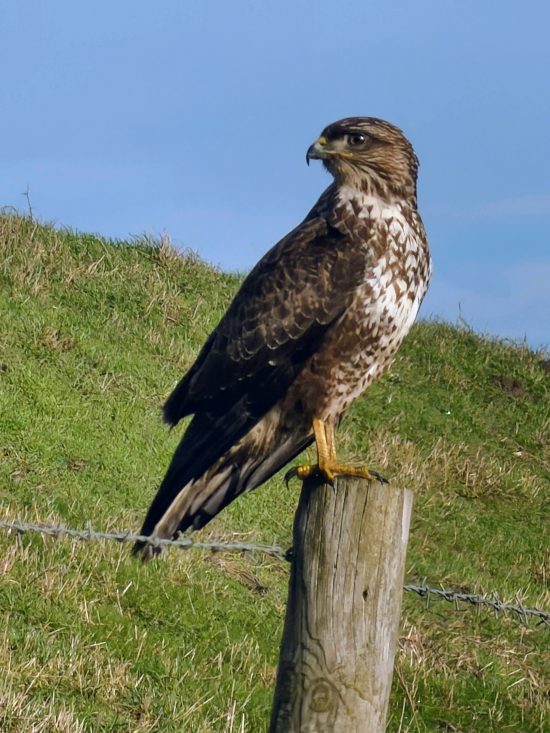
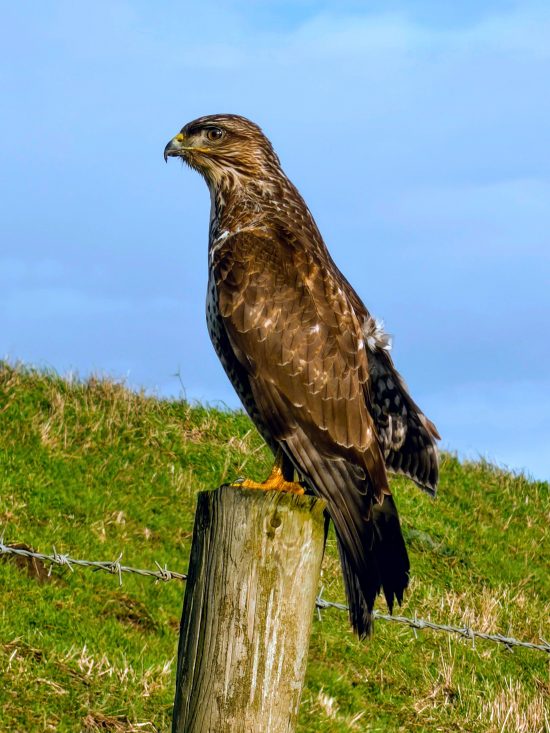
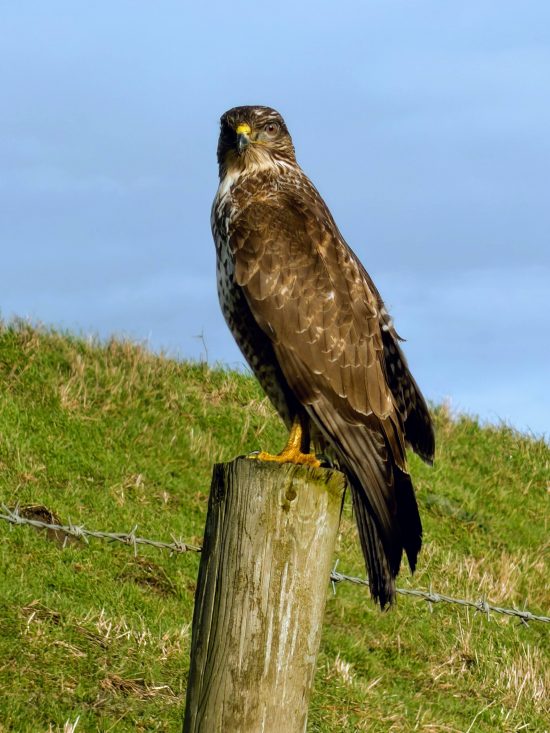
What a bird.
What a moment.
And yes, the birdwatching that followed was good (whitefronted and taiga bean geese plus 4,000 or more lapping migrating), but not much was going to beat sharing time with a buzzard like that.
Thanks for reading this post.
You can share this post on social media of your choice by clicking these icons:
There are links to this blog's glossary in the above post that explain technical terms used in it. Follow them for more explanations.
You can subscribe to this blog's daily email here.
And if you would like to support this blog you can, here:

 Buy me a coffee!

What beautiful pictures. What a beautiful bird.
After Cambridge, If you do eventually arrange one of your meetings in the north, might I suggest that you come to Leeds. Here we have plenty of Red Kites soaring over the city. From my house I see, every day, up to eight. Some swoop fairly low, but I have yet to see one really close up like your Buzzard.
Thanks.
I like kites, but not nearly as much as buzzards, and this monent was nothing like any I had experienced before with them. It was luck, and having a phone in my pocket.
I love common buzzards too. Their cry as they circle the thermals on a summer afternoon – so evocative and quite chillingly beautiful. We had several pairs around us – gone now – seemingly driven out by red kites as they have spread in numbers into Sussex. Strange though, because the two species don’t compete over food sources perhaps an example of correlation not causation. An issue economists and political journalists don’t seem to grasp.
Much to agree with.
Red kites are still uncommon around here, but are creeping in.
wonderful pictures – thank you – and, re my birding, I have had to make do with ‘Swan Lake’ (Varna International Ballet – Bulgarian, but very international dancers, including one English) – Tchaikovsky, so music good and, as usual with that Company, beautiful costumes – oh – and the dancing (despite the difficulties of Buxton Opera House stage) was good too! Now off to ‘The Nutcracker’ – meanwhile the Canada Geese are still absent here, presumably not enough tourists to feed them?
Enjoy!
There were Canada geese, greylags and Egyption geese as well as white fronts and tundra been geese for me this morning. Not bad!
It’s interesting to hear the experiences of bird people in other parts of the country. We normally sit in an open-air coffee establishment having a leisurely coffee on the other side of the river from the Washington Wildfowl Trust. It’s a bird-watcher’s paradise. (Very goosey, Richard!) Buzzards are a regular sight there – seemingly circling the area looking for prey. I assumed the poor “residents” of the WWT were a convenient buffet for the buzzards. It hadn’t occurred to me they were so fond of mere worms.
Red kites, on the other hand have not taken a liking to this part of the world. In the 1950s and 1960s I remember they were said to be common only in Wales and the West Country. About 15 years ago they were established very successfully near Blaydon-on-Tyne and the local authority started a clearly mapped Red Kite Walk around the neighbouring countryside. We visited them quite often until last year. We did the walk in late Spring only to find there were no Red Kites to be seen. And they never did appear in any numbers near the WWT. In contrast, when I visit my daughter south of Peterborough, I notice a real difference. Kites are everywhere. I wonder how closely the RSPB monitor such things. Also, on the subject of big changes, we used to see Kestrels almost every day. I haven’t seen a single one around here for months.
Thanks. I have never visited your Washington, but it looks very good.
Just south of Peterborough on the A1 there are masses of red kites- around a waste site. They seem to have spread our way from there.
Buzzards are not common at Welney – marsh harriers keep them at bay. Hence, eating worms, which are however a common food for them.
We see a lot of kestrels. East Anglia is becoming a stronghold for them. They seem to be in retreat everywhere else. They need voles in large numbers. We must have them.
About 200m away from our house, on the far side of the primary school my wife works at, is a large copse containing a buzzard roost. Often get checked out when cleaning the car. Alas the land (green belt) is earmarked for a 250 house development after years of attempts. Wildlife has already declined drastically in the last 25 years, now this, and projected further housing further down the stream valley.
That’s a shame. My nearest buzzards roost about 300m away, and with the A10 in between, I think they’re safe. I hope so.
Hi Richard, when I saw the headline I thought it was either about Trump or Farage. But seeing the pictures showed something much more beautiful and what the world needs, unlike those two charlatans.
Glad to see you had a wonderful day
Thanks
Lucky bleeder!
I love how you’ve captured the highlight in the eyes.
The closest I’ve come to something like this was following a barn owl along one of the Winster roads over the tops one winter’s dusk returning from work – it was just a couple of metres to my left and the journey seemed to go on forever until the owl peeled off to the left…………..toward a barn on the hill of course.
Thanks for sharing.
We were lucky. A massive buzz.
Here, on the fringes of Bognor Regis, we see many buzzards. Where we live, we are fortunate to have agricultural land at the rear and we have a view of the Southdowns. We also have sparrowhawks who are rather partial to the pigeons which we seem to have attracted to our garden.
Sparrow hawks are lethal. They hit at speed and that is it. A buzzard is docile by comparison.
You’re dead right, Richard. Lethal is the word when it comes to sparrowhawks! Over the 40 years I have lived in my present house, I have witnessed some truly gruesome murders committed by sparrowhawks; before my very eyes. The following is not for the faint-hearted.
My first such shock was a sparrowhawk pinning a blackbird to the ground just outside our kitchen window. It proceeded to eat the poor bird, which remained alive and screeching for a minute or two, on the spot, until little more than the beak and legs remained. Then sometimes, I find small piles of pigeon feathers plus sundry wing parts on the back lawn. I’ve tried shooing the hawk away after such a kill only to see it carry the pigeon away to eat in the shrubs out of of sight.
Last year, I saw the most amazing incident in my garden with a sparrowhawk and two sizeable wood pigeons. The sparrowhawk had caught one of these huge pigeons but the victim was struggling and fighting back. The other pigeon attacked the sparrowhawk over and over. It nearly saved the victim. It momentarily put the wind up the hawk by crouching on the grass and spreading its wings and tail feathers out to make itself look far bigger than it actually was. It circled the hawk and squawked loudly, making a show of mock aggression. Sadly, it was all to no avail.
Even though the pigeons make a horrible mess of cars in my driveway, I can’t help feeling sorry for them. The magpies rob their nests and leave the debris of broken shells and scattered yolk all over the place. Then, if the young somehow manage to survive, they have to spend their lives looking over their shoulders for hawks. And all we have to complain about is Trump, Farage and the Tories!
🙂
They tend to get starlings in my garden, with the same gruesome outcome.
Fab pics! I often hear our resident buzzards before I see them; their high piercing shrill cry gets me searching the sky. When they drop nearer to the tree line over the meadow behind our house, a murder of crows suddenly appear and I’m always surprised that the buzzards fly off.
There is no love lost between crows and buzzards, and crows ate quite large birds.
Buzzards seem to have got rarer in North Wales (at least in the parts we know). In the past I’d see quite a few buzzards on our way to Bwlchtocyn, but last summer didn’t see any on the journey. Plus we used to get them in the field by our caravan – they like to perch on the telephone wires. Only saw one last summer. Our landlord has planted some more trees in the next field, maybe that’ll attract more of the buzzards.
My best ever sighting of a buzzard was from my bed in Liverpool. Just happened to look up at the crucial moment as a buzzard dropped from our roof past my bedroom window, presumably to land in our front garden. While I’ve always known that buzzards are large birds, seeing the size of it as it dived past my window (so only about10 foot from me) really brought home to me how HUMUNGOUSLY huge they are!
They are big raptors.
You can see why the crows hate them.
We had buzzards in the midlands for many years, usually heard far above. Then the red kites came in the last few years. Now I’m near the coast and don’t see either nearby, but we have starlings here, which I enjoy.