
New polling data is out from Scotland. Party support there looks like this (and remember, in Scotland there is a form of proportional representation, so people vote for both a constituency MSP and for a regional party list, each returning members to Holyrood):
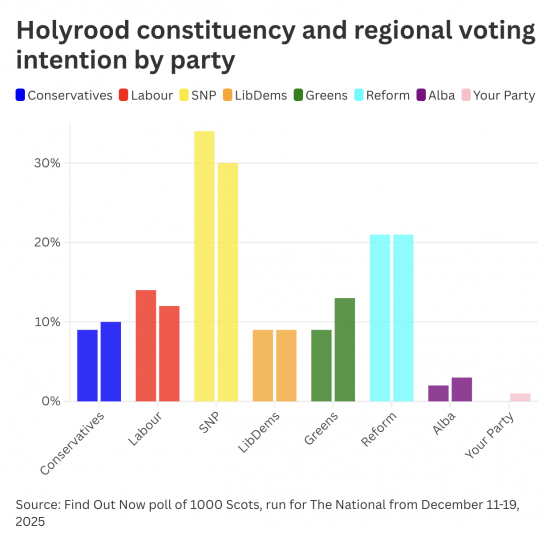
As my colleagues on The National note:
According to a seat projection from polling expert Professor John Curtice, if those results played out in the May elections, the SNP would return 59 MSPs, six short of the 65 needed for a majority.
However, the Greens would return a record 13 MSPs, meaning the Scottish Parliament would have 72 pro-independence members.
The resulting seat allocation would look like this:

Why does this matter? There are several very good reasons.
First, it very obviously matters to those who believe in an independent Scotland.
Second, the collapse in the support for Labour is massively important. Remember that Labour took a large majority of the Westminster seats in Scotland in 2024, and now it looks as if they will struggle to come equal fourth in 2026.
Third, if events turn out like this, this represents a rejection of all the major Westminster parties, and not just Labour. The old order is dead.
Fourth, at least in Scotland, it seems as if Reform is being contained.
Fifth, the Greens have always done well under the list system in Scotland, but look as if they might do better. The nationalist vote is looking as if it might learn how to vote tactically. The Greens in Scotland are not the same party as in England and Wales.
Sixth, the SNP looks as if it will continue to form the Scottish government, which was an outcome that was unlikely only a year ago.
Finally, and seventh, it looks as if Scotland might elect a strongly pro-Independence parliament, again. For how long this can be ignored by Westminster is now a very real question, and in the event that Reform did form a government in Westminster, the conflict between that government and the government in Scotland might become so severe that the move towards independence might be reinforced, albeit in ways that are unpredictable.
As a note in this morning's video, Scotland and Wales are the only parts of the UK where there is some sign of new political hope at present, and in each country, those with vision are providing that hope, as Sinn Féin might be in Northern Ireland. It is independence from Westminster that might, from May 2026 onwards, dominate the agendas in three of the four countries of the UK. For how long is the pretence that we are a United Kingdom viable in that case?
Comments
When commenting, please take note of this blog's comment policy, which is available here. Contravening this policy will result in comments being deleted before or after initial publication at the editor's sole discretion and without explanation being required or offered.
Thanks for reading this post.
You can share this post on social media of your choice by clicking these icons:
There are links to this blog's glossary in the above post that explain technical terms used in it. Follow them for more explanations.
You can subscribe to this blog's daily email here.
And if you would like to support this blog you can, here:

 Buy me a coffee!

Slightly tongue in cheek response …
The UK hasn’t been United for some significant period of time. Of course, disunity only requires any part of the UK to dissent … Not all three “nations”.
However, your question demands timing data ….. I’ll start the bidding with three () :
– Internment without trial was introduced in Northern Ireland on August 9, 1971. “Operation Demetrius”, lead to widespread arrests, increased unrest, and major civil disobedience.
– Margaret Thatcher’s address to the General Assembly of the Church of Scotland took place on Saturday, May 21, 1988. The speech, often referred to by the press as the “Sermon on the Mound” (a play on the location of the Assembly Hall on the artificial hill in Edinburgh, “The Mound”), was highly controversial at the time.
– The poll tax was introduced in Scotland in 1989 by Margaret Thatcher’s Conservative government, ahead of its implementation in England and Wales. (The Act of Union said taxes should not be imposed in Scotland and not England).
All three noted.
But this has to end, one day.
And all thsoe events were pre-devolution as we now know it.
And that, in itself, is notable.
We should always ask the Tom Sowell question “Compared to what” when considering what a Scottish Parliament would look like with 72 pro independence MSPs in it.
In 2011 the same Parliament had 69 SNP MSPs and the Greens 2 MSPs. The 2026 Parliament might swing an extra seat in favour of independents.
In 2014 residents of Scotland voted approximately 5 to 4 in favour of remaining in the United Kingdom. The question of independence isn’t going away, no-one serious is saying that it is, but if we are doing a projection we should be realistic and suggest a future independence referendum would deliver an outcome a bit closer than the one in 2014 but still in favour of remaining in the United Kingdom.
That is not what opinion polls now suggest. Why ignore that?
We all know the only poll that really counts is the one we take at the ballot box. HOWEVER, some people delight in twisting polling statistics to suit their own purpose.
It’s been done by unionists parties and press in Scotland for years.
For now, all we have are the polls BUT, for Scotland’s sake, I hope more of the electorate “see the light” and vote TACTICALLY for INDEPENDENCE.
Surely Westminster governments have strangled our economy for long enough.
Also, good luck Cymru and N.I.
I think David hasn’t taken into account that Scotland has moved on considerably since the 2014 Referendum:
1. In 2014 a big factor in the final outcome was the large number of over 65s, the majority of whom voted to stay in the Union (what we Scots describe as “the aye-been syndrome”: too fixed in their ways to support radical change). In contrast, the younger voters (and remember the voting age in Scotland is 16) were in favour of Independence. Since 2014 an estimated 500,000 of the over-65s have passed on and their place in the electorate has been filled by people who were under-16 in 2014.
2. In the years since 2014 the SNP Gov in Scotland has made life here less burdened by mitigating a large number of Westminster Conservative and Labour policy decisions.
3. The devolution settlement has constrained the devolved economies via the Barnett Consequentials making the Block Grants dependent on government spending in England. Westminster austerity policies since 2010 have reduced UK Gov spending considerably in England and, thanks to Barnett, in the devolved nations too.
4. As a result, the SNP Gov in Scotland has been unable to govern as it would have if it were an independent state. The result of this affects polls here: polling for an independent Scotland is markedly higher than it is for the SNP as a governing party.
5. The total indifference of Westminster for Scottish governance and the marked swing in England to the right has made the Scots more aware of the urgency for secession than before. Reform and Your Party are only going to split the pro-Union vote even further.
6. If both Plaid Cymru and the SNP win in in 2026, it will be harder for the UK Gov to remain bluntly dismissive of the devolved nations’ wishes. There are no Stormont elections in N Ireland until 2027, but the move towards secession from the UK is already underway there and the impact of a stronger resistance by Scotland and Wales to Westminster policies can only fortify the move in N Ireland towards Irish unification.
Thanks, Ken.
Much to agree with.
Go well in 2026.
Absolutely spot on Ken
Why did David Cameron feel relaxed about allowing the 2014 referendum? Because in 2012 – just two years before the referendum – polling for independence and a Yes vote was at 30%. The polls in favour of independence narrowed considerably as the referendum approached.
Scottish politics academics generally see (and it should be obvious) that polling for Yes for independence at 47 % (lower range) and 52% (higher range), is a floor (and not a ceiling).
Therefore at the very least, a future campaign – and polling for Yes is a majority for those under 55 – will start from nearly a half positive towards independence, and any future referendum would be 50+1.
It is for the pro-Union side to make a convincing case to swing it the other way.
(Incidentally, polling for Yes for Welsh independence is now at 30% and thus the figure it was in Scotland just two years before the Scottish independence referendum. With a majority of under 35 in favour of Welsh independence.)
Thank you
I look forward to hearing the UK Government’s ‘positive case’ for staying in the Union Duncan. On past performance they are far more likely to opt for scare mongering: Who’ll pay for your state pension? You can’t use the £, Your mortgage/insurance/private pension provider (take you pick) will withdraw your cover because you can no longer pay in £Sterling, you’ll not get into the EU, there’ll be a hard border at Gretna Green, passports needed, England is Scotland’s biggest export market etc. etc.. Those leading the independence cause when the time comes need to have robust answers to these challenges. Better still, they need to anticipate them and ensure the Scottish public are aware of the answers well in advance.
Much to agree with
All very true, Ken. Talk to my bright young relatives in Edinburgh, all twenty-something graduates starting on their careers and ask them if they feel “British”. They, very politely, will explain – with some puzzlement – that, no, Britishness means nothing to them and that they are Scottish by birth and European by inclination.
You might as well ask them if they are Paraguyan, or Kazak or indeed Martian, such is the degree of alienation from the UK state.
The Scotland they represent is the Scotland that is coming, the “aye-been” (how I loathe that phrase!) demos is the Scotland that is fading and independence is going to happen. It is only a matter of time.
Thanks, Bill.
I feel European.
At 85 years I am one of the “aye been” generation. As quite a few of my like aged friends, I have “aye been” for Independence. Remember we too are getting fewer. Please get a move on!
Excellent post.
My hope is that the next general election produces a hung parliament with Labour (under a new leader and one that is recognizably left, and wants to work with other parties as Compass would want) doing deals with the Greens, Plaid, SNP and Lib Dems to form a supply and demand agreement.
If so, Plaid and the SNP must demand a repeal of the Westminster Section 30 that gives Westminster the power to allow an independence referendum. As a price for support Plaid and SNP should demand that a Scottish or Welsh government that sets a independence referendum bill and stages a successful campaign that wins, will be bound and accepted as valid by Westminster (and thus the international community).
The Senedd election with the prospect of a Plaid and Green coalition is a potential exciting prospect too, considering the recent polling in Wales!
I like the idea.
In Scotland there is a way out from England’s race to the far right.
As you say Farage as PM will accelerate fracturing and division.
Weak Westminster democracy captured by billionaires and corporations could be reformed by Labour, but they behave like control opposition, feathering the nest for Farage.
The mainstream media and politicians have effectively abandoned us.
All around us in the town where I live in the midlands are cheap St George’s and Union flags forlornly flying at half-mast on lamp posts, ironically signifying the pathetic last gasp of of the Union and the dominance of England.
Plastic flags just don’t look right. Especially when they are white and look like a made in China recycled supermarket bag that costs 99p. If you value the flag then you should try to show that in the chosen of material.
One of the main, and arguably decisive arguments against independence is about which currency might be used if a country seceded from the Union. I know you’ve probably thought and written about this at length in the past twenty years, but for the benefit of more recent followers of the blog, could you give an outline of these thoughts.
If, as you suggest, this topic comes quickly in 2026 to top of the agenda, the question will be raised by many people who have no idea of what is possible and consequently will fall in line with what the English press and the BBC think about it.
My own thoughts are that Scotland can have its own central bank and therefore operate as a separate entity to England and Wales. I believe Northern Ireland will eventually join with the republic and adopt the euro. Scotland’s economy is small relative to whole UK and its citizen’s will be worried about a possible currency devaluation, or joining the EU and adopting the euro which is currently worth only 87p. It was a tough argument for pro- independents in 2014; it will be much harder now in the current political news environment where scare stories are presented as facts.
Please excuse me asking you to address such a complex topic, which you’ve almost certainly done before in detail.
Your are right: I have written at length many times on the need for a Scottish currency and even helped draft the 2019 SNP policy technically committing that party to having one after independence.
You are also right that this issue will be weaponised by the BBC and much of the London press if independence returns to the agenda.
Let me state the position clearly, as I have consistently done.
There is no technical obstacle whatsoever to an independent Scotland issuing its own currency, supported by its own central bank. Every modern state with monetary sovereignty operates this way. Scotland already has the institutions, skills and legal capacity required; what it lacks is political permission, not economic feasibility.
The scare stories always focus on devaluation, but this misunderstands what currencies are for. A currency is not a badge of prestige; it is a policy tool. A Scottish currency would allow Scotland to set interest rates, support its banking system, manage fiscal policy, and prioritise employment, investment and resilience. Remaining dependent on sterling without control over monetary policy would be the highest-risk option, not the safest.
My argument is simple: risk management requires Scotland requires Scotland to have its own currency from Day 1 as an independent country.
As I have long argued, the real risk is not currency change but currency subordination. Using another state’s currency permanently means surrendering macroeconomic control — and that is what makes economies fragile.
Yes, opponents will present this as “radical”. It isn’t. What is radical is pretending that Scotland could run an independent economy without the normal tools every other country takes for granted.
This debate is not about technical economics. It is about confidence, honesty — and whether Scotland trusts itself to govern.
The website of the Scottish Currency Group, of which I am a member, has more on this.
Joining the euro is a separate political choice and not a prerequisite for EU membership. Many EU countries retain their own currencies. Adopting the euro without first establishing monetary sovereignty would simply recreate the constraints that have damaged countries like Greece. That is not a progressive route.
Given what you say about a Scottish currency maybe the people who voted to stay in the Union in 2014 were aware that an independent Scotland retaining sterling was a dumb idea. My (British) recollection is that the independence campaign was lack lustre and left too many questions unanswered. Better luck with it all next time, if that’s what Scottish people want.
Alex Salmond and I discussed his own error of judgement on this issue several times before he died, and he always apologised for making the mistake of suggesting Scotland would go with the pound at that time.
Beautifully answered Richard.
Thank you
See also this https://www.thenational.scot/news/20590270.independent-scotland-will-need-currency-insists-richard-murphy/
The polling does indeed suggest that there will be a pro-independence majority in the Scottish Parliament.
But the pro-independence vote share is well short of a majority (SNP + Green = 43%).
What is happening is that the Additional Member System has become worryingly disproportional as the number of parties with signicant vote share increases.
The same phenomenon has occurred in Germany in recent years, though they have dealt with it in different ways,
putting a high priority on restoring proportionality.
On this occasion the disproportionality may help the pro-independence side, but it would be much better long term to have a system such as STV that is more reliably proportional.
For a fuller explanation see
https://www.libdemvoice.org/the-additional-member-system-and-its-overhang-problem-78820.html
The opinion polls on independence suggest a majority for it persistently now.
You’re right, which raises the question of why the pro-independence parties aren’t doing better in the polls.
Clearly there are a lot of voters who support independence but not the SNP as it is at present – which after nearly 20 years in gvernment is perhaps not surprising.
Denis’s second paragraph is spot-on. A change to STV would be far more representative of voter intentions than the current d’Hondt system This was deliberately chosen by Labour when it was in power in Westminster to prevent any other parties gaining a clear majority in Scottish elections. The voter’s two vote choices (full details here https://www.parliament.scot/-/media/files/spice/factsheets/parliamentary-business/scottish-parliament-electoral-system-12-may-2021.pdf) are not fully understood by a large swathe of the electorate. The first choice is for the voter’s constituency and is selected on FPTP basis.
The 2nd choice is for the Regional List (there are 8 regions) and is the one which is widely misunderstood (see the link above for the convoluted detail). The aim of d’Hondt is to produce a hung parliament which, in normal circumstances, would prevent radical political changes. This gives the Westminster Gov the over-riding control of major political issues. As a result, the SNP usually needs the support of other parties (e.g. the Greens) to have a clear majority in Holyrood – mission accomplished for Westminster. For Scotland to become independent and governance sensibly managed, it’s pretty clear that the voting system must be simplified and representative of the electorate’s voting choices.
Thanks. Spot on.
Perfectly put Ken.
Nobody I talk to understands the D’Hondt system (I live in Edinburgh).
I’ve read a description of how the system “works” but can’t say that I understood it well enough to explain to others. However, I do know that information on how to vote tactically (rather than wastefully) needs to be made widely available if the SNP is to win a majority of seats.
Sign of the times. The Daily Mail editor now using anti-semitism to undermine Zack Polanski:-
https://www.thecanary.co/trending/2025/12/29/daily-mail-jewish-caricature-zack-polanski/
Where are the police investigating this? Too busy arresting Palestine Action supporters! What a shabby country we now have!
Is the UK even a legal entity?
The UK exists because the Scottish people were denied their lawful rights
The Union wasn’t completed by consent, it was completed by removing the only moment in which consent could exist.
https://angrypict.substack.com/p/annexation-the-uk-exists-because
Apologies if you have already examined this.
It’s obviously not a nationalistic agenda when labour is failing so miserably as it is? Is it set to fail?
Are we being doomed with a homogeneous state is another question?
Yes we are! Imo opinion. .
Thankfully we have social media, although sometimes that’s not a great thing!
As an independence supporting Scot, at this point it seems to me that the SNP do not have a clue how to move on from where we are, unless are there some drastic changes of personnel within the SNP or a unexpected external event that brings independence to the fore again.
Based on that, my own theory is that the break up of the union will come from England as opposed to Scotland…
You can imagine a scenario in the 2029 election where Reform perform well in England but fall short and are kept out of government by a (very loose) confidence & supply coalition of Labour, Lib Dem’s & SNP. Given that the rights response to any setbacks seems to be to tack ever further right, it doesn’t seem implausible to me where the 2034 election manifesto would include a commitment from Reform/Conservatives to have a referendum on England leaving the UK to stop the Scots from meddling in ‘Englands will’ , especially if the 2029 election winners start to look at any closer ties with Europe.
The curveball is that by that time you would think Farage may have left, reduced his time in or is bored of front line politics, so who knows who would come in after him, I’m guessing his style of politics would have either ran its course or be normalised by then.
Some time ago, I made the ‘tongue in cheek’ comment that Scotland Wales and NI. should get together and chuck England out of the U.K. But now I’m wondering if such a Celtic Alliance might be viable. Scotland and NI voted to remain Wales was 47.5% remain and the appetite to rejoin grows. So any split from England would lead towards increased pressure to rejoin. Adoption of the euro would bypass the currency argument, while the loss of the flexibility of a fiat currency could well be outweighed by the benefits of EU membership. (Given the U.K. Government looks unlikely to ever exercise that flexibility)
At the time you stated “it would never happen” and I had to agree.
But I’m interested to know what you think now.
The euro does not in any way avoid the currency question.
You have to have your on currency before joining the euro.
In that sense it solves the currency question – leave the ppund.
But the euro is and always will be a disaster for smaller states and does niot prevent EU membership, as many states prove.