
A couple of weeks ago, I wrote suggesting that investors should beware the end of December.
Why? The UK stock market peaked on 30 December 1999 and took more than a decade to recover, having halved in value over the following two or so years.
Then I note this morning's news in the Guardian saying:

and:
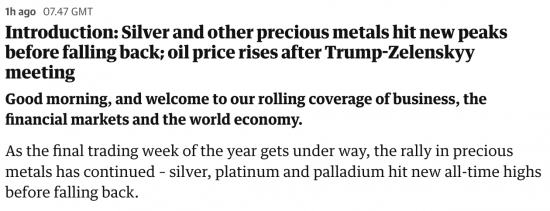
It seems that fools and their money are still being parted. I still think this will end in tears. These prices are evidence of the exuberance of money seeking returns from speculation rather than purpose, and every such bubble in history has burst. There is no reason to think it will be different this time.
Comments
When commenting, please take note of this blog's comment policy, which is available here. Contravening this policy will result in comments being deleted before or after initial publication at the editor's sole discretion and without explanation being required or offered.
Thanks for reading this post.
You can share this post on social media of your choice by clicking these icons:
There are links to this blog's glossary in the above post that explain technical terms used in it. Follow them for more explanations.
You can subscribe to this blog's daily email here.
And if you would like to support this blog you can, here:

 Buy me a coffee!

China will begin restricting silver exports on the 1st of January. This could start the slide everybody is now expecting and burst the “everything bubble”.
More on this here:
https://substack.com/home/post/p-182775552
I’m not sure that this will end in tears. That would only be for the rich fools who voluntarily parted with their money and lost a substantial wedge of it. The amount lost would unlikely be 50% as using the 1999 comparison that could only happen if you bought at the peak and sold at the trough. But that would be sad for them and if you know such people you can only advise.
But if you listen to progressive writers on economics there is a causal link between reduced wealth inequality and societal well being. In the word of MT the logical response is “Rejoice”
I will not rejoice at jobs lost and austerity.
When the crash happens share prices will decrease significantly. The 1% and above may lose money but it will not affect their day to day lives. I have little sympathy for them. Reducing inequality will be beneficial to society as a whole and, I think, even to the wealthy. But, sadly, a crash will not only affect the 1%, it will also affect the real world, the rest of us.
One way a crash will affect us is by reducing the wealth apparent stored in defined contribution pensions. For many people, under 55, most of their pension wealth is stored in shares. They are told, incessantly, everywhere, that, long term, shares will rise even if there is a temporary dip, so they should not worry about a crash. Well, in the long term we are all dead and a “temporary dip” may last decades. Someone in their thirties of forties, who is already suffering from lack of job opportunities, extortionate housing costs, excessive taxation (in the form of student loan repayments and so on), will also see a considerable part of any savings they have in their pension lost. Not just their current well being is poor, but they will not even have a pension to look forward to.
There is no guarantee, in fact quite the reverse, that the stock market will continue to increase despite what savers are told (by the chancellor, the mainstream media, financial advisers, uncle Tom Cobley and all). Demographics, our current fertility, of 1.4, is way below replacement rate, mean that the population will become skewed to the more elderly and will eventually decline. This may happen, according to some estimates, as early as the 2050’s. When that happens, more money will be drawn from defined contribution pensions than is added. And the inevitable effect is that stock prices will greatly decline. If this is combined with a crash today, the stock market may never again reach the peaks it is reaching at the moment.
I suggest a crash will be serious for everyone.
Agreed
I am reading Cory Doctorow’s “Enshitification”. The book is useful but gets somethings wrong: specifically IBM and the cloning of the IBM PC BIOS – you can copyright expression (code within the BIOS) you cannot copyright basic computer functions – which was why the BIOS could be cloned – a point Doctorow did not seem to understand (for the avoidance of doubt on this – I was closely involved with the original EU Software Copyright Directive”). Also his rationale for the design of the IBM PC is incorrect – the IBM board were by 1980 fed up with projects taking too long & getting gold plated. Hence the approach taken (to use outside suppliers). He also omits to mention DR.DOS, in the 1980s, a much superior product to MS.DOS.
Anyway, the money extraction machines which are Google, Apple etc – rests on so-called “intellectual property” – IP (the points about Apple’s “walled garden” app money making machine – are well made). The share prices of all the big dot-com stocks rest on the IP legitimising large-scale money extraction. If this ceaces for any reason – the share prices for those companies affected will tank. I’m rather surprised that China or Ruzzia has not taken a pop at this, e.g. hosting app farms that offer products which destroy many/most/all of the controls that Apple etc implement to extract money. As for Apple’s walled garden – even in the early 1980s this was the case & it is no surprise that this “approach” has been extended to applications (which you never own – & are only licensed to us). IP erosion is, in my view, a case of when, not if. Once it starts, goodbye Apple share price, ditto Google etc & global financial crash – for the dot-coms & perhaps some others.
A note on intellectual property, or IP.
Patents protect inventions by providing monopoly rights for 20 years from application. This can be extended a little for some pharmaceuticals. One might argue whether this is appropriate but it is, at least, time limited. And it is relatively easy to determine when patent rights expire.
Copyright, on the other hand, protects creative works. Copyright lasts a great deal longer. Officially it lasts for the creator’s life plus 70 years. Often creative works are the product of multiple people, for example movies. And often the creators assign their rights to a corporation. Then it is difficult to determine when copyright expires because you have to be sure that everyone involved has been dead for 70 years. With current life expectancy copyright could easily last 100 years, after which time it can be really difficult to determine if everyone has been dead sufficiently long. Incidentally, the story is that the copyright period has been extended multiple times to ensure that Disney’s copyright on Mickey Mouse was still valid.
Software is protected under copyright as a creative work. Software patents are, in theory, inadmissible. So software IP is copyright, lasts a very long time, and provides immense protection for the tech giants. In my view this period is grossly too long. So the tech giants are particularly favoured even compared to other large corporations who have to use patent protection.
No, it was more than that. IBM did various deals so that they wouldn’t be broken up by anti-trust legislation (the Sherman Act??).
They had to publish the architecture of their hardware. This was so that ‘plug-compatible’ companies, such as Memorex, could supply hard disks and memory to IBM customers, thereby giving them choice. This applied to PCs as well.
Apple has always opposed this approach, which is why you have to take what you are given. It is why they ran into problems in the 80’s. They wouldn’t even allow general networking and limited the Macs to DECNet.
There was PC-DOS, IBM’s operating system as well as MS-DOS. The story about DR-DOS, a multi-tasking system, was that the developer’s wife didn’t pass on the message when IBM phoned before contacting Microsoft.
I worked in the early PC/Apple Mac industry. I still remember the number of customers who typed in ‘Format’ when they were on the hard disk. They were confronted by ‘press any key to continue’. This included ‘Esc’. You had to hit the power switch otherwise it formatted the hard disk.
By the way, if you want to know where the technology for the iphone came from and who paid for it, read Mariana Mazzucato’s ‘The Entrepreneurial State’. It has a whole chapter on how it was funded indirectly by the US tax payer/Government.
Thanks
A good rule of thumb is to check if Fa***e got/gets paid to promote it, then avoid it (and him) like the plague (applies to gold, silver, crypto, Brexit, Trump, Putin, Reform UK Ltd., racism, misogyny, ableism, toxic patriotism, Christian Nationalism, fossil fuels and insurance based health provision).
Hi everyone … I’ve been wondering, what are the economic justice oriented or ‘progressive’ ideas on how to deal with the problem of falling pensions if stocks crash or there is long term low growth in the economy?
The short answer is that progressive economics does not treat pensions as a bet on financial markets. It treats them as a social promise about how resources will be shared over time. I wrote about this years ago in something called “People’s Pensions” (2003). It was published by the New Economics Foundation
Let me unpack that.
1. The problem is not falling asset prices – it is financialised pension design.
The vulnerability you describe exists because we deliberately replaced collective, defined-benefit pensions with individual, market-dependent defined-contribution schemes. That shift transferred risk from society to individuals, while pretending that “long-run growth” would always bail everyone out. It was never true, and it is demonstrably false in a low-growth, climate-constrained world.
2. Pensions are claims on future output, not piles of money
At the point of retirement, what matters is not the nominal value of a pension fund, but whether the economy can provide housing, food, care, healthcare, transport and energy for older people. No stock market can guarantee that. Only real economic capacity and political choices can.
3. Progressive responses therefore focus on de-risking retirement, not maximising returns
That implies:
– A much larger role for state-backed, pay-as-you-go pensions, insulated from market volatility.
– Collective risk-sharing through defined-benefit or collective defined-contribution schemes, rather than atomised individual pots.
– Recognition that the state cannot outsource retirement security to financial markets, any more than it can outsource healthcare or defence.
4. Low growth is not a technical problem – it is a distributional one
If productivity and output grow slowly, the question becomes who gets what, not how fast the pie expands. Progressive economics is explicit about this. It accepts that adequate pensions may require higher taxation on wealth and rents, and greater inter-generational solidarity, rather than wishful thinking about asset bubbles.
5. Ultimately, pensions are part of a politics of care
A society that allows older people’s incomes to collapse because markets fall has made a moral choice – and it is not a defensible one. Retirement security is a collective responsibility, grounded in maintenance, continuity and care, not speculation.
So the progressive answer is not “better investing” or “more financial literacy”. It is to reverse the financialisation of pensions and to re-embed them in democratic, publicly accountable systems designed to work even when markets fail – because markets inevitably do.
Are you not, in effect, arguing for a much more substantial state pension (with some sort of inflation protection)?
Even defined benefit company pensions had problems, due to the link to company contributions and the fund’s performance: as you say, financialised – with ‘successful investment’ leading to companies taking contributions holidays (and reducing costs, increasing profits for the benefit of shareholders) followed by shortfalls when growth forecasts weren’t met. The risks weren’t shared appropriately, but the ‘solution’ was worse: putting the whole risk onto individuals; and even deluding them into thinking they could ‘beat the market’ and get a better result.
The question of entitlement (to a state funded benefit) then arises: should it be based directly on some history of contributions (or credits for various ‘justifiable’ non-employments) such as our current NI contribution-years basis; or something more like a UBI? (Citizens’ rent as I’d rather call it.)
I would prefer a state earning’s related pension scheme. (SERP).
My pension experience was:
15 years employed in small professional practice, putting my money (no employer contribution) into a personal pension which ended up as the Equitable Life Guaranteed Annuity fiasco. Government response was that I should get compensation but “they couldn’t afford it”.
Then into church work for nearly 30 years in a well provisioned DB, then DC scheme (10% & 5%), which nearly went under, then got handed over to an insurance company with a big capital injection from the denomination and big sacrifices from the individual employers (churches) too.
During this period, I was in and out of SERPS as gov’t havered and moved goalposts.
Gov’t constantly (and falsely) told us that decent state or DB pensions were “unaffordable”, hence all the deleterious changes. But they appear very reluctant to admit that their preferred “every person for themself” market model doesn’t work either. They are as cowardly about facing the pension challenge as they are about fixing social care – both issues lie somewhere buried in the long grass at the bottom of “someone else’s garden”.
Interesting to see the long delayed response of gov’t to injustice of miners’ pension shenanigans. As usual, justice delayed for decades.
https://www.theguardian.com/money/2025/dec/23/former-mineworkers-celebrate-historic-100-a-week-uk-pensions-boost.
The things in short supply are not money, but political and moral courage. Change occurs when politicians are more frightened of the “problem” than of implementing the “solution”.
You describe radical but entirely do-able change.
So, all WE need now, is to find and elect moral leaders of courage, vision and intelligence. Sadly, we are out of practice at that, and need to limber up, pronto.
“ The things in short supply are not money, but political and moral courage”
So true.
Thanks, I agree.
Hi
Can you comment about the threat the unwinding of the yen carry trade poses to the global financial system? With Japanese interest rates rising and the yen strengthening along with likely US interest rates decreasing when Jerome Powell is replaced could trigger an serious flash crash.
No, because I am genuinely not the right person to do so. The risks are real, and relate to rate differentials and expectations about them, but others could comment better, I suspect.
The ‘carry trade’. Borrow yen at 1%, sell yen/buy dollars, invest dollars at 4%.
If the FX remains stable you will earn 3% per annum….. but that’s a pretty big IF. FX rates are volatile and this trade has cost a lot of people a lot of money over the years when it goes wrong. Historically, usually the target currency is a small, high interest rate currency like NZD, AUD, GBP (ITL, FRF pre-EMU) and flows tend to swamp any real trade/investment flows….and can cause economic problems. (Hence, FX controls in many SE Asian currencies). I’m not sure these trades have great global significance.
USDJPY currency pair is different. First, US capital markets are deep and Japanese trade and saving surpluses need a home. Japanese institutions hold massive amounts of dollar assets – indeed, I was sent to Japan in 1988 to serve these clients. Whilst, technically, one could call these flows a ‘carry trade’, they are not short term or speculative. Now, their liabilities are all in JPY so what might trigger them to repatriate their money? I don’t know…. but it has a deeply political and military dimension…. not merely economic.
Thanks. Appreciated.
Talk about these global markets is difficult and getting my head around the details of what is happening in global markets with say silver and the yen feels really out of reach for me, and I imagine for the average citizen. I can just about get my head around big tech Monopoly problems and the ways the 2008 crash funnelled money to the rich instead of to the many. But it takes a lot of reading, a lot of time and thought. It’s harder once the crisis hits, trying to think on the hoof, in an emergency and panicked frame of mind. That is why I think it’s essential that we have some ideas in circulation about how to deal with crises before they happen. For example, planning and discussing different responses for when the AI bubble bursts. So that citizens can already have different ideas to argue about and no-one can say ‘there is no alternative’. The Guardian has published letters from me and other readers today about getting ready for the inevitable AI crash. I think we need to be talking and perhaps disagreeing and arguing now about what to do when it comes. https://www.theguardian.com/technology/2025/dec/29/we-must-take-control-of-ai-now-before-its-too-late
A good letter. Thanks.
[…] wrote a reminder of the danger of the end of December in financial markets yesterday. In it, I highlighted the rise in the price of precious metals, including silver. And yesterday, as […]