
I did a video yesterday on campaigning and why most of it is just moaning.
I put up a poll on YouTube asking why most campaigns fail. An astonishing 5,400 people have voted. This is the result:

Then I listened to the third of this year's Reith lectures last night, by Rutger Bregman. It was as bad as the second. The promise of the first has been lost entirely. Bregman is a headless heart, wanting status and not change, and name-dropping rather than offering solutions.
The second lecture felt elitist, at the very least. It could have been worse than that, and the Liverpool audience for it called it out for what it was.
This third lecture fawned and made wildly inaccurate claims (neoliberalism is, apparently, dead and gone, which shows a stunning lack of economic insight on Bregman's part). But like the second, it had a giant hole in the middle, except this time there were three. It lacked moral vision, which was called out. It lacked a plan and any idea of delivery. The Edinburgh audience called it out.
Bergman is like so many campaigners: he wants to be thought of as a nice do-gooder, buit hs no idea what he really wants to do, where he wants to do it, why he wants to do it, to whom he really wants to do it and most especially nhow he wants to do - hoping at best others will work that out for him. As a Reith lecturer, he is a failure.
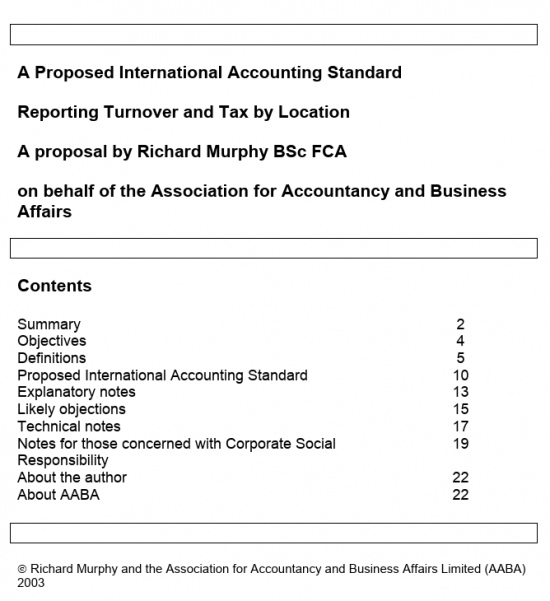
And if he wants to know how you campaign, you start with the details. Take this, for example, which was the first ever publication on country-by-country reporting, written by me and issued in January 2003 by the Association for Accountancy and Business Affairs website run by Prem (now Lord) Sikka. This was a complete plan for what country-by-country reporting would be, written as an International Accounting Standard so no one could be in doubt what was meant, and why it was deliverable. That is how to campaign. That is why we got country-by-country reporting: the devil was always in the detail, and there was never any doubt as to what that was. Why is it so hard to work out that this is how to win?
Thanks for reading this post.
You can share this post on social media of your choice by clicking these icons:
There are links to this blog's glossary in the above post that explain technical terms used in it. Follow them for more explanations.
You can subscribe to this blog's daily email here.
And if you would like to support this blog you can, here:

 Buy me a coffee!

Just so that you know, this is why I always come here and nowhere else.
🙂
What you set out as the effective way to campaign ‘show how change will work’, by providing the practical detail, sounds very similar to corporate lobbying. Lobbyists go as far are drafting legislation. One important difference is the level of transparency.
My comments are aimed at the left, who almost never do these things.
Two words I like, which I think you apply in your suggested approach to campaigning for something to happen.
1. Assiduousness- being very careful with the minutiae or detail of your proposal. Thinking everything through, anticipating questions and likely misconceptions.
2. Magnanimity- making allowances for the shortcomings of your target audience. Being generous with your approach by not assuming their familiarity with the status quo and the conventional wisdom.
I liken it in my own experience to setting an exam. It’s going to be much more important to those who sit it than to those who have set it.
Thanks, and agreed.
It is really quite odd as I am currently reading his book Moral Ambition and finding it quite good because he calls out all the things that he seems to be guilty of himself! He calls them/himself noble losers.
Richard, part of me is sympathetic to your position. If I can paraphrase with a bit of licence: “most campaigning is just moaning – why can people just make proposals that are suitable to become legislation and make practical change?”.
Your country by country accounting approach and impact was exemplary …. Your taxing wealth report is great … And there is some evidence that some politicians are picking up snippets.
The skills and confidence needed to draft legislation or to harmonise tax inconsistencies are not universal. Many good people struggle to understand their pay slip or submit a tax return.
Some people campaign simply to draw attention to issues that are ignored or suppressed – but are still shocking or unfair. The act of raising awareness could be seen as simply moaning … But it can highlight issues and also reassure some people who feel isolated and abandoned. That can also be useful and helpful.
I am convinced some folk in our society are not aware of the hardship being endured by others. Simply identifying this and highlighting it is a start – though few are in a position to write “The Conditions of the Working Class in England”, as Engels did. And yet many of those with empathy are on the right side – even if they can’t draft legislative-ready drafts or a statistical assessment of the conditions endured.
Sadly, too many of political leadership seem to have none of the attributes needed: awareness, compassion, a plan to address the issue or any leadership to call to action. I definitely agree with that!
Noted. Thanks.
Agree a vacuum.
They may understand the problems, but lack real craft – real world experience and technical skills learned over decades, that can do detail, and deliver change.
Also surrounded by careerists who similarly lack craft, other than the craft of spin, hot air and self-advancement.