
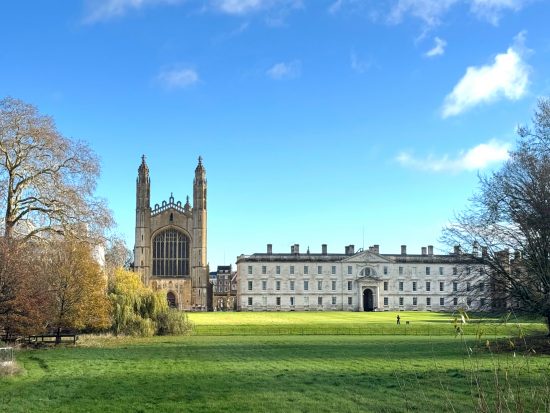
Taken during a walk along The Backs in Cambridge this morning:
Thanks for reading this post.
You can share this post on social media of your choice by clicking these icons:
There are links to this blog's glossary in the above post that explain technical terms used in it. Follow them for more explanations.
You can subscribe to this blog's daily email here.
And if you would like to support this blog you can, here:

 Buy me a coffee!

nice architecture
If you want to suggest privilege and power, behind enclosed spaces.
Bastiat would have taken a photograph of empty fields beyond Welney and labelled it as a statement of power. It’s in that empty state because of the power of farmland owners to extract rents, privileges and subsidies. Bastiat was a great analyst of the unseen.
King’s is by reputation the most progressive of Cambridge colleges, the home of Keynes and Pigou – and more briefly of Wynne Godley, whom I had the pleasure of. knowing when I was a research fellow there.
I was then living behind the 3rd and 4th windows from the left on the top floor of the building in the photo, with my girlfriend and her orange cat. I found out recently that MR James of ghost story fame lived in the same rooms for a few years around 1900.
I guess I was privileged, but it sadly hasn’t led to power.
🙂
Thanks
Not sure if the caption is apposite. The university work very hard to ensure that young people who would benefit from a Cambridge education (intelligent, motivated) can go, regardless of their background, taking pains to avoid a public schools bias. One of the key goals when they shake down their alumni is to fund scholarships. Of course, intelligent, motivated, educated young people often do go on to positions of power and privilege but could that not be considered to be ‘achieving their potential’?
Your view of this is very different to mine.
Eton Hall in Cheshire (Duke of Westminster) would be a good addition to your snapshot collection.
Yes
But it did have a very neat 15″ gauge railway for a while.
Oxford has a model engineering society and what looks like a rather nice club track
https://cosme.org.uk/
As does Cambridge
https://www.cdmes.uk/
Talking of walls and privilege, it’s well worth reading this essay on the corruption of Christianity by the MAGA/Trumpist right in the US (if you haven’t already seen it). Even as an atheist I’ve often wondered how the teaching of Jesus has become so utterly corrupted in the US, such that they can believe that a man who would be happy to use the bible as a door stop, and is likely the most corrupt pathological liar on the planet, is their “saviour”. Well, Bill McKibben provides the answer.
https://www.theguardian.com/us-news/ng-interactive/2025/nov/23/america-christian-evangelical-discrimination-immigration
That is well worth reading. Thanks. I had missed t.
This is well worth reading: too
China has brought millions out of poverty. The US has not – by choice
Eduardo Porter
Also in the Guardian.
Thanks for that Mr Horrocks.
Christianity (& all organised religions) has always been malleable, used by whoever holds power to reinforce that power. My grandmother and mother, catholics, & poor, regarded the church & its structures with deep suspicion, priests and nuns were seen as, basically, evil/weird, unless proved otherwise. I found that odd at the time, less so now, & extendable to most organised religion. A recent article in the Daily Kos speculated that to be baptist ministers in the USA one needs also to be a peadophile (based on the quasi daily cases that emerge). Empathy, kindness to strangers, trying to do the right thing – I don’t need a religion for this, but it appears increasing numbers of Americans do. Perhaps they are simply sheeple – I notice the New testment compares people to sheep, odd.
I was struck, when I was helping on a friend’s farm a few years ago, by how much more intelligent than the sheep the goats appeared to be. This sheds a slightly different light on several Biblical stories.
In 1963, a friend and I analysed Tripos results as correlated with type of school. (He public school, me state; we wanted to settle an argument). In that year, the proportion of different classes of degrees was nearly equal between public and state schools. Only Direct Grant schools did worse — lower grades than would be expected. It covered just one year; I don’t have the numbers any more, but it was at least an indication of lack of bias in entry policy then. (Back then, Cambridge exam results were published in the Times, with school attached to each name, which made the survey quite easy)
But classes of degree have nothing to do with access.
Henry VI did not set out to manufacture an elite upper class. He intended to cultivate a body of educated, disciplined, and pious men who would serve Church and state with humility. The ethos of the college’s “Foundations” is one of service, modesty, and the moral improvement of society, rather than exclusivity or privilege.
So let’s dream. King’s could reclaim Henry VI’s vision by putting access, humility, and public service at the heart of its mission, without needing limitless new funds.
Admissions could focus on potential, not pedigree: foundation years for students from disrupted schooling, deep partnerships with state schools, and substantial bursaries so that finances never block talent. Generous support for ordinary-background students would become the college’s defining goal.
Public service would be central. Scholarships could target teaching, healthcare, social work, climate action, and public administration. Students could gain placements in real-world, service-focused roles, with achievements in contribution and community celebrated as much as academic accolades.
Funding this is feasible. A portion of the college endowment’s returns could be redirected toward bursaries and service scholarships. Internal spending on prestige projects or ceremonies could be partially reallocated. Targeted alumni appeals framed around concrete social impact would attract support, while foundations and grants focused on education and inequality could contribute to outreach and research programs.
Finally, the college could open its resources – libraries, events, expertise – to local schools and community groups, while publishing annual reports on access, diversity, and social impact. By combining strategic funding with cultural reform and civic engagement, King’s could shift from being a symbol of privilege to a living embodiment of Henry VI’s ideal: a learned community dedicated to opportunity, humility, and service.
King’s does quite a lot of that already. Its strapline is “We aim to transform the lives of our students, preparing them to be both ethical leaders and meaningful contributors to society.”
It is no more expensive than other colleges and universities – all have pretty much the same fees at £9k+ – and it offers what it can to students from disadvantaged backgrounds.
It has had a positive-discrimination approach to student admissions since the 1960s, shedding its link with its co-foundation of Eton – which of course started out like King’s with the aim of educating poor but bright students for church or civil service, but now really is a bastion of prestige (I think its fees are around £50k).
The appearance of privilege of King’s is perhaps in the beauty of the buildings especially the expensive-to-maintain Chapel. There is also the exclusion of the public, but that’s not what the College would prefer or used to have; they’ve had to introduce it because of overwhelming visitor pressure.
Alumni support is already directed on some of the lines you advocate – see https://www.kings.cam.ac.uk/alumni/support-kings
– but the shopping list you suggest is unrealistically wide.
It’s part of one of the world’s leading academic institutions and it makes sense to continue that focus, looking for the next Keynes or Turing, regardless of their background, while trying to hold to an ethical approach, whether that be on diversity or sustainability. [That grand expanse of lawn in the view is now cultivated as a wildlife meadow – better than in the days when I was there, when the Professor of Fine Arts complained that the colour of the cows was different from those in C17 classical paintings.]
It might do all that, but that’s rather likle the average public school doing a little outreach to try to keep its charitabvle status. My description is at many levels still entirely appropriate and valid. Coming from a state school to King’s does not imply there is no privilege involved: there often is, and the aim is usually power. Your own language implies that at the end of the piece.