
Thanks for reading this post.
You can share this post on social media of your choice by clicking these icons:
There are links to this blog's glossary in the above post that explain technical terms used in it. Follow them for more explanations.
You can subscribe to this blog's daily email here.
And if you would like to support this blog you can, here:

 Buy me a coffee!

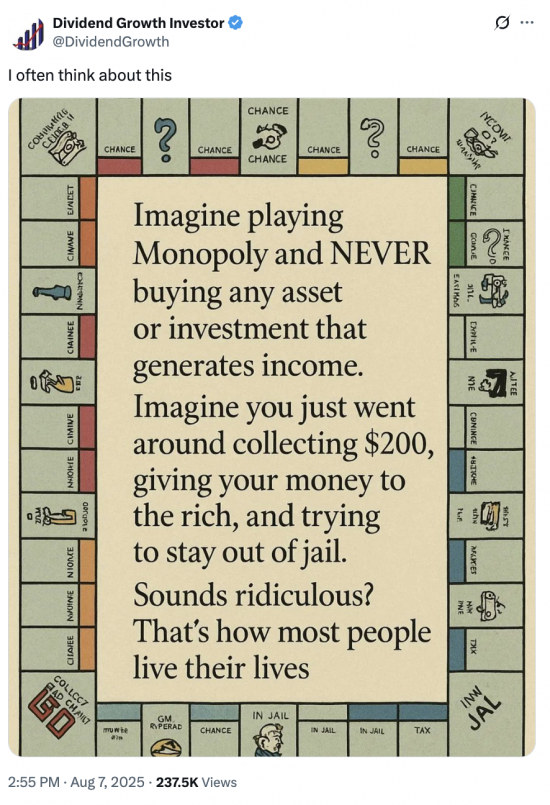
Capitalists may point out that anyone can win a game of Monopoly.
Socialists may point out that everyone else loses…
…and there is more than enough property so that no one has to go homeless.
There is a lot of truth in that and it will only get worse in the mid term.
Ever played Monopoly with someone as banker, who cheated, using the bank money as their own?
I’m sure most of the people here know that Monopoly was created to illustrate the evils of capitalism and concentration of asset ownership. I expect we have almost all played it, even though it is an awful slow boring game. Some may enjoy it, or at least the memory of it, but any good games shop will have hundreds of better games. Try Carcassonne or Race for the Galaxy (or San Juan) or Bohnanza instead.
I admit to thinking the advantage of adulthood and grown up children is never having to play such games again.
I have four grown up grandchildren and they always want to play board games when they come here.
My grandson who is still at school will be coming tomorrow and want to play Labyrinth with me, as his cousin is on holiday in Denmark and won’t be available to play with him.
His 25 year old sister saw once that I was going to send the game of Anti-Monopoly to the charity shop and got most upset, so I kept it.
Both my grandsons are autistic, and we have always found that playing games helps them learn.
Games have rules
Autistic people like rules
Hah!
Just wait until you have grandchildren, Richard. 🙂
I keep telling them not to think about it, yet.
Monopoly is even better for illustrative purposes than a superimposition of a meme.
Monopoly has two vital, and relevant, rules.
1. The Bank never “goes bankrupt” but issues as much money as is necessary in the form of IOUs written on ordinary paper. [Central Bank money creation]
2. Tax spaces: A player landing on a Tax space hands over the tax demanded to the Bank. [Tax *revenue* from Bank-issued money)
Agreed
I often use a Monopoly analogy for tax and spend….imagine starting a game of Monopoly where the banker (government) has not yet put any money into the game (economy). First go you roll a 5….Pay your Taxes.
My father played lots of Monopoly on a troopship to India, going round the Cape, in 1943. He passed on the habits — fast, ruthless playing, no cheating in any way, no being nice to friends, always collecting the last penny of moneys due. This way, a game takes about 45 mins. It teaches you to lose without whining and win without crowing, and also to realise that these in-game behaviours are only a game. Not the way you want to behave in real life.
I was thinking of this a while back and that for millennials and GenZ it’s like joining a monopoly game late on with most of the property bought up, existing players have more money than you and if you wanted to buy a property it’s open to all.
Oh and the banker has a favourite player.
That’s about it.
Excellent mix of words and images! I learnt fairly recently that Monopoly was (as a Andrew points out) created as ‘The Landlord’s Game’ to teach students about the workings of rentier capitalism. Another person stole the idea and made lots of money from it…
Excellent use of words and images! I learned fairly recently that the game was created as ‘The Landlord’s Game’ to teach students about rentier capitalism, and that another stole the idea and made lots of money from it under a new name.