
Stephanie Kelton's new film, Finding the Money, is finally available to rent. You can do so for £2.99 from here.
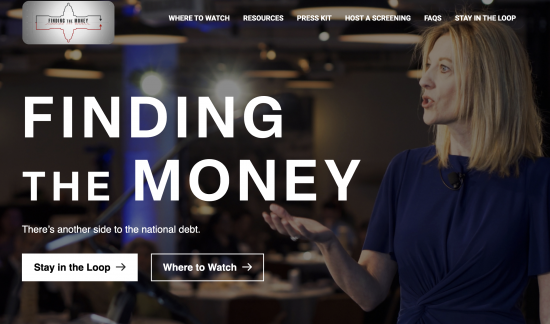
I hope to watch it very soon - and having not done so as yet.
Accept that the film has an inevitable US bias. Then, realise that modern monetary theory is of vastly greater importance than any US context.
Thanks for reading this post.
You can share this post on social media of your choice by clicking these icons:
There are links to this blog's glossary in the above post that explain technical terms used in it. Follow them for more explanations.
You can subscribe to this blog's daily email here.
And if you would like to support this blog you can, here:

 Buy me a coffee!

Absolutely splendid Richard, thank you.
I saw it on Thursday in a packed house at UCL, followed by a panel discussion. Zack Polanski, Green Party Deputy Leader, was on the panel. Are you in contact with him?
The film is excellent. Stephanie Kelton is persuasive and there are many other interviews, mostly pro and a few con. The long fight to persuade the academic economics profession is under way.
Zack and I know each other, but not well.
This is brilliant, I’ll “give it foive & buy it”.
With Rachel Reeves’s chaotic incompetence being noticed even by her fellow monetarists, its a good time to collapse the whole edifice of monetarist economics.
IMHO, every time a Cab. Minister appears in front of a microphone, they should be complimented on their wardrobe/specs, asked if they bought it themselves, & then asked where money comes from, then asked to explain the difference between the national debt & the nations savings.
#Austerity
#MMT
#Economics
I bought it, and so far, my favourite bit was when I realised that Joseph Bernstein, Biden’s economic adviser, knew even less about how government-issued bonds work, than I do (and I’ve almost got there thanks to Richard, Stephanie et al.). He was clearly totally at sea, but doubtless pocketing a fistful of newly created $$ for his “expert” advice.
Great film!
I also saw the film in the overheated lecture theatre at UCL last Thursday (by fortunate coincidence having to be in London that day).
It’s 90 minutes and for me (as an MMT ‘convert’) it was too slow working through the basics, but would be a good intro (with Stephanie Kelton’s Myths busted; and some nice graphics – especially on double-entry: hooray! and on tax = money destruction); plus some hilarious and sad moments of excruciating silences or bumbling, waffling incomprehension from several so-called experts, chairs of committees of advisers etc etc. so maybe useful for those less well educated than readers here, provided they tolerate the length. (It keeps interest going, though.) And a clear message that the UK is basically the same, but currently LINO rules are even worse than the US.
We also get to see that Stephanie has a big dog; and Warren Mosler drives a flashy sports car at his house in the Virgin Islands.
I read her book, The Deficit Myth. Superb, eloquent and [relatively] easy to follow.
Richard, for the general public, I don’t think MMT answers the question – ‘why would a government with power to create money, borrow it at interest, to the point of national bankruptcy?’ … They see debt, they see interest, should we not repeat the approach of Franklin and Lincoln? Issuing money that everyone can use?
We can do that
Are we ready to do that?
While too few know of Greenbacks https://youtu.be/Nr9-pKhus90?t=570
Even fewer know of pre-revolution colonial money https://www.youtube.com/watch?v=VrkTZJ1pGUM&t=4s
But there is more familiarity with the WW2 Keynesian economic miracle
( https://prospect.org/health/way-won-america-s-economic-breakthrough-world-war-ii/) which is quite consistent with your economic proposals. It lasted until the mid 70s until the monetarists blamed Keynes for the inflation caused by the Vietnam War and Opec. They took us back to the economic fallacies of the early 20th century as per Vickrey’s 15 Fallacies of Financial Fundamentalism
https://www.pnas.org/doi/10.1073/pnas.95.3.1340
Thanks
Richard, surely this precedent is what you need to convince the public that they should pay more intention to your prescription. The Brilliant Law Professor Robert Hockett makes the same case.
The people need a narrative, to be motivated to support you.
The Lesson Of World War II Robert Hockett
https://www.forbes.com/sites/rhockett/2021/11/12/war-on-inflation-part-1-the-lesson-of-world-war-ii/
You have the ivory tower knowledge, but you need to find the right parable to produce a meaninful movement.