
The paper I write for in Scotland, The National, is none too keen on Starmer's line on austerity. This is its front page today:
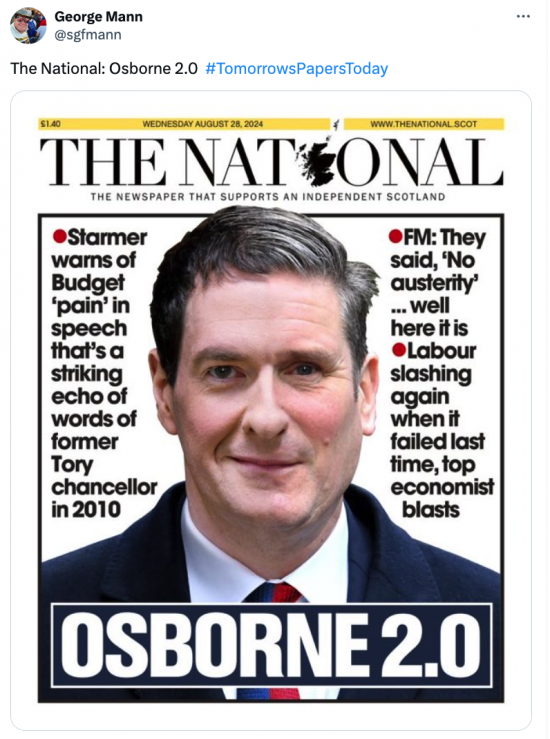
They're right, of course.
Thanks for reading this post.
You can share this post on social media of your choice by clicking these icons:
There are links to this blog's glossary in the above post that explain technical terms used in it. Follow them for more explanations.
You can subscribe to this blog's daily email here.
And if you would like to support this blog you can, here:

 Buy me a coffee!

Who needs zombie apocalypses, alien invasion fleets or Tories when we’ve got our current government to finish us off? I wonder if a bit of buyer’s remorse might be starting to creep in around the edges of the minds of some of those who thought LINO was a good idea?
Is the Guardian still pretending Starmer isn’t Osborne 2.0?
Pure evil considered from another member of the STP (Single Transferable Party).
https://www.theguardian.com/politics/article/2024/aug/27/liz-truss-considered-cutting-nhs-cancer-care-to-pay-for-tax-cuts-claims-new-book
Can Streeting top Truss for nastiness?
Thank you.
The neoliberal and neocon backed Cameron in 2010.
Fun fact: Many Grauniad hacks are Tories, vide Allegra Stratton and Amelia Gentleman (Mrs Jo Johnson).
Absolutely they are. Wicked front page!
Thank you, Richard.
You are a lot more on the money than you think.
At the meetings that I attended with the then shadow Treasury and Business teams, i.e. before the general election, Osborne was often praised for being the adult in the room. All the blame for the UK’s problems are laid at the feet of Johnson and Truss, not Thatcher, Major, Cameron, May and Sunak. This is where the phrase “stability is change” comes from. When I hear nonsense like that, I think of “arbeitet macht frei”.
I have met Osborne and consider him, not just a sociopath, but ignorant and a snob, too. Richard has also met him. Later, I learnt what Osborne has in common with Johnson, Starmer and Asquith.
Oooh Colonel. Admirable ultimate paragraph. Guess it has more to do with potential kompromat than having the same barber.
“I learnt what Osborne has in common with Johnson, Starmer and Asquith”
Which is????
I decided there was too much risk in the explanataion….sorry. I am the publisher here
@Richard
I understand.
Starmer is going to fail as he is not moving fast enough. He does not understand the time constraints he is under.
His PFIs (and/or public-private partnerships) will not work. He and HIS government just need to immediately get-on with fixing the things they were elected to fix.
A roving eye?
Well, maybe not exactly ‘eye’.
I’d identify Osborne as a politician who is evidently well on the anti-social personality disorder spectrum. He just ticks so many boxes.
Reportedly sociopathy iincludes about 1% of the general population, but 3% of certatin occupational groups, including politicians.
His actions 2010-15 were cynical, dispassionate, calculatedly brutal and cruel.
I have seen no evidence of any redemptive behaviour between 2016-2024.
Osborne shows everything that is wrong with ‘The Establishment’. Decided to become a journalist after University (where he didn’t study journalism, naturally), couldn’t get a job so instead went straight to work for the Tories. Entered politics, became Chancellor, in spite of his lack of training in Economics, cocked everything up and was then installed as Editor of The Evening Standard by the son of a KGB agent-turned-Russian oligarch who was subsequently ennobled by the Tories!
Honestly, if you wanted to tell a tale of back-scratching and corruption, you would struggle to make up a better story than this.
During his time as Chancellor, Osborne obviously did what he was told by Tufton Street, not knowing any better.
What is Reeves’ excuse?
@Mariner
Reeves has no excuse.
She no doubt has her own reasons in terms of her intended career path, but there is no excuse.
Incidentally I find the photo-composite Starmer interesting. It seems to me it resembles Jeremy Hunt. (?)
STP (Single Transferable Party) in action under Starmer:-
https://www.theguardian.com/commentisfree/article/2024/aug/28/cannot-afford-charge-wheelchair-energy-price-rise-disabled-people
Richard I hate to harp on this point, but as you yourself said to Linda Evans about our monetary system in a recent post – none of this is easy.
Only in wars and crises will politicians do things more like you advocate. Otherwise they fall for the household fallacy, worry about debt service, and many other of Vickrey’s 15 fatal fallacies .
A far simpler, understandable approach is Lincoln’s Greenbacks – interest free funds to cover government revenue shortfalls in a non-full employment economy. Many fine economists agree including Friedman.
The government has the right to create money, and should in wars, recessions, natural disasters, financial crises, etcetera.
https://www.pnas.org/doi/full/10.1073/pnas.95.3.1340
I am struggling with this
Our notes are already interest free
What are you proposing then? CBDC instead? But in that case – who provides credit? The state? Really?
What am I missing? I can’t make your proposal add up in any way.
Joseph Polito wrote:
“Only in wars and crises will politicians do things more like you advocate”
So the politicians’ corporate masters will only allow them to use the full purchasing power of the state in pursuit of death and destruction? Sounds about right.
I think Starmer is being set up by Reeves to fail with the neoliberal stuff, so that Reeves can replace him. A labour thatcher. Someone from labours left or someone influential with labour and capable of enough numbers needs to sort this. Labour, Tory shell, LibDems or Reform: none of them are fit to govern. A regenerated left wing or centre left wing is the better solution, whether any of them see that is another matter.
Richard I am recommending digital bank notes for digital wallets, that is central bank money that is useable by the public. CBDC has a great deal of controversy because of the programmability concern. A digital bank note is a narrower concept and is a version of CBDC.
Theoretically central banks could print notes for our wallets and bank vaults but that is a vastly inferior model.
That does not prevent banks from creating its digital credit for the private sector.
But, I ask again, who provides the credit? The central bank won’t. They will take deposits. Who provides the credit to create them?
Richard, one of us is not getting it, and your stellar record would suggest that would be me 🙂 but my impression is that both the private banks and central bank create credit. The central bank reserves are credit that only the banks can use. However everyone can use central bank notes, and everyone could use central bank digital notes. Banks keep notes in vaults, and could keep digital notes in digital vaults, just as we keep notes in our wallets and could keep digital notes in digital wallets … Once spent into the economy, the banks would have greater deposits to lend!
What am I missing?
Your are right, central banks create the deposits commercial banks hold with them.
Who creates the credits that you now also want deposited with the government, and how?
Why should the state take the deposits but not the credits that create them? How does that work for commercial banking?
I think your proposal is a recipe for total banking instability and an answer to no known problem. Sorry…
Richard when I promote your blog and youtube channel, I am promoting insightful expertise that I have learned from. But what I have proposed about digital notes is from other people like you.
Soddy and the Chicago Plan were active in the early 1930’s. Friedman’s 1948 proposal came from them and would be so much simpler to understand than what you described as ‘not easy’ to Linda Evans.
“Under the proposal, government expenditures would be financed entirely by either tax revenues or the creation of money, that is, the issue of non-interest-bearing securities”
https://miltonfriedman.hoover.org/internal/media/dispatcher/214916/full
Many fine current economists and Law experts are saying the same thing – Joseph Huber, Michael Kumhof, Christine Desan, Saule Omarova, Robert Hockett, … some MMTers have moved in this direction too – Kelton, Mosler, Hudson, …
Ok
And I am not convinced, not least because you are not trying to answer my simple question based on double entry.
And I am not convinced because I cannot see a way in which a plausible answer does exist right now. I could change my mind, but have no evidence or reason to do so right now.
Well you always ask for open minds, and you have one, so time will tell.
Thanks for all you do to promote the welfare of all !!
Richard
William White – who was with the Bank of Canada and BIS advocates similar reforms:
https://www.ineteconomics.org/research/research-papers/why-the-monetary-policy-framework-in-advanced-countries-needs-fundamental-reform
Well known private banker Thomas Mayer (Deutsche Bank) advocates reform as well:
How to Escape from the Debt Trap: Lessons from the Past
https://papers.ssrn.com/sol3/papers.cfm?abstract_id=3848340
You mean digital currency?
Yes Richard. Both are advocating that just as we once replaced free banking with government issued notes, we could have the government issue digital money without debt servicing for government. Money the public would use , rather than reserves for the banks only.
The scholar Hockett gives the related history of money in this article
https://scholarship.law.cornell.edu/cgi/viewcontent.cgi?article=2756&context=facpub
So, how do we preserve inter-bank liquidity?
I cannot wait for the answer to your question!!!
I have been following this “digital money” discussion but get more confused as to what we are actually talking about with each post.
All this digital currency nonsense smells like the old time “company script” issued during The Great Depression that could only be spent in “company stores” because that was the only place “company script” was accepted.
I know no question to which digital currency is as yet the right answer – not least because that is what we already have – and I have no idea what happens to the money already in existence if we have another digital version
Richard you are confusing me with the scholars I reference 🙂
Off the top of my head I would say banks would settle net imbalances by using the digital notes. Currently the banks need an account at the central bank to use reserves to settle. Digital notes would permit settling too, but add usability by the public.
How? Are they to be required to transfer their interest bearing central bank reserve accounts into digital currency?
BayTampaBay
All money is made out of thin air. The question is – who issues it. Mayer and White and Hocket and Omarova, and Desan and other current economists are agreeing with Friedman and his mentors that the current franchising system hurts the economy and the people!
The banks have hijacked the money creation power of the government. They are capturing the seigniorage by charging government interest.
They have not hijacked it. They have been licenced. The question is do we maintain, rescind or modify the licence? That seems to be the question to me.
Richard, people like kumhof and Huber explore your excellent questions like the above, “How? Are they to be required to transfer their interest bearing central bank reserve accounts into digital currency?” Someone of your stature should be able to contact Mayer or White or Kumhof about such questions.
As an aside about expertise, perhaps I am missing the obvious, but when I talk to others about your magnificent, Wealth Tax Report, I can’t easily find a link. It deserves a special link on all your pages. It is your masterpiece!
https://taxingwealth.uk/wp-content/uploads/2024/04/Taxing-Wealth-Report-2024-Full.pdf
Noted
And re the second, can’t people have too much of something?
Richard, that report is your masterpiece. It is an incredible achievement, related to your strongest expertise.
It is a huge asset to battle the foolishness of governments failing to meet the needs of the people – because of the ‘there is not enough money’ argument.
It is pragmatic and fits the basic experience of people. Whereas many more knowledgeable people have much more difficulty with understanding your expertise on money.
In sum – it should be a key part of your menu! It is as close as you get to a silver bullet for meeting the essential needs of the country.
Maybe I should link it on the front page
Richard your menu is at the top of every page. Seems to me a web address with ‘tax research’ should post its ‘tax reform’ masterpiece on that menu.
I am looking at this…